
Sequential Fourm or the “spiritual Pro-4”, is a new 4-voice polyphonic analog Synthesizer based on the soul of the Prophet-5 and Pro-One.
Many Sequential synthesizers are known by the name Prophet or Pro. Pro-One, Pro-2, Pro-3, or the Prophet-5, Prophet-6 and others. Now, the gap between Pro-3 and Prophet 5 (Pro-5) is closed with a Pro-4 synth.
Sequential today unveiled the Fourm, a new 4-voice polyphonic analog Synthesizer derived from the legendary Prophet-5. In that sense, it is a “spiritual Pro-4” even if it is not called or described as that.

Sequential Fourm
According to Sequential, Fourm is the company’s most affordable Synthesizer to date. That’s true, but don’t forget we had in the Dave Smith Instruments area, the Tetra from 2009, which had four analog voices for £564, including VAT.
Fourm is a new subtractive 4-voice polyphonic analog Synthesizer based on two Prophets: the legendary Prophet-5 polysynth and the Pro-One mono synth.
Classic Analog Design
It offers two SSI 2131 oscillators with control over the octave and frequency. Both oscillators feature sawtooth and pulse waveforms with tweakable pulse-width modulation, while OSC B also includes a triangle waveform.
Additionally, you can sync them easily with a button and turn OSC B into a low-frequency oscillator with two ranges (LO1/LO2). If you prefer more juice, you can activate Unison mode with up to four voices.
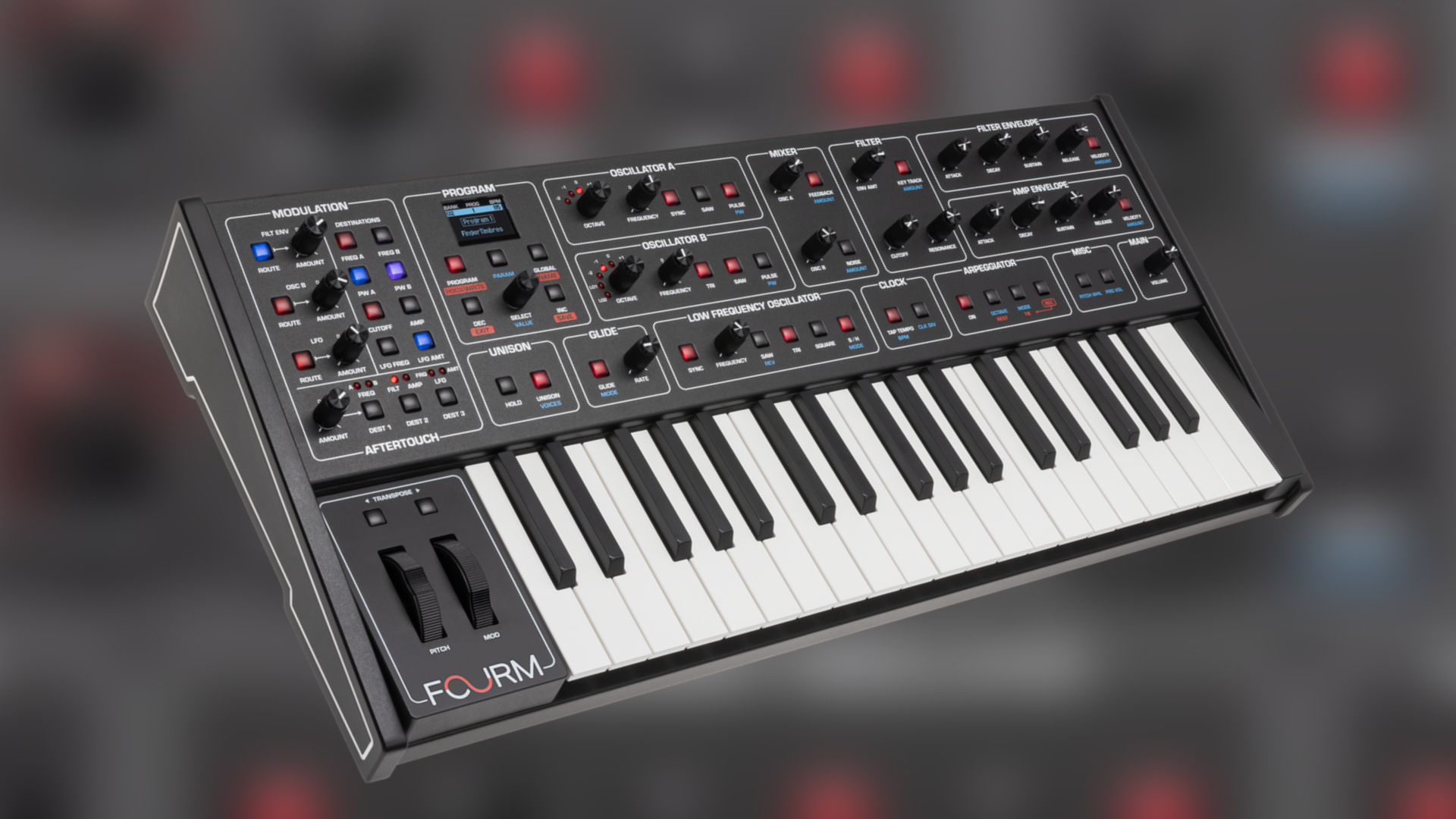
From here, it proceeds to a mixer featuring level controls for each oscillator, an adjustable multimode noise generator, and a switchable feedback circuit. With this, the signal loops in again, creating character and warmth.
Then, you shape the oscillators with a classic SSI2140 4-pole lowpass filter with control over the cutoff and resonance. Plus, you can activate key track and route the dedicated filter envelope to the filter from the same section. Good, they added bass compensation.
Unlike the Take 5 or TEO 5, the VCA section of the Fourm is analog and uses the SSI 2164 chip, also confirmed by the developers.
On the modulation side, Sequential Fourm features two ADSR envelopes with adjustable velocity and a single, syncable multi-wave LFO with frequency control. You can choose between saw, triangle, square waveforms, and S&H with a button press.
Since Sequential is talking about envelope curves modeled after the 1978 original, it’s easy to assume they’re digital envelopes and LFOs. This is not a downer, since analog envelopes/LFOs are rarely used these days, and the digital counterparts only have advantages.

Pro-One Like Modulation, Routing & Polyphonic Aftertouch
The heart and control center of the modulators is the hands-on modulation matrix inspired by the Pro-One.
With dedicated knobs and buttons on the hardware (filter ENV, OSC B, LFO), you can easily pair modulators with parameters without needing to dive into menus.
A destination matrix shows which parameters are available for modulation, and the mappings are visualized in color. One step below is a secondary, smaller modulation matrix for aftertouch, specifically polyphonic aftertouch.
For the release of Fourm, Sequential has returned to polyphonic aftertouch after a 40-year hiatus. They developed a new Tactive™ slim-keys poly AT keybed with three octaves to work in concert with Fourm’s analog synthesis engine.
Just as before, with dedicated knobs and buttons, you can quickly route PolyAT to up to three destinations simultaneously. In this case, the OSC frequency A or B, filter or amp, and LFO freq or amount.

Also onboard is a multimode arpeggiator with a step sequencer mode with up to 64 steps. It’s polyphonic and supports acid-style glide per step, and it can also be used as a modulation source.
There is also a clock section featuring tap tempo and divisions, as well as a glide function. A multi-FX processor is missing.
Connectivity
On the backside, you have a mono line output, a stereo headphone socket, and a 5-pin MIDI interface with IN/OUT/THRU sockets. Next to this is a foot switch/expression pedal input, a USB-C port for MIDI and firmware update duties, and a 12V/1.2A power supply input.
It’s a shame there’s no stereo line output. If you want stereo sound, you must use the headphone output.
Sequential Fourm: First Impression
The analog Synthesizer market is highly saturated, and the polyphonic market is following a similar path. Ten years ago, the Fourm would undoubtedly have been met with great enthusiasm.
Today, in the age of affordable polysynths like Behringers, Korgs, Dreadbox, and the like, the Fourm looks like a solid beginner-friendly all-rounder polysynth with a lovely, rich sound character. It’s great to have another alternative in the budget analog polysynth area.
However, it will not cause a tremendous enthusiasm now; there are already too many similar polysynths. The polyhonic aftertouch keyboard is an excellent feature, enabling expressive playability, but to stand out from the crowd of polysynths, you have to do something special. A modern Poly Evolver comeback would be a good idea, dear Sequential team.
Sequential Fourm is available now for 949,99€ or £799.99 including VAT.
More information here: Sequential
Available at my partners

actually, analogue envelopes have a much better knocking wood sound than digital envelopes. also, some digital envelopes make a clicking sound due to the DSP which you can’t remove…
OK. but even the Juno 106 Has Software envelopes. very rare indeed nowadays.
…and just in time Messenger got a price cut. Also agreed, there are already too many similar polysynths… to think of it, its been a while since we see something from Arturia. For Korg I think it was the 700Sm? Roland even longer with the Juno-D… I think to a point it is understandable with all the economy uncertainty and what not it makes more sense to keep the boat afloat with plugins for a while until things get a bit more stable.
The add on the sequential page is awesome with the guy making waves with his hands
wow. good Thing i haven’t bought the Moog Messenger. this is sick. 4 voice Polyphony with poly aftertouch! 🤘😎
guess the Headphones Out is Just dual Mono.
why should it Concert everything to stereo?
would BE great. my old Waldorf Pulse Had Panning ability.
headphone socket is just mono :S
Headphone output mono (1/4” TRS phone jack)
So, sound in both right and left ear (slightly offset, as to not cause phase issues on the mixer). Same as any other synth that has no stereo architecture.
Black Corporation synths have the same outputs as this one.
Unless there’s stereo effects or voice panning, it makes sense to see a mono output.
Behringer Pro16 if it ever arrives will be bang up against this.
better the original. cannot compare the quality in both.
triggering everyone’s dislexia not calling it “Forum” 🥲
Choosing this name made it possible to implement a sine wave – like “Synth Anatouy” 🙂
No stereo means no buy for me. Big mistake. Also, as others have mentioned, it’s a crowded market. If they could have hit the $600-$700 price range, maybe.
Incredibly silly name and looks like a toy, especially with those cheap knobs.
If they remake the PolyEvoler keyboard for less than 4K euro I will instantly buy it.