
Review: Cherry Audio SH-MAX revives the Roland SH-5, SH-7, and SH-3A and melts them into a new analog-modeling synth plugin.
The Roland SH series has a long history. It began in 1972 with the SH-1000, and many more followed. The most popular, especially in modern electronic music production, is the SH-101, which is now available in various analog and digital clones/replicas.
In my opinion, the most experimental and unusual models in the series were the SH-5 and SH-7, which offer unique signal paths and features. Although we’ve had an SH-5 clone with the MS-5 from Behringer for some time now, there hasn’t been any attempt to digitally emulate it.

Cherry Audio is now filling that gap with the SH-MAX, but it’s not just an SH-5 emulation on steroids.
The Cherry developers kindly sent me a copy in advance for review. Since I neither have an original in the studio nor the money to buy one, I won’t go into detail about how close it is to the original models.
Cherry Audio SH-MAX Review Summary
Pro
- 1-to-1 feature set of the Roland SH-5 plus features of the SH-3A and SH-7
- SH-5 sound design workflow
- distinct sound character
- SH-5 signal path concept taken even further
- 16 voice polyphony
- polyphonic aftertouch
- powerful sequencer
Neutral
- authenticity
Contra
- high CPU compared to other CA plugins
- smaller missing things: FX modulation parameter not freely selectable, no SEQ ratcheting
Cherry Audio SH-MAX
SH-MAX is a new analog modeling Synthesizer plugin for macOS and Windows. As the name suggests, it’s designed to emulate the Roland SH synthesizers – not one, but three in one package.
It virtually replicates the Roland SH-3A (1974), SH-5 (1976), and the SH-7 (1978). Since many elements across all three synths are the same or similar, Cherry Audio decided to pack the highlights of each synth into a single SH-MAX polyphonic Synthesizer with 16 voices.
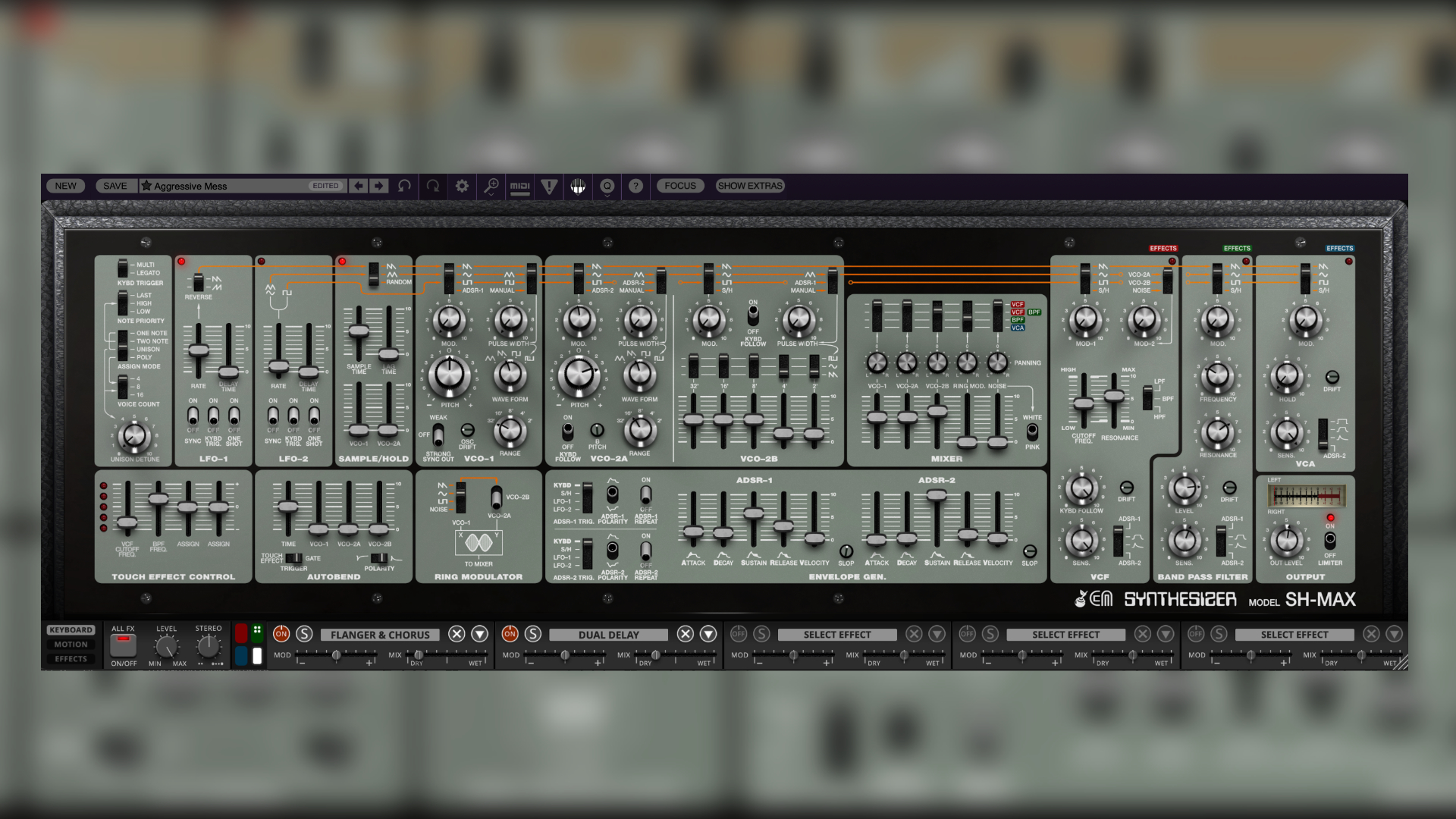
The workflow is very authentic. Cherry Audio has designed a knobby and slider interface that is very close to the original, but with significantly more parameters, including the Roland-style pitch/mod slider.
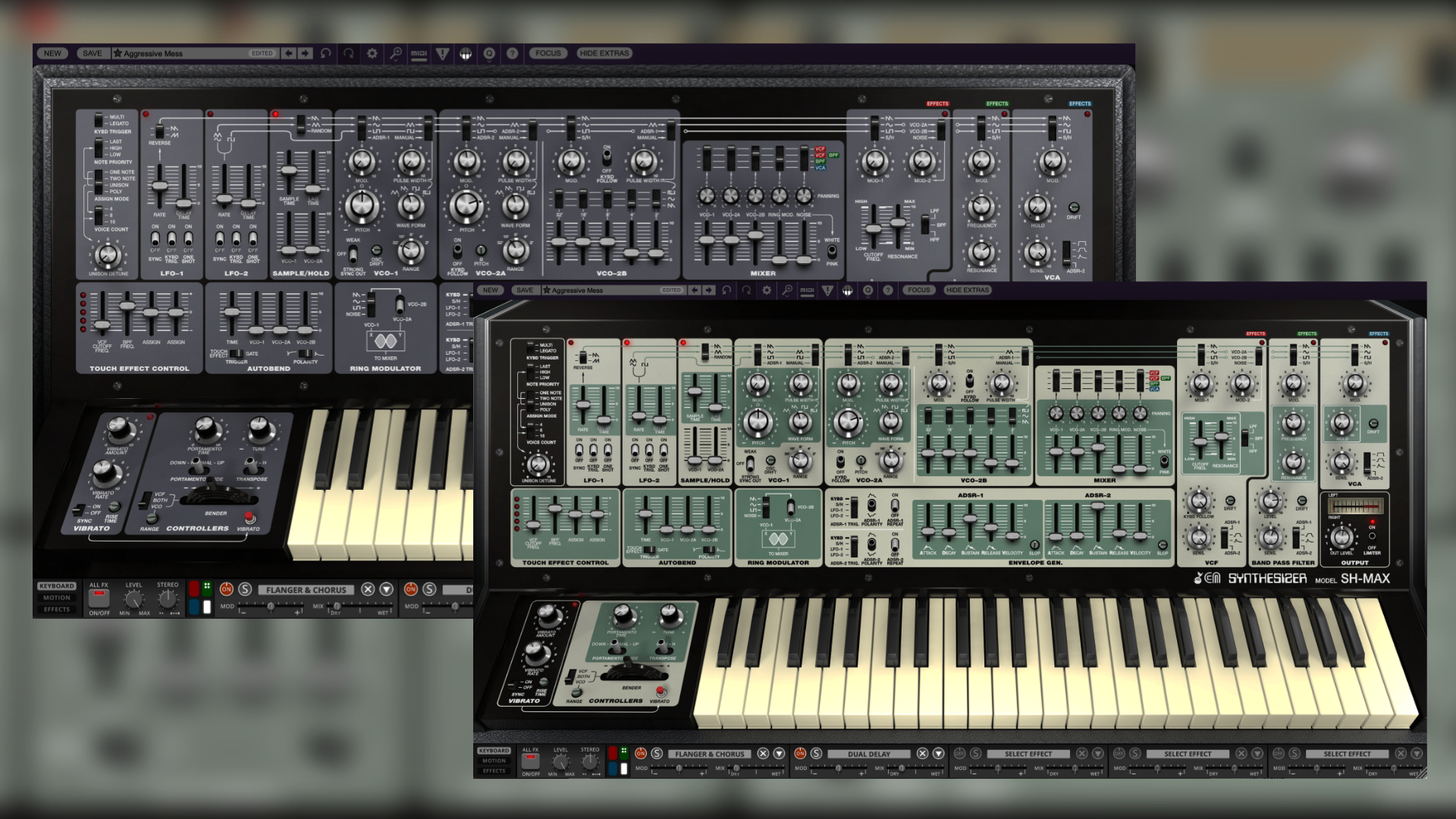
You can choose from three themes, each with the color of the respective SH synth: army green for the SH-5, gray for the SH-3A, and white-green for the flagship SH-7. There is also the option to fold in the keyboard.
SH-Max consists of three UI areas: the synth, sequencer, and a multi-FX processor. Let’s start with the synth.
SH-Style Voicing
The core of the SH-MAX Synthesizer is the Roland SH-5. It features the essential functions, including dual oscillators, two LFOs, a unique parallel filter, a ring modulator, and sample-and-hold functionality.
Oscillator 1 is classic and offers multiple waveforms with PWM and sync, ranging from 32′ to 2′. Intriguing are the weak and strong sync options, offering you two different “sync” flavors. Weak sounds more organic, while strong is more dramatic and bright.
Oscillator 2 is a hybrid. In its first part (VCO-2A), it is identical to oscillator 1. VCO-2B is special because it incorporates the SH-3A additive-style oscillator. Here you can mix and match waveforms from five octave registers.
Each register can have its own unique waveform, allowing you to create some very interesting sounds. Each oscillator also has plenty of modulation options, which I will discuss in the dedicated paragraph.
One highlight of the Cherry Audio SH-MAX is its mixer, which includes a noise generator and a ring mod. Sadly, the plugin doesn’t support the original’s unique external audio input capability.
Same for the hidden extreme mode, where you can route the LFO2 at the highest frequency into the ring modulator for experimental, metallic FM-like tones.
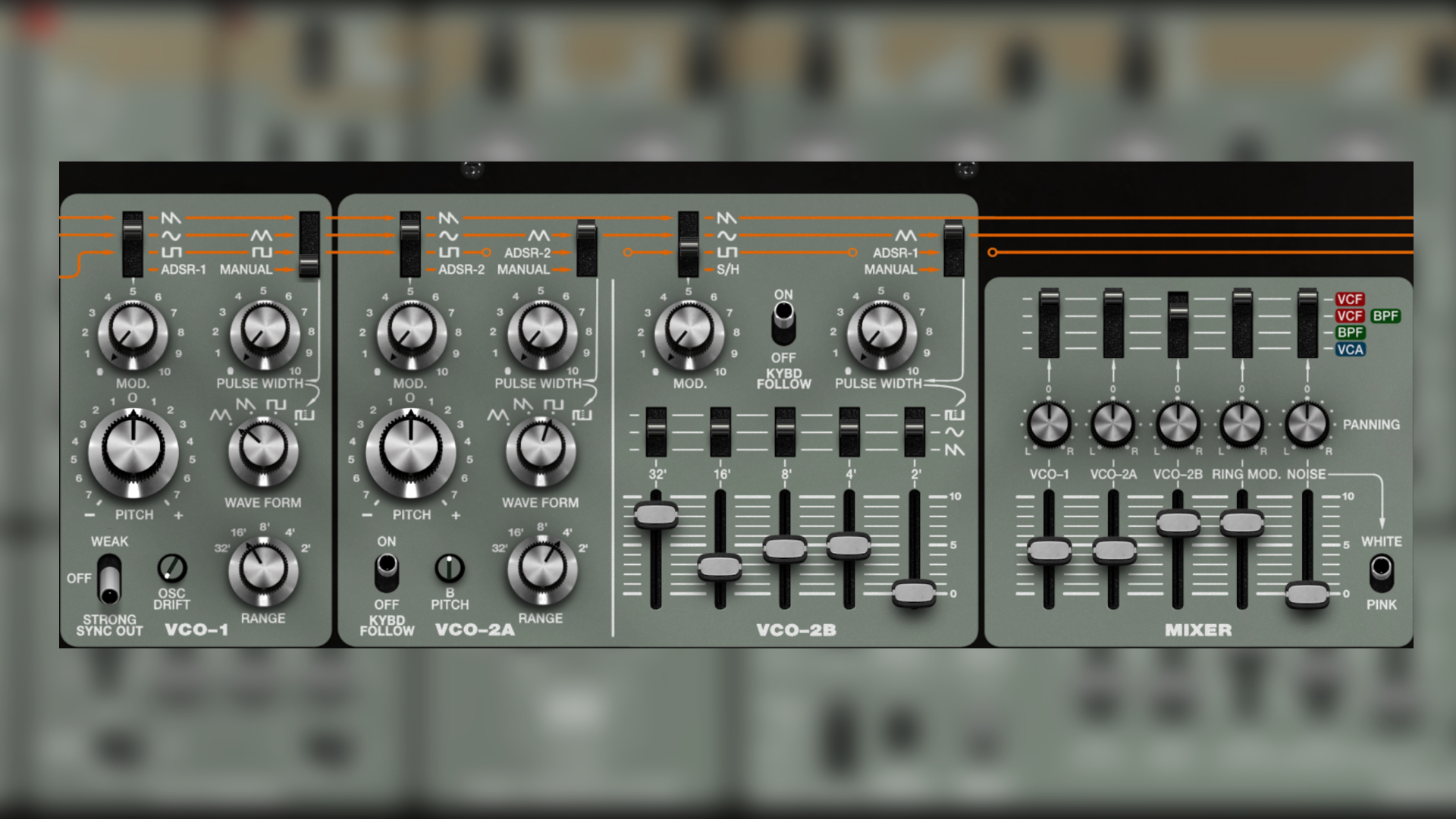
This mixer, taken from the SH-5, is the crucial part of how your patch will sound at the end. Each sound generator can be routed differently here. Either to the main filter, to the filter and bandpass filter, only to the BPF, or bypassing the filter and going to the VCA.
This gives you a great deal of flexibility at the oscillator routing level, enabling you to shape each oscillator differently.
Filtering
The SH series also offered more unique filter capabilities that you can also find in the Cherry Audio SH-MAX. It starts with the VCF, a multimode filter with lowpass, band-pass, and high-pass options. It’s tweakable with cutoff and resonance controls.
This was pretty atypical for the early Roland days, where the low-pass filter dominated its design. Built-in modulation routings to the LFO and envelope enable instant modulations.
Neat, it also offers a 3-way oscillator – filter FM option taken from the Roland SH-7 for extra sharpness in the sound. The highlight is the dedicated bandpass filter section.
Yes, another bandpass filter, but the key point is that this second-order BP is different from the one in the main VCF filter. It has a different BP filter topology, which adds a different level of colourisation to your sound design workflow. It sounds lovely, gnarly.

Since the mixer matrix allows direct routing of signals to the dedicated high-pass filter, it can also serve as the main filter. Alternatively, you can combine it with the main filter to unlock additional duties, including intense sound shaping or musical equalization.
By matching both HPFs, you can generate very organic and sometimes weird sounds with the SH-MAX. This ranges from shifting formants to vocal-like textures to even metallic sounds.
Although many focus on the oscillators, the routing matrix with its filters is the highlight. It offers a great deal of flexibility that one wishes were available in other classic synthesizers. It’s like a mini semi-modular synth.
Next to this is a VCA section with built-in mod routing. The hold function that opens the VCA also enables SH-style drones.
Modulation
Let’s talk about modulation, and it’s also quite comprehensive. There are two ADSR envelopes with velocity, two LFOs, and an S&H. These are the core modulators. Classic, but with some neat goodies from the SH-5.
For example, you can trigger each ADSR envelope not only with the keyboard but also with a sample-and-hold or an LFO for rhythmic retriggers synced to the DAW. Also neat are the repeat option, which gives you two additional LFOs, and the slop option.

LFOs, on the other hand, are very classic, consisting of a few waveforms, sync, keyboard retrigger, and one-shot. More waveforms would have been nice. Also, it’s a shame that they are not audio-rate, which would allow for crazy sounds.
Alongside these, you can work with a sample-and-hold that you can route to VCO 1 and 2, as well as other destinations.
There is no classic modulation matrix. Instead, each section has its own independent switches and potentiometers that allow you to route the modulation. Like a miniature mod matrix for each section.
The workflow is very intuitive and analog-like. You push and turn, and the modulation is active.
In addition to these, there’s also poly aftertouch as a modulator called touch effects, which can be assigned to four slots. I really appreciate that the intensity is visualized; this is missing in many synths. Further modulators can be found in the two other sections.
Model 104-Style Sequencing On Steroids
Part of the new Cherry Audio SH-MAX is a sequencer inspired by the legendary Roland Model-104. Not a 1:1 copy, but also expanded in many areas to offer more possibilities for modern music productions.
Four lanes can be programmed. Each has up to 64 steps, various playback directions, and can be spiced up with probability and chance. The gate is globally adjustable, not per step, just like the hardware.

Interestingly, these lanes can be used not only for notes but also for modulation. For now, you can assign the VCF, BPF, and volume to it. I hope Cherry Audio will expand this in the future via an update with free selection.
Modulation sequencers offer many creative possibilities. One obvious application is note sequences. Since parameters can also be modulated, these note sequences can be made very lively and varied.
Alternatively, the sequencer can also be a quad modulator, resulting in rhythmic movements in your sounds. If the ability to assign other parameters were to become available in the future, it would even be possible to trigger individual oscillators while leaving others unaffected.
Quad Multi-FX
The hardware SH Synthesizers didn’t feature classic effects. The SH-MAX improves on this, offering a range of effects available in a dedicated multi-FX window. At the beginning, we saw how complex and intricate signal routing can be.
Here, it gets even deeper. You can place a multi-FX processor with five effects into almost every available signal path. More precisely, you can add to the following: VCF, BPF, and VCA. Plus, you have a global multi-FX.
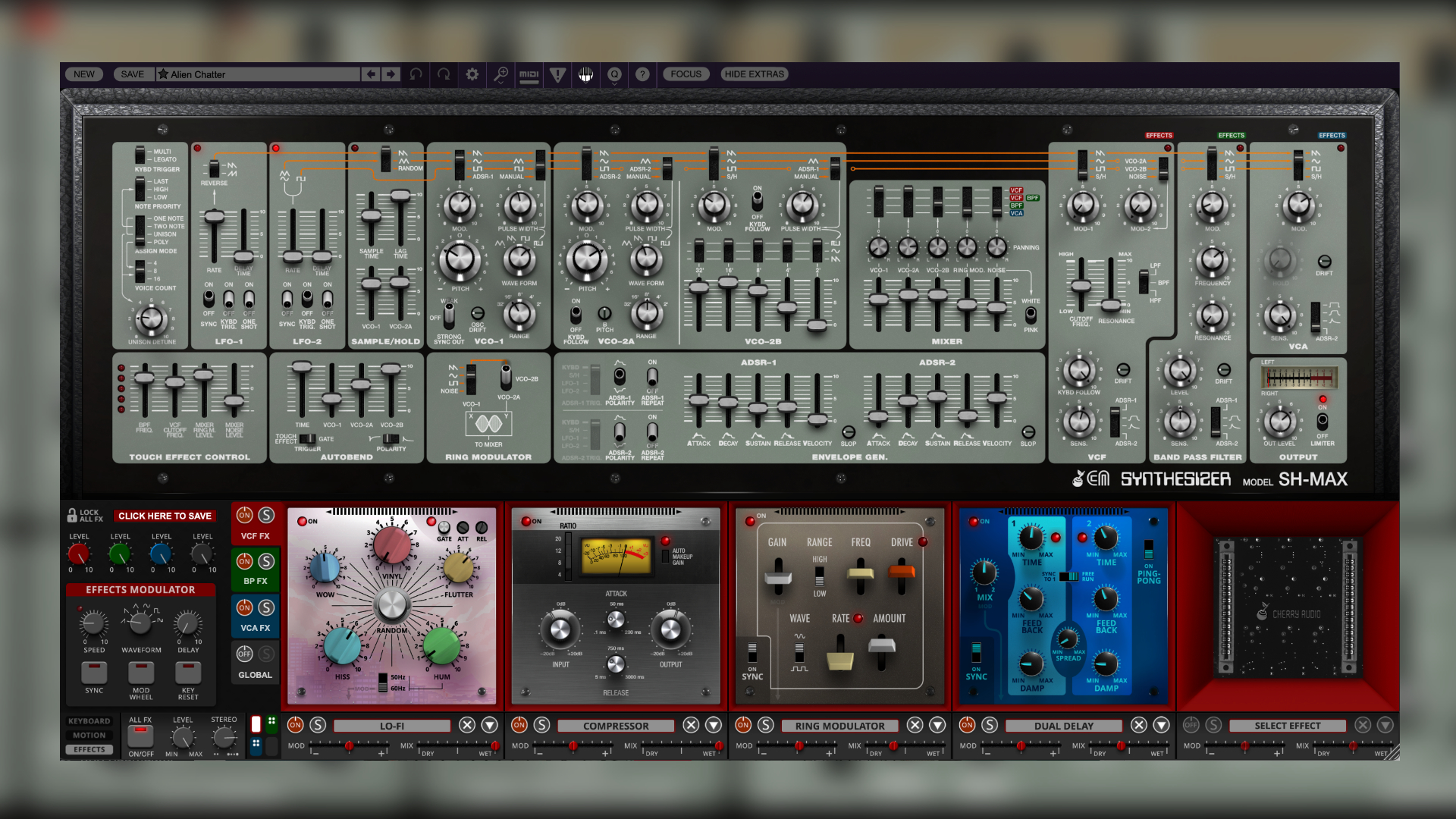
Thus, you can have three distinct signal paths in a signal patch, each with a different effects setup. Crazy deep. On top of that, each signal path has its own synceable effects modulator (LFO) with up to five destinations. A pity, they are fixed and not freely assignable.
On the FX menu, there are 20 different effect modules, including many Cherry Audio algorithm classics, such as digital delay, flanger & chorus, and glactic reverb.
Also onboard are the effects introduced with the Mercury-8 (Roland Jupiter-8 emulation) plugin back in November 2025, including the DCO Chorus, panner, and the pulse FX, a lovely gate FX with 32 steps, great for rhythmic effects.

These are exactly the same effects as in the Mercury-8 plugin, so my testing results will be the same. They are convincing in both sound and functionality. As I said before, I would prefer to have the freedom to assign the parameter to modulate.
A like goes to the option to save effects chains. Often overlooked, but can be very helpful in sound design sessions. They can also be exchanged with the Mercury-8 and Trident plugins.
Sound Design
The SH-MAX offers a lot for tweaking and sound design. Initially, it can be a bit overwhelming, of course.
The easiest way is to use one of the 300+ included presets (by James Terries and Andrew Longhurst) to get to know the engine and, more importantly, the signal paths. You can also use the presets as templates.
If you are confident in your SH-style synthesis programming skills, you can also go all-in with the init patch.
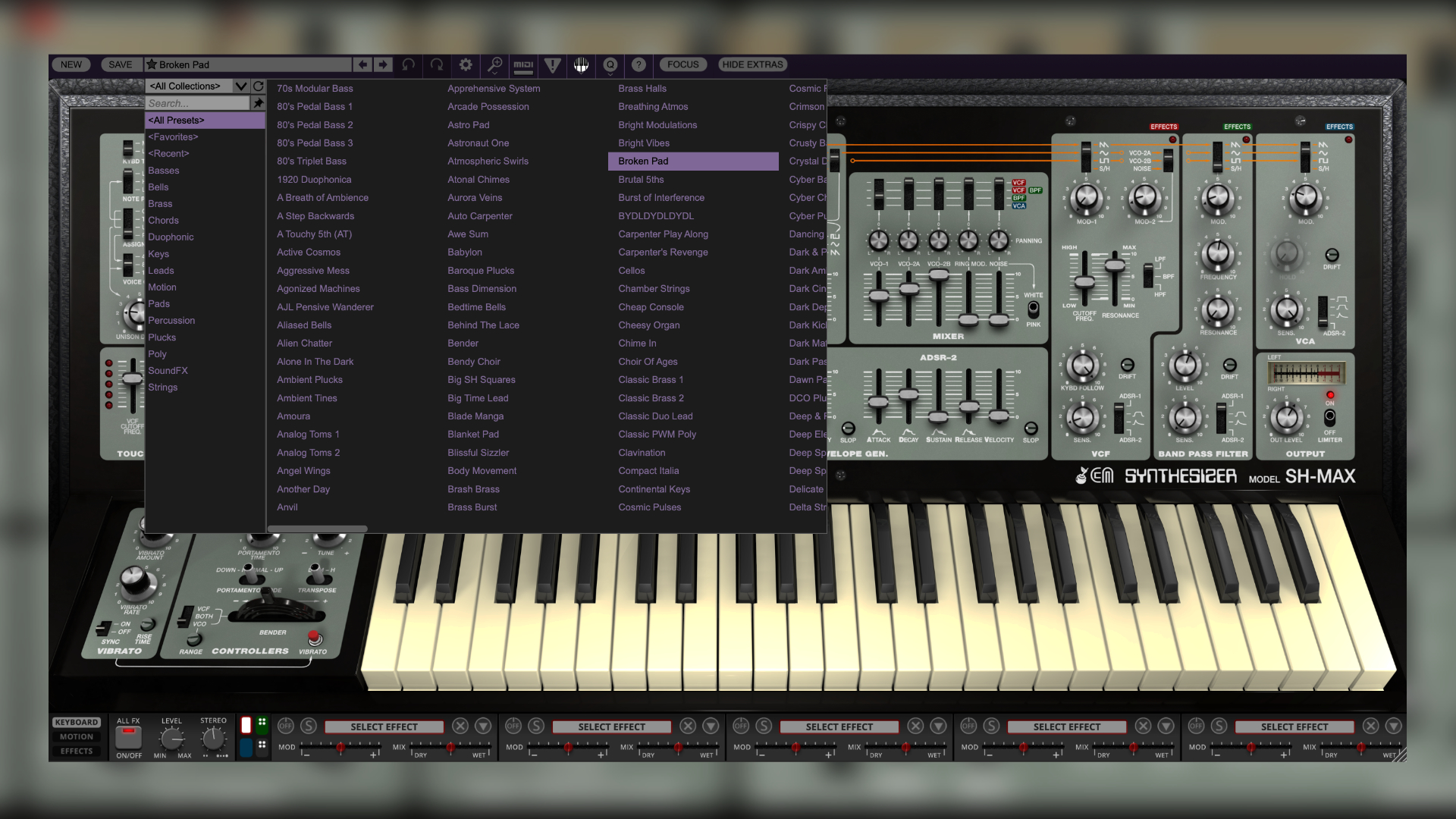
Compared to vintage Roland SH synthesizers, its sound range is much larger. This is primarily because it allows up to 16-voice polyphony rather than monophonic operation, onboard effects, and more.
The original SH-5 stands out for its powerful, distinctive, and often unusual analog sound. Powerful bass, percussive sequencer and arpeggios, experimental, weird ringmod and FX sounds, unique leads…
The Cherry Audio SH-MAX can do that too, and with plenty of character. However, as I don’t own the original hardware, I can’t say whether it comes close to the SH-5, but it’s a sound design package that has the vibes of it.
But the SH-MAX goes even further, allowing you to create beautiful ringmod polyphonic sounds or evolving melodies with the 4-track sequencer that are impossible to recreate with the original. For this, you need extra hardware.
Cherry Audio SH-MAX Review Conclusion
The SH-MAX is a great-sounding analog modeling Synthesizer plugin. Yes, it’s another classic analog-like synth, but its impressive signal path flexibility makes it unique.
Running the signals through different filters simultaneously (using two BPFs in parallel) and then adding multi-effects to each signal path goes beyond the capabilities of a traditional subtractive synth.
The interface is big and bulky, but it’s very analog-like and direct. It motivates you to tweak parameters and program, and there is no risk of getting lost in menus. Everything is on the interface.
I’m less fond of the relatively high CPU consumption and various minor issues I mentioned in the review. Nevertheless, the Cherry Audio SH-MAX was a lot of fun during the review phase.
I’m glad there’s now an SH-5 emulation for macOS and Windows. How accurate it is remains to be seen. The sounds you get out of it are great, powerful, and versatile. Also a bit weird and experimental, just like the original.
The most important thing is to have fun with it. And you’ll definitely have fun here. You get a Synthesizer plugin that replicates the signal path and programming workflow of the vintage Roland SH-5, plus features from other SH synths and modern extras.
Cherry Audio SH-MAX is available now for $59 USD. It runs as a VST, VST3, AU, and AAX plugin on macOS (native Apple Silicon + Intel) and Windows. A free 30-day demo is available on the official website.
The Maximum Overdrive preset pack by James Dyson, with 100 new presets, is available for purchase separately.
More information here: Cherry Audio
Available from my partners


An (old) SH-7 emulation did exist already, by the name of Krakli SK7
but not the SH-5 🙂 I mainly point to the direction that nobody of the big players has so far tackled this synth 🙂