
Thomann ComboRack is a new keyboard furniture with a pull-out shelf; this review will answer whether it’s a must-have.
Check the point: Update 2 for the latest hardware update
A keyboard synth here, a desktop there — once you start collecting synthesizers, a studio fills up fast, especially when the right deals come along. But organization becomes the real challenge. Are your instruments plugged in and ready to play, or hidden away in a cupboard until needed?
I’ve been searching for a compact, elegant system (not like my Jaspers 5D-120B and 4D-105B) for years that keeps synths organized, accessible, and ready to use. It should be similar to the drawer system in Moby’s studio. Unfortunately, such furniture is made on demand and pretty pricey.

At the end of 2025, the market finally saw some movement with the Thomann ComboRack, a studio piece of furniture that combines a side rack and a keyboard shelf.
The latter has three pull-out drawers for synths with up to 61 keys, desktop synths, drum machines, pedals, etc As a bonus, it has two 6U rack spaces.

The total dimensions are (W x D x H): 1046 x 600 x 773 mm, and the pull-outs are 974 x 300 mm. That sounds like exactly what I’ve been looking for for a very long time.
Disclosure: Thomann gave me the opportunity to make a ComboRack review for you. They sent it to me for free, but have no say over the review and don’t get to see it before I publish it.
Thomann ComboRack Review
The doorbell rang, and a not-so-subtle 55-kg package made its presence known. As soon as I carried it in, I noticed that the package had Thomann on it, but also a second company.
According to the label, the ComboRack was manufactured by the well-known Romanian studio furniture manufacturer Zaor. I’m pretty sure some of you have a Zaor studio desk.

Once unpacked, you’ll find various EVA-based panels, screws, rails, etc. This triggers memories of construction nightmares with furniture from a Swedish company that also sells small meatballs and hot dogs at ridiculously low prices.
The panels also had that familiar smell straight out of the box. These are made of pressed wood, like you know, Ikea, with a layer of EVA on top. This is a special, non-toxic, eco-friendly material often used in the food industry.
Oh, btw: you can see the ROCKnROLLER CK-1 keyboard in the picture. A review is still pending for it. Spoiler alert: cheap stands do the job just as well.
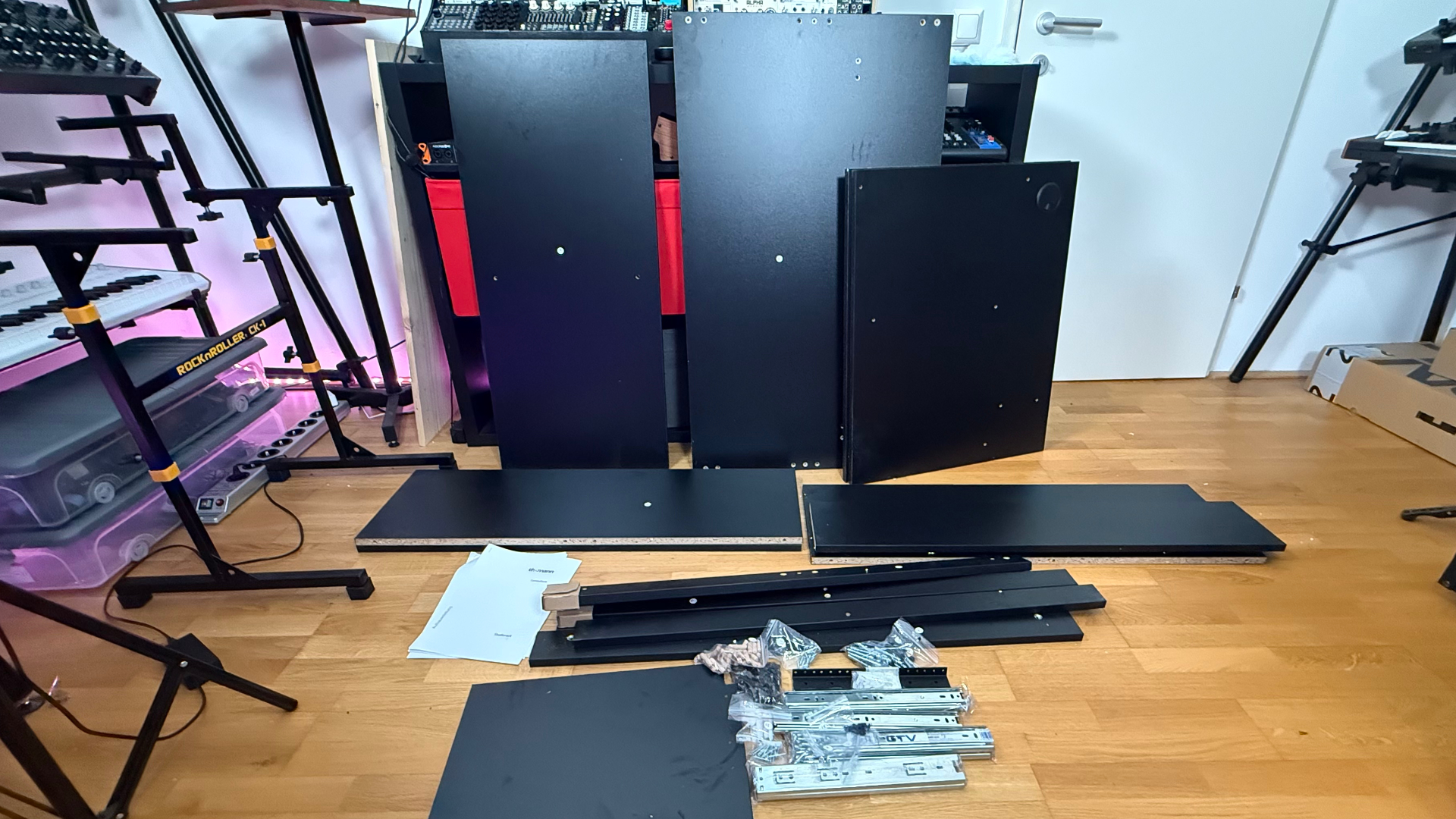
Assembly
Thomann delivers the shelf with two sets of assembly instructions: one in German and one in English. It doesn’t really matter which one you use, as the text content is relatively small.
The instructions are reminiscent of Ikea. They are clear and easy except for a few minor points where I had to look things up a couple of times to understand how they work.
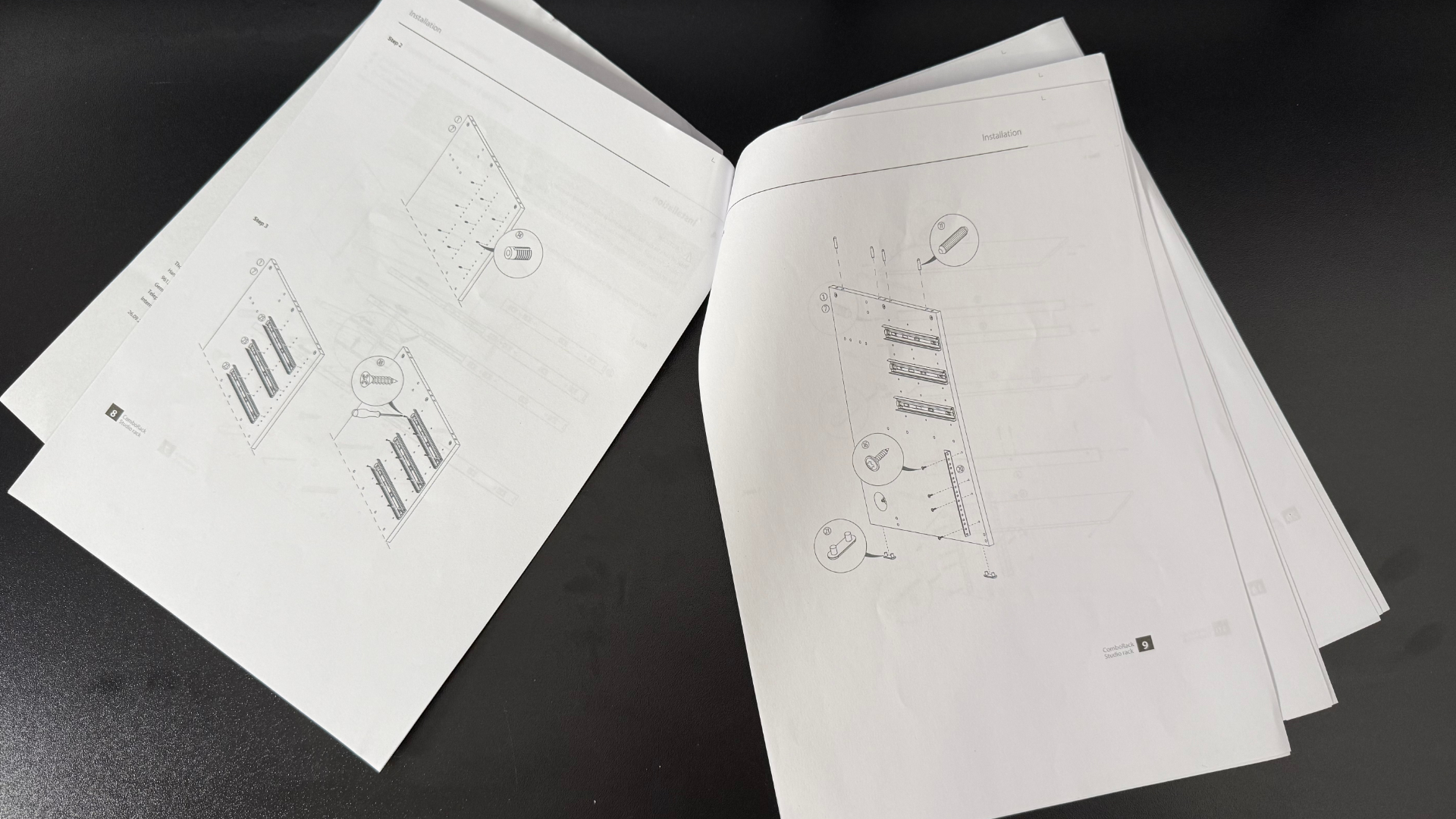
On the plus side, each black panel has a numbered sticker, so you know exactly which part you need next. I was careless and left some of them attached. Tip: remove them before assembling.
One of the first steps is attaching the drawer rails to the side panels. Here, you determine their size. Since I’m reviewing the ComboRack, I’m setting it up according to the instructions. However, you’ll see later that this isn’t necessarily the best setup.
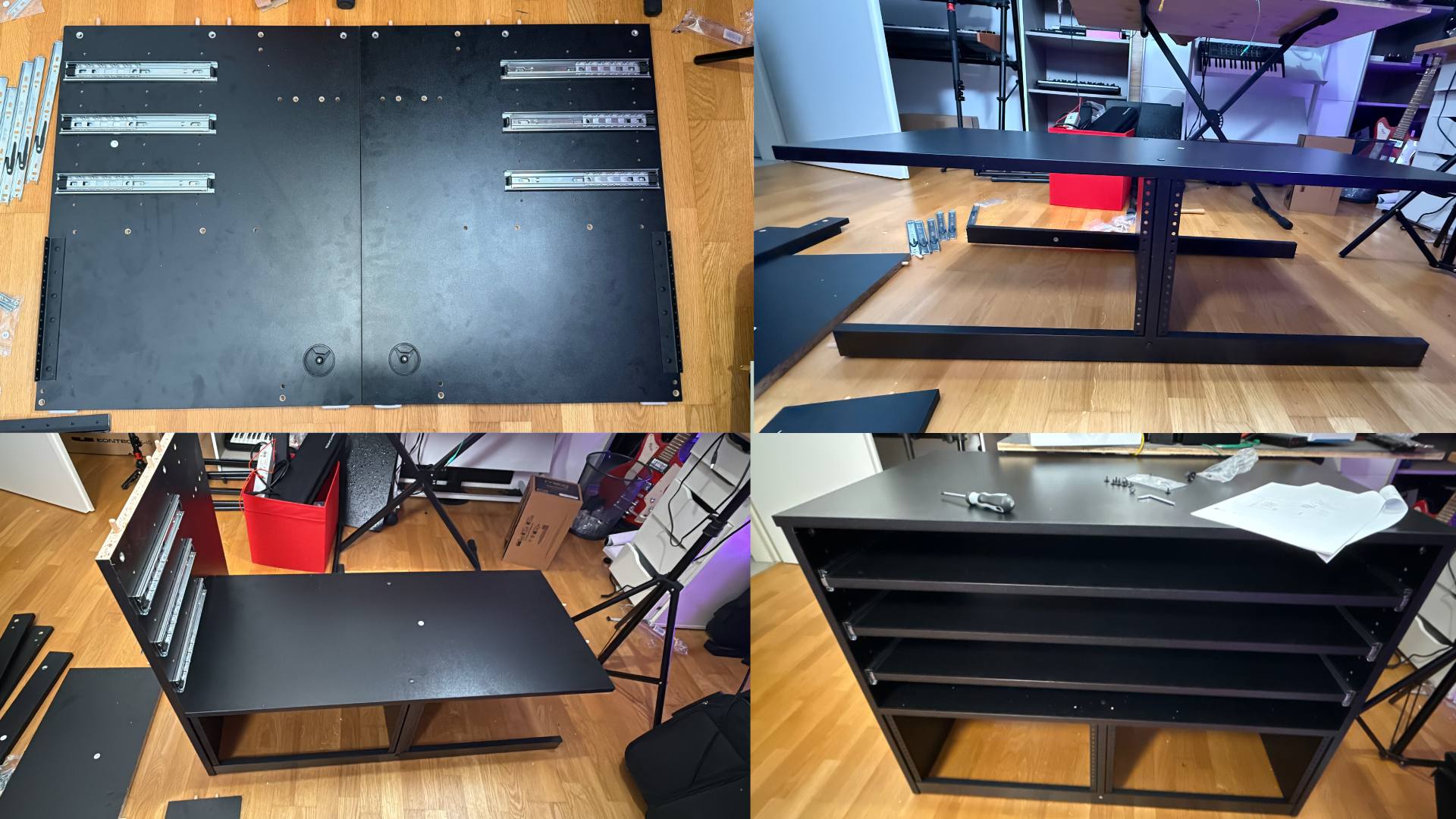
Once that’s done, the assembly goes quickly. The frame is built, the back panel is attached, and in the last step, the drawers are assembled. It’s a bit monotonous, since you have to do this three times, and yes, the stickers are still on mine.
My assembly wasn’t flawless. My unit has two holes without screws, because the pre-drilled holes on both parts don’t align, making it impossible to attach them. The rack is holding up, but I’m considering re-drilling them when I have time.
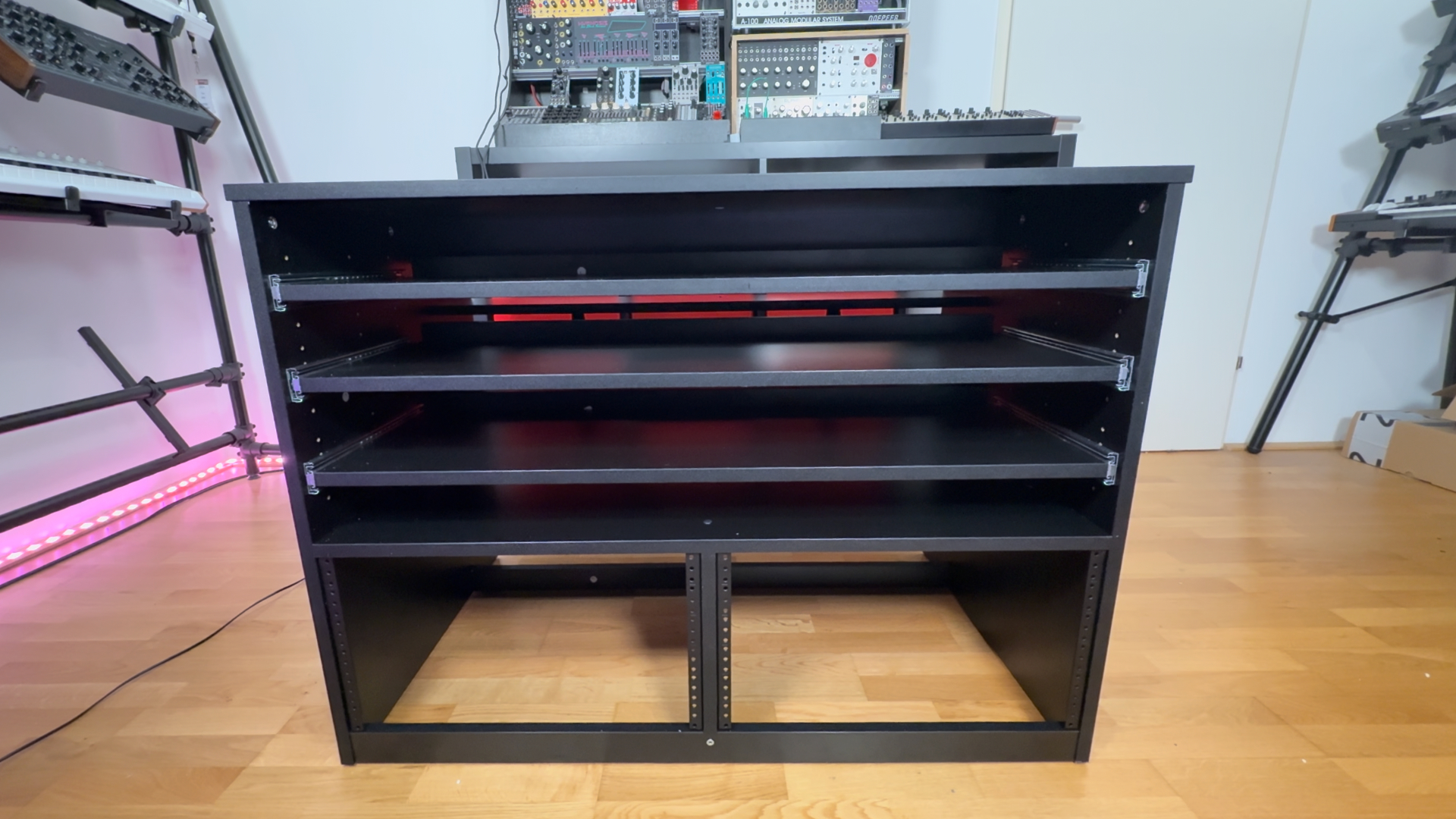
The ComboRack seems to be of good quality. It’s not premium, but at 55 kg, it’s very solidly built. However, the flaws with the pre-drilled holes are a bit annoying. Mistakes happen, yes.
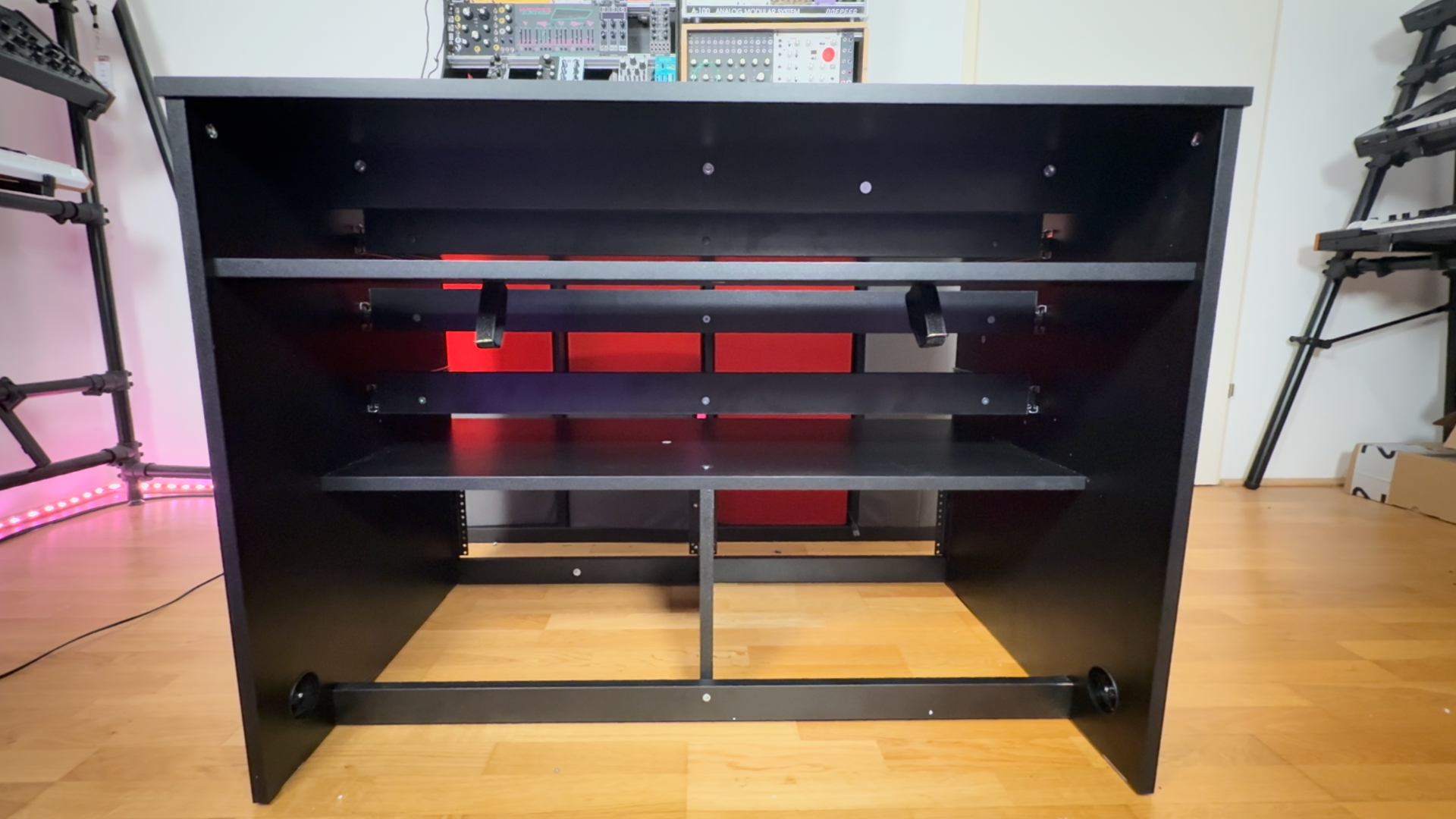
The most important thing is that the Thomann Comborack is ready, and now the most important part of the review begins: setting up the keyboard synths, desktop synths, and more.
Setting Up The Thomann ComboRack
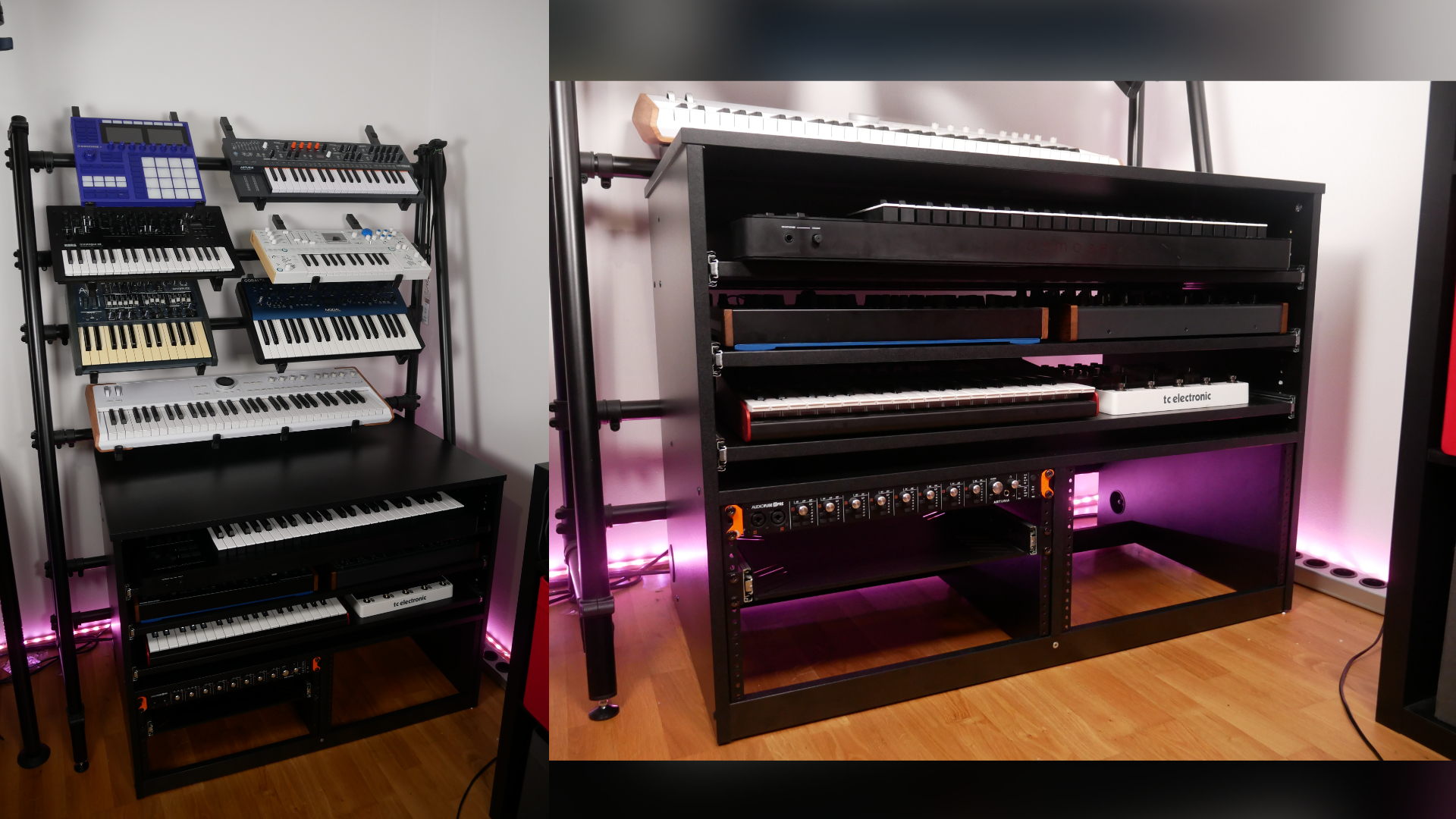
The photos show the ComboRack in the standard configuration as shown in the assembly instructions. Don’t worry: the drawers can be adjusted in height. My goal is to fit in 1-2 keyboards, a few desktops, and some pedals. Let’s give it a try with some examples.
The slots are all roughly the same height in the standard configuration. As a reminder, the dimensions of the pull-outs are 974 x 300 mm. First try: the Novation Peak and Erica Synths Steampipe fit in them, even both at the same time.

Then a combination of the Arturia MiniFreak and the Beetlecrab Audio Vector synth. At 578mm, the MiniFreak is one of the widest portable synths, which limits the usable space on the right side. However, both fit inside.

Houston, we have a problem. The Korg Minilogue XD just barely doesn’t fit, as it’s a bit too tall. Depending on your cabling skills, you can even fit two desktop synths, as in the example with the IK UNO Synth Pro and the Sonicware ELZ_play.
I’ll get to the wiring later, as there are some things to be careful about.
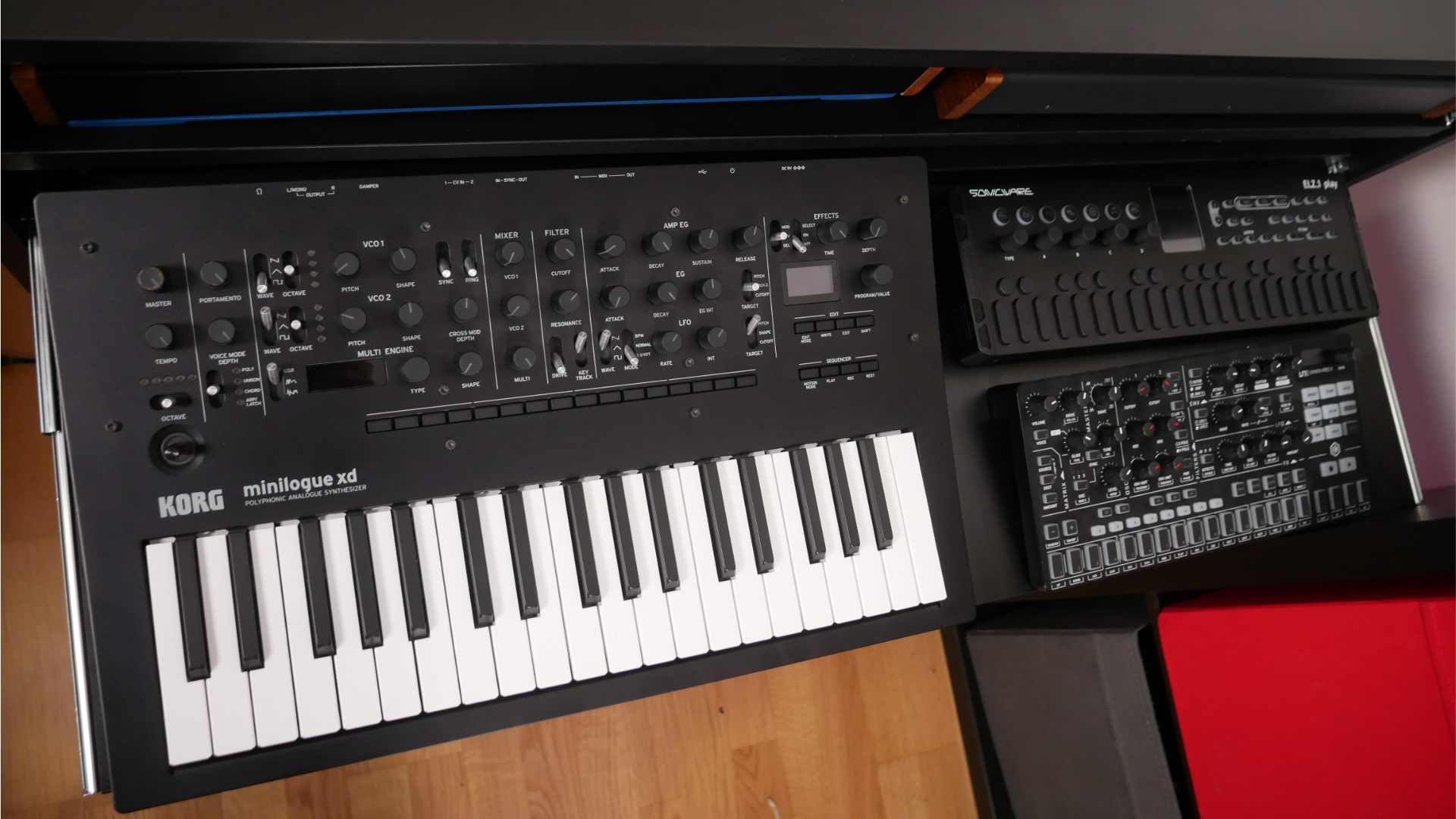
Flagship Keyboards – Do They Fit?
Thomann advertises its new keyboard shelf on its website as able to fit keyboards with up to 61 keys. Let’s test it out.
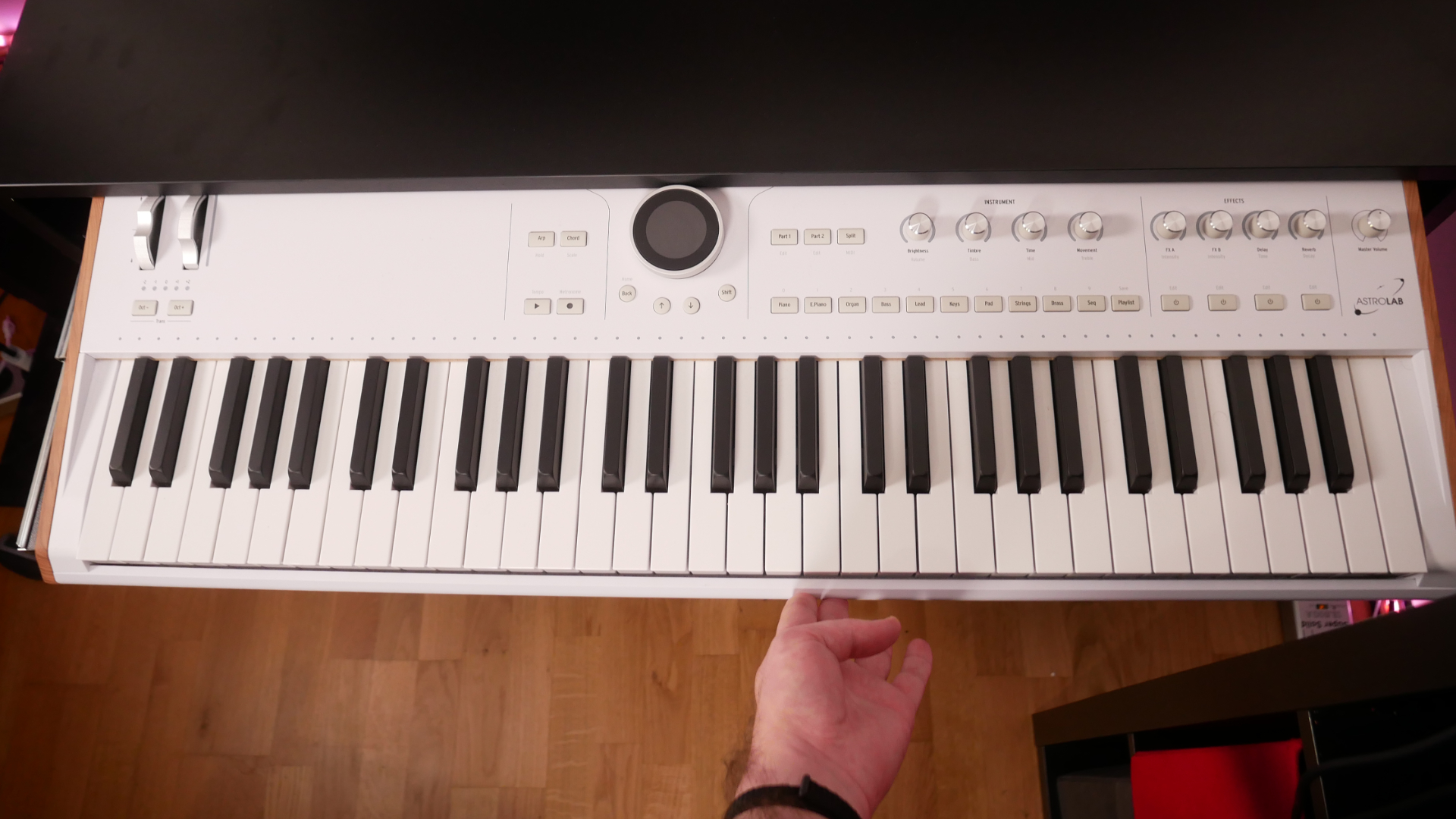
The Arturia AstroLab doesn’t fit in the standard configuration. The culprit is the popular Nest thermostat and the pitch-and-wheels. The keyboard also doesn’t fit the board completely, but it stays in place.
Next up is my beloved ASM Hydrasynth. It doesn’t fit either. Too big and too tall for the standard configuration.
The same goes for the Expressive E Osmose. The Moog Muse doesn’t even fit in a keyboard drawer. It’s too wide.
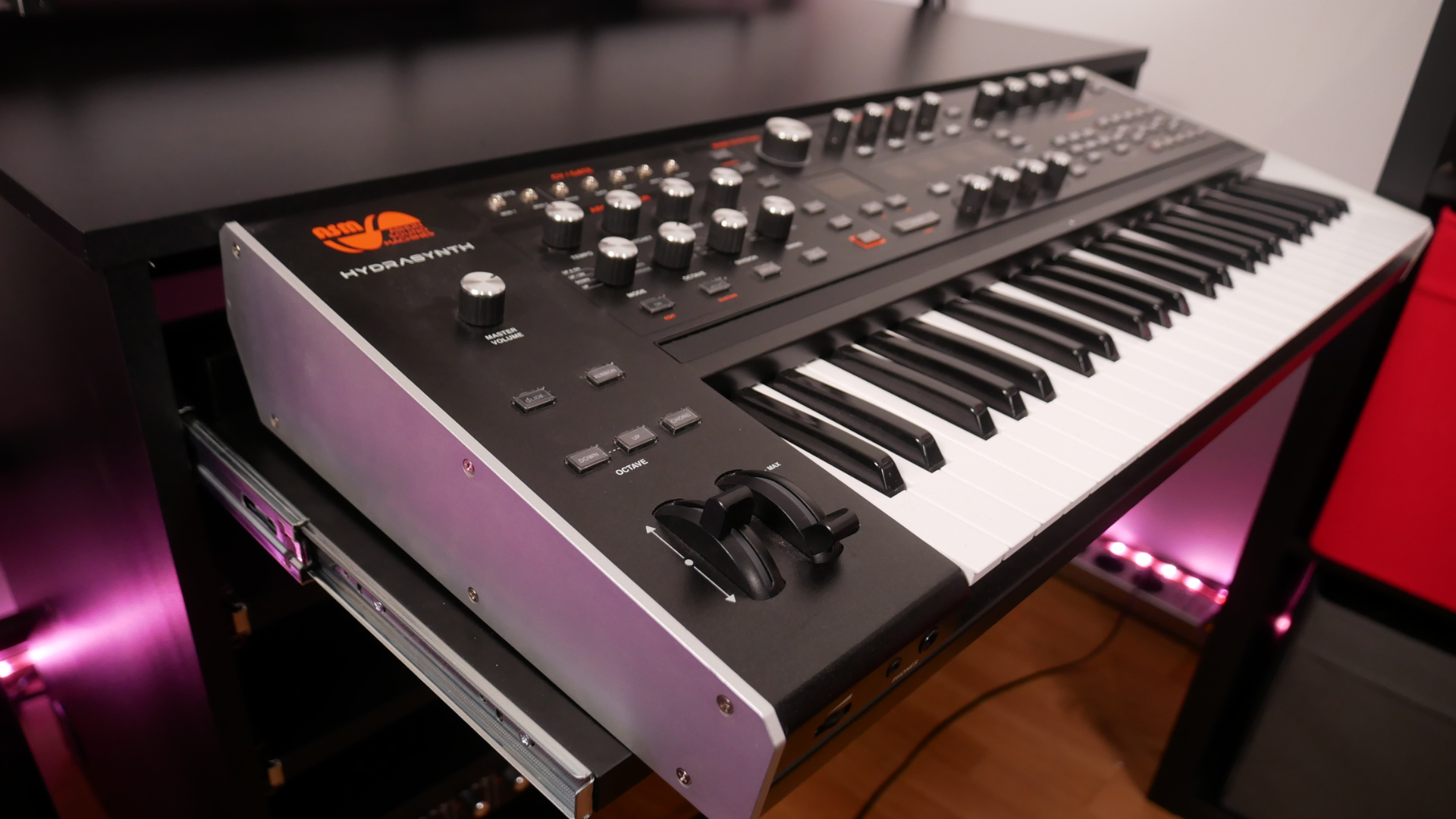
It seems Thomann didn’t measure the drawer slides perfectly. None of my 61-key keyboards fit so far. Or maybe I have only synths that are too tall and wide, who knows. I give it a second try in another configuration.
Many studios have modular and semi-modular synthesizers. For space reasons or workflow optimization, many install them directly into a large Eurorack system. Others use them standalone.
Eurorack & Pedals?
However, those wanting to fit them into a combo rack will be disappointed. Neither the Arturia Rackbrute nor the Behringer Eurorack Go fits in the standard configuration.
The same applies to the semi-modular boats from Moog and Behringer.

This shows how restrictive the basic setting is. The Thomann ComboRack isn’t designed exclusively for synthesizers, but since that’s my focus, I’m highlighting them in this review.
It can also be used as a pedal cabinet. Plenty of pedals fit in without any problems, as you can see in the added picture.

The assembly instructions should include a note that the surface layout need not be followed exactly and can be arranged flexibly.
I Personalize My ComboRack
Back to the assembly, time for the power drill again, and all the inserts, including the rails, are being removed. Oh, what I love it, not. Unfortunately, the drawers have to be knocked out of the rails; there’s no other way to remove them.
Warning rack nudity! This is what the ComboRack looks like without its single drawer.

The image on the left shows the mounting of the supplied dowels in the standard configuration. I’ve decided to move these two holes downwards so that the upper compartment will be higher. Simply removing the plastic dowels, however, is proving difficult.
Thomann/Zaor is supplying another set of white dowels. However, the quantity is insufficient for a third fitting. That’s not ideal, especially since it’s promised that the system is freely adjustable.
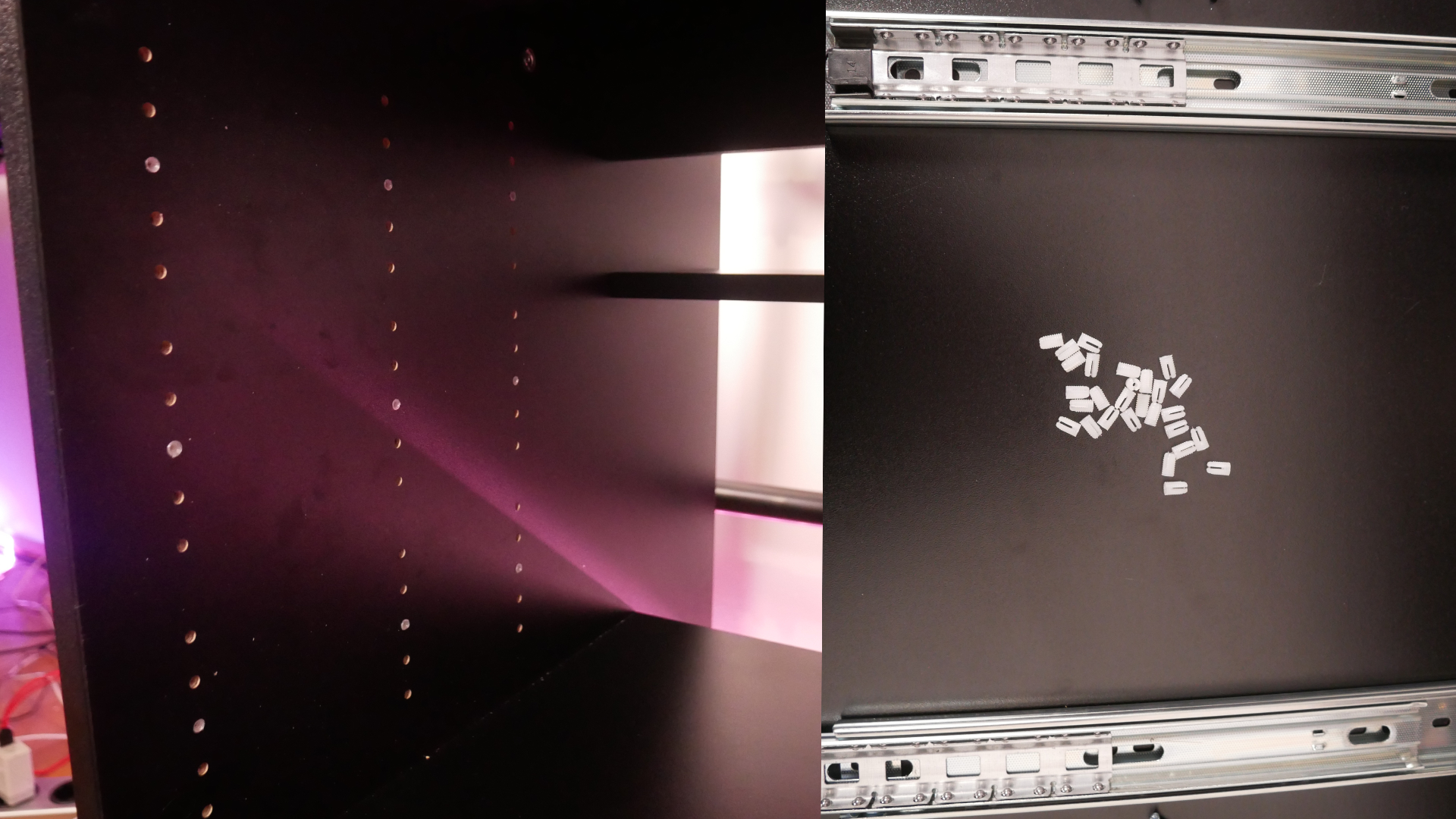
I haven’t checked whether these dowels can be reordered or found in a hardware store. Please check how much space you need right from the start for your setup to avoid disassembly.
From my experience, take more space, as the standard configuration is very tight, especially if you want to include a bigger keyboard. Let’s move on to the third round with instrument positioning. ¨
Synthesizer Fitting Round 2
Good news: both the Expressive E Osmose and Arturia AstroLab now fit in the first drawer.
Important: due to the cables on the back, neither instrument can be fully inserted. They protrude slightly from the compartment, but it is stable and playable.
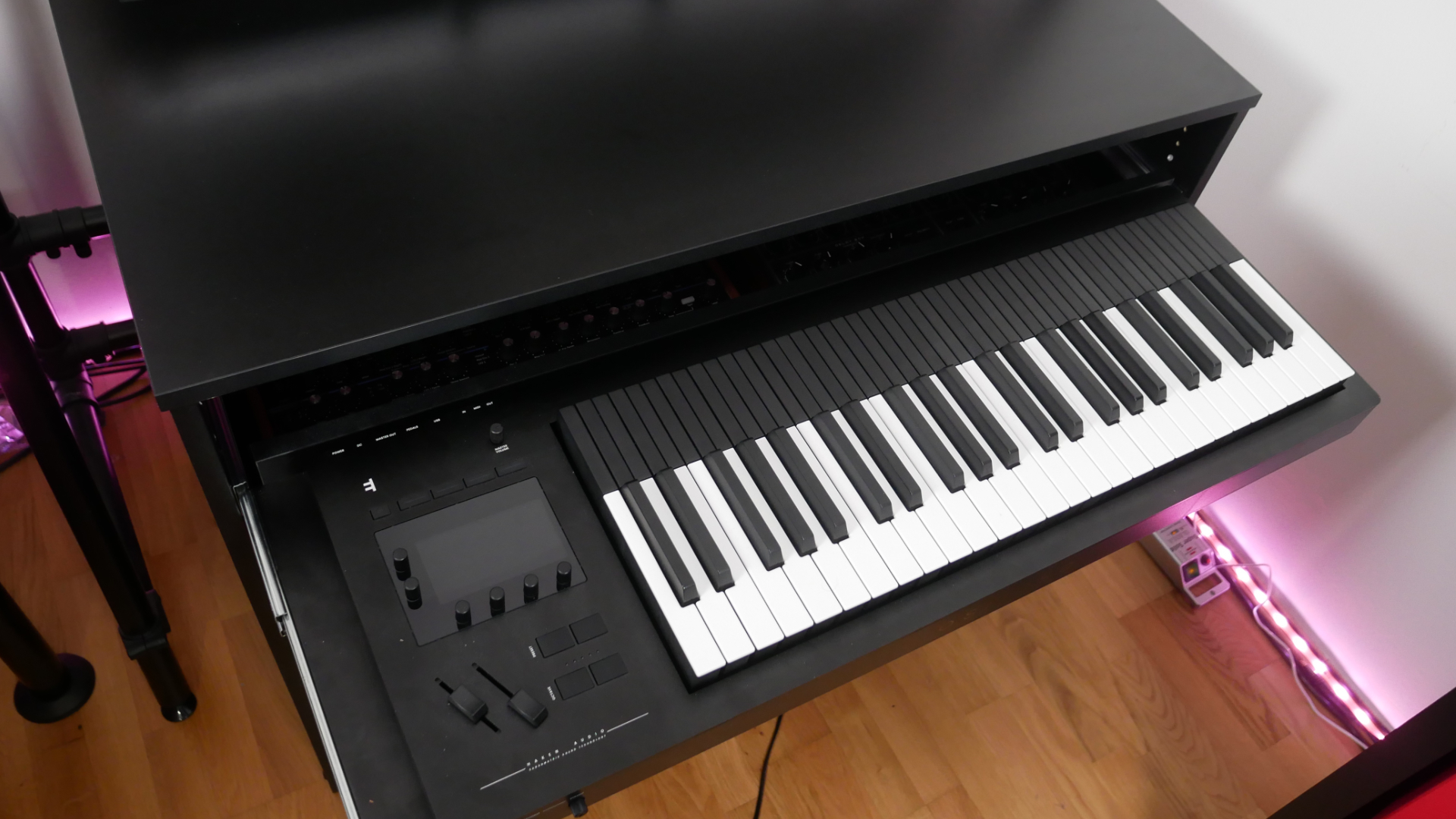
The Moog Muse still doesn’t fit. The ASM Hydrasynth fits now, but something sticks out because the synth is a bit too wide.
My Korg minilogue XD fits in without any issues. The same applies to the Modal Electronics Cobalt8 or Argon 8 keyboard. Yes, also the new Carbon8, as it has the same housing and design. Two of them together don’t fit.

Two Modals are sonically a match but not on the shelf; the ComboRack would need to be a bit broader to accommodate both in the same drawer. My Italian “beauty”, the UNO Synth Pro, also finds a place. And there’s room for one or two pedals as well.
With the second configuration, which I customized to my liking, more synthesizers from my studio now fit on the drawers.

Ultimately, the Osmose now sits in the top drawer. The Peak and Steampipe desktop synths in the second. Even if the drawer opens when you push out the Osmose.
This is because the wooden element protrudes downwards at each drawer, thus reducing the height. And finally, in the third row, I have the Uno Synth Pro with pedals. This is the current setup, but it may change.
Cable Management
As shown in the image above, the rack is open at the back, allowing you to route the cables. Alternatively, there are cable outlets on each side, which is very convenient. Additionally, there are two cable clips in the rack for bundling the cables.
The key to cable management is mounting the drawers correctly. I just made that mistake. Thanks to the reader who pointed it out. Never build a shelf between Christmas and the NAMM Show. That leads to problems.
The first picture shows the wrong mouting which leads to cabling issues.

When properly assembled, the cables fit, and the keyboard can be fully used.

Update – The Nonsense Drawer Back
A reader pointed out that the back panel was incorrectly mounted, which prevented cable management from working. That was correct, thanks again. Now that I’ve been using it for a while, I realize how pointless the wooden supports behind each drawer are.
I have the Novation Peak and Erica Synths Steampipe in the second drawer. If I pull the Osmose out of the first drawer, I pull both desktops out as well because the support sticks down. The first drawer, therefore, is a kind of sweeper. I added a photo with the UNO Synth Pro.
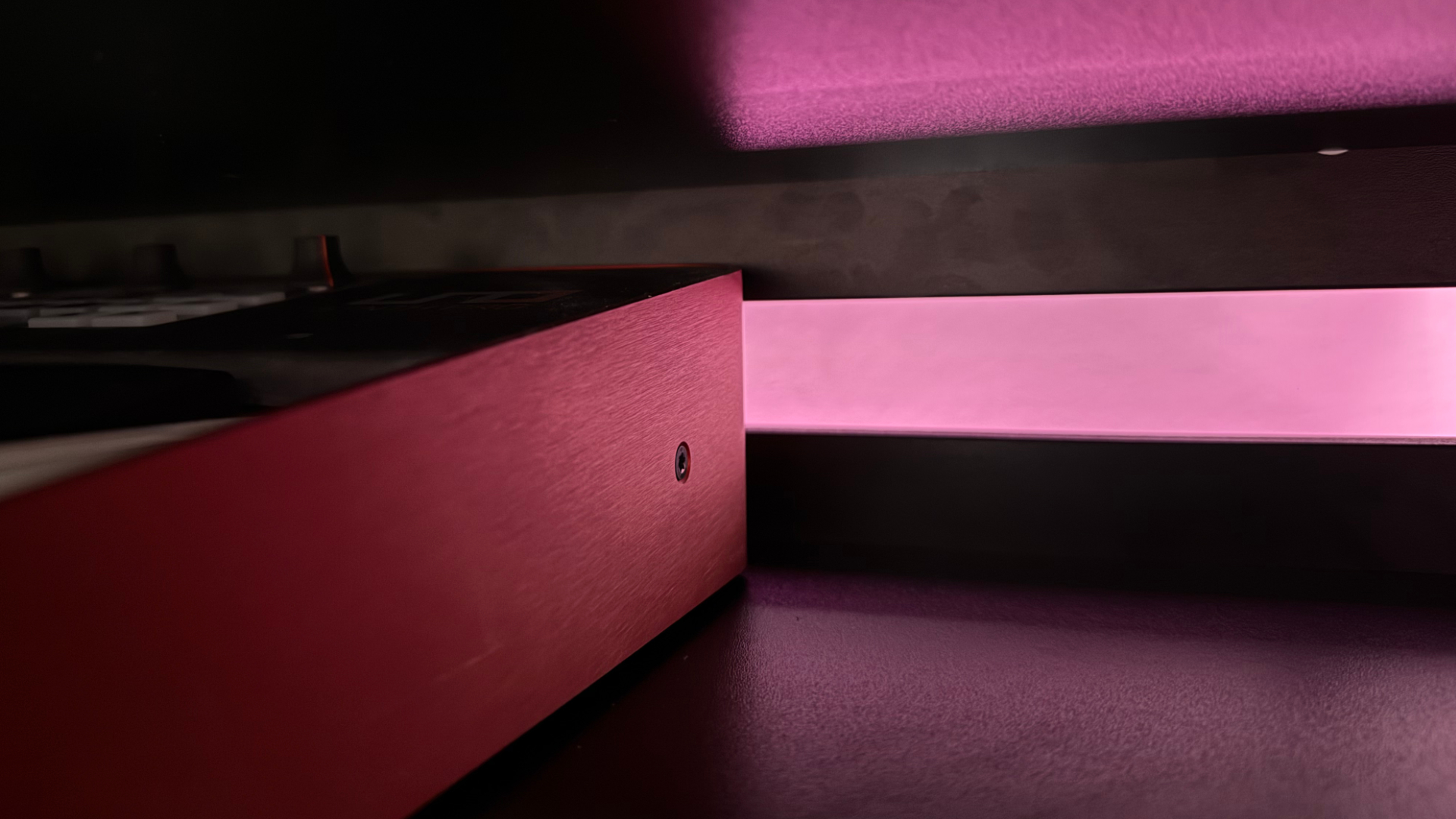
To fix it, I removed one of the bars for testing, and now the drawers are working as they should. I’m wondering why this isn’t noticeable during prototype testing.
Update 2 – Thomann Releases Hardware Update
Thomann has acknowledged the issue with the back panels and released a hardware update. They have reduced the size of the black panels by almost half. Customers who purchased the ComboRack should have already received replacements from Thomann.
I installed the new panels directly and can report that I have mixed feelings about the reconfiguration.
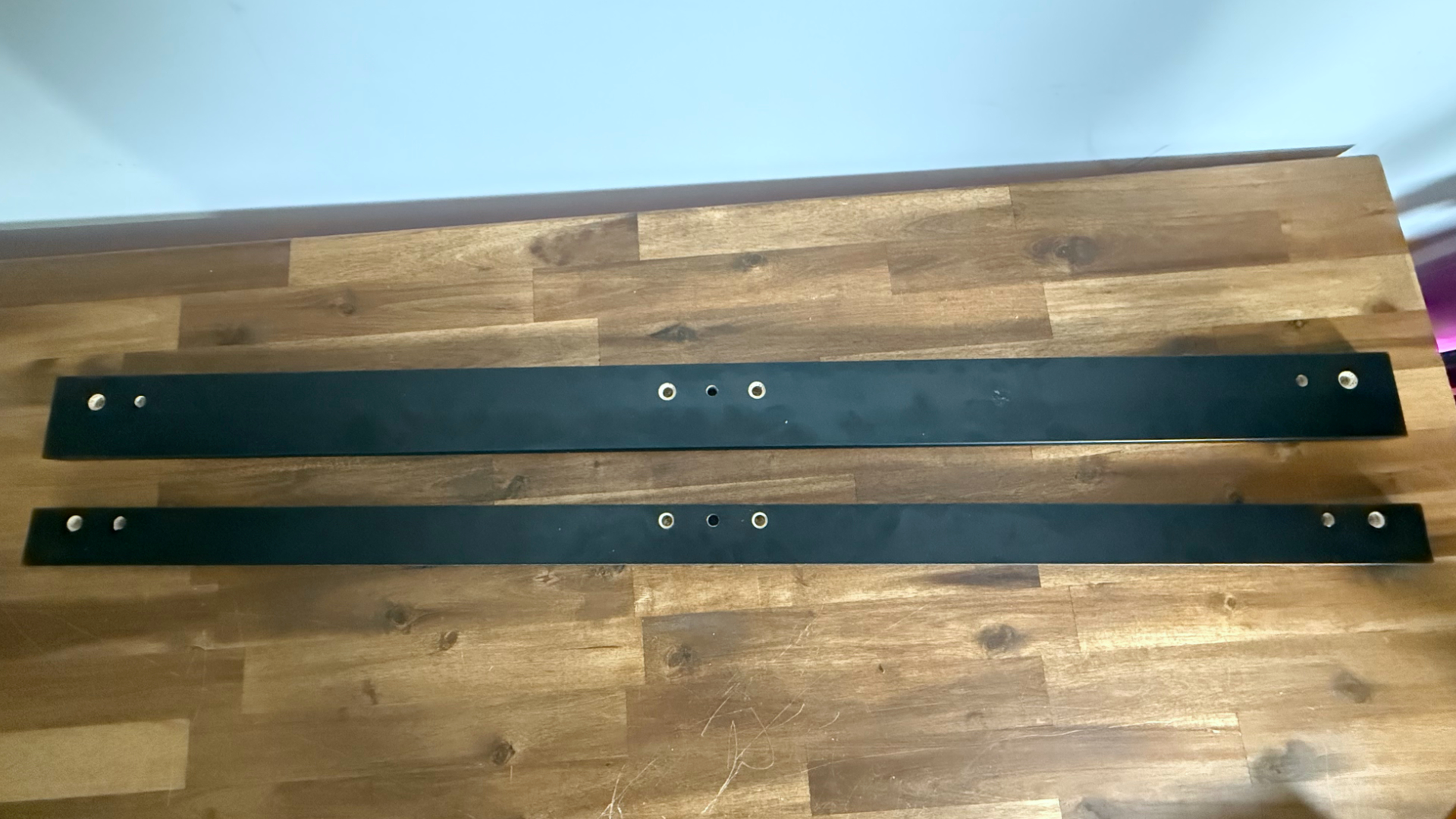
Yes, it solves the problem, but not everywhere, especially with synthesizers and devices that are taller and where the knobs protrude.
The peak is narrow enough, but with the Erica Synths Steampipe, the height is still insufficient. Even the shortened panels function as a sweeper here. Either I’ll leave the first drawer blank on the back side, or I’ll cut it even shorter so it fits.
The Rack In ComboRack
The name Thomann ComboRack also contains the word “Rack,” and that’s part of this review as well. The ComboRack has two 6U rack spaces, which can be used for rack synths, rack effects, or simply for additional storage.
It comes with a bag of black screws and nuts, making it easy to mount everything. My setup includes the Arturia AudioFuse 8Pre, which functions as an ADAT interface and fits perfectly.

I’ve also added a raw drawer to keep additional synths or effects readily available, but I haven’t decided yet how I’ll use the other space. It’s possible that I will add more rack gear or more accessories like drawers or a rack power strip, as I have in my main rack.
The 6U rack is a neat bonus that comes with the ComboRack. Even though some criticized the rack’s position in my news post, I find it perfect for my setup/workflow.
It gives me more options for using additional synthesizers or effects and, above all, creates more space and organization.
Thomann ComboRack Review Summary
We’ve reached the end of the Thomann ComboRack review. I have to be honest, I’m torn. On the one hand, I’m very pleased that a manufacturer, in this case Zoar for Thomann, finally offers a shelf dedicated to keyboards and electronic gear.
Until now, this was only possible through pricey on-demand and custom orders. Here you can get one delivered to your door for 399€ with fewer clicks. The concept and the idea are great, but there are some things you must know.
It starts with the size of the ComboRack itself. Many keyboard synthesizers, even budget ones, aren’t portable synths but proper instruments. You need space to house them.

With 49 keys, the ComboRack is almost at its limit because many 61-key synths are significantly too long or too wide. We need a ComboRack XL that is considerably wider and has larger surfaces.
The ComboRack is suitable for 37- and 49-key keyboards, desktop synths, drum machines, or pedals. Even though most grooveboxes are quite compact, my Maschine+ fits perfectly. That’s the length limit the groovebox should have.
Additionally, there were a few manufacturing issues, including screws that didn’t fit in the holes or the plastic dowels. They are difficult to remove, damaging the wood in the process.
Alongside this, I would appreciate it if the assembly instructions mentioned that there are essentially three possible positions.
The Thomann ComboRack now has its permanent place under my Jaspers 5D-120B. With a little modification, Thomann’s keyboard shelf fits perfectly.
Can I Recommend It?
All in all, the ComboRack is an exciting keyboard shelf that allows you to organize your synthesizers and electronic instruments while keeping them ready to play. Unfortunately, it has some weaknesses that can’t be ignored.
If it didn’t have these, I would fully recommend it to everyone, as I don’t know of any other product like this except for DIY or custom-made. For now, it’s more like: great idea, very usable, but with some suboptimal things you must live with. If I had to rate it, I’d give it 3/5.
Pro
- overhaul quality and solid construction (55kg without instruments)
- perfect to store electronic instruments while keeping them connected and ready-to-use
- two 6U racks (tons of space for extra gear or accessories)
- top-level surface adds more space for gear
Neutral
- 6U position (perfect for my setup/workflow)
Contra
- processing issues (two holes don’t fit )
- assembly instruction improvements
- size (not optimal for 61-key keyboards as advertised)
- drawer backside (pulls out other drawers if the synth a bit higher)
Thomann ComboRack is available now for 399€
More information here: Thomann
Available from my partner


You mounted the back piece of the drawer oriented toward the the top, but on the manual it’s clearly oriented toward the bottom.
That’s why it messes with your cables behind the synths.
I will check it. Give me some time
look at the picture on thomann. It should protrude more on the bottom than on the top.
I changed it and it’s fine now but we lose space in the end of the drawers but works.
What I would probably try if it was mine, would be to reverse the orientation of the drawer, and have that part in the front of the drawer and not in the back !
you were right. It was my fault. Now it works as it should. The wood piece need to be on the other side 🙂
It’s interesting to see your synth collection!
Given those were synth keyboard styled drawers, where is one supposed to put one’s legs or are we supposed to use the keyboards standing sideways.
This!!
I waaaahhhhnnnnntttt that…
This rack would have been a guaranteed buy from me if it weren’t for the fact that almost none of my synths actually fit, even though most of them are 49 or 61 keys. It’s too shallow, the space between the shelves is too tight and it’s not wide enough. Please make a slightly larger version, Thomann 🙏
I would get 2 units a 2 shelves with legs for less money. Bending for sure would mess my workflow (and ,y old back) as well as fiddling with 3 drawers. The bottom rack is useful for things you dont tough often like audio interface, midi and power but again its too low if you have rack stuff like Vermona drum synth. There are too many synth setups and their workflows so the more modular this stuff can get (like Ikea) the better (also good for shipping purposes).
Not quite what I’m looking for, yet nice.
Over here, I hoard tiny synths without keys. I have something in the works, like a pseudo-Eurorack for tiny synths. It holds about 20 synths depending on size and will have an integrated patchbay, power supply (std & USB) as well as a MIDI hub. Also, I finally found a way to hold the synths without hurting them.
It’s not ready yet but you can get an idea by looking at my Insta account (@ravelsberg.klang).
Thanks a lot for the detailed Review. Buso Audio also has some interesting offerings in form of their Synthstation and Synthdock. Somewhat pricier but same ballpark.
these things are pretty different tbh
I guess it depends on which aspects you emphasise. If you focus on the drawer aspect that you highlighted, they are for sure quite different (and yeah, not only in that regard).
very expensive for what it does and then many issues Like the wrong Holes.
you can buy a quiklok 3 Tier stand for 180€. i have bought one.
yeah but different concept. Personally, I already have two Jaspers so this fits better to get more space. Depends always how your organization is. Don’t have space for a quiklok or Jaspers
This is something I need, but I’d really prefer that it could fit some vintage synths. It feels I might only be able to use at most 2 drawers, not all 3 because of the height of them. Still this is a good value for modern synths.
Quite interesting, are those drawers has a lock in retracted position?
no locking
how many Volca Mix can I fit per drawer?
jokes aside, it looks great for those with many “gadgets” and smaller synths. which unfortunately means I’m out as I could only fill less than half of this and still would need more space elsewhere. an XL version that can accommodate 88 key keyboards would be every interesting.