
UDO Audio DMNO is a new hybrid Synthesizer featuring two independent synths in one instrument, playable with an Oberheim-influenced workflow.
This weekend, Machina Bristronica takes place in Bristol (UK). It’s set to be a hot synth weekend, with PWM showing off the new OSCar Re-birth and Modor the NF-1k. There’s also another big surprise.
UDO Audio has unveiled the DMNO, a new hybrid Synthesizer that bears two independent synths in one instrument, playable with a concept reminiscent of a legendary analog synth.

UDO Audio DMNO
The DMNA is a hybrid, but it differs from the previous UDO Audio synthesizer structures, such as the Super 6 and Super 8.
This starts with the interface, which has a dedicated control panel for each layer. This two-layer layout reminds me strongly of the Oberheim Two-Voice, which also features two identical sections. The arrangement is also very close to this classic.
So, the first UDO synth no longer features the vintage Roland Jupiter-style layout. Also, a first for a UDO synth is the display on the left side. According to the developers, it’s a high-quality, long-lasting electroluminescent glass vacuum fluorescent display (VFD). A feature that many people have asked for.
The new DMNO is playable with a 44-key keybed with aftertouch. Yes, no polyphonic aftertouch like the flagships, but traditional monophonic aftertouch. A Roland-style assignable joystick is included for added expressive playability.

Hybrid Synth Architecture
The DMNO core is hybrid and reminiscent of the UDO Super Synths. It’s an 8-voice, bi-timbral binaural hybrid Synthesizer with highly flexible and dynamic signal architecture, promise the developers.
DMNO hosts two fully-featured independent synthesizers, each with its own dedicated set of front panel controls. The built-in play modes allow you to interact differently with them—more on this later.
Each synth is driven by two ultra-high sample rate, high-resolution, FPGA-powered digital oscillators.
Each oscillator features classic waveforms as well as the best-known DDS waveforms, which can be created and imported into the engine. The oscillators are tweakable with various controls, including tuning, PWM, and sync.
Additionally, you have an oscillator mod section, where you can modulate the detune, wave/PWM, and pitch mod of one or two oscillators at the same time. The next step is a mixer with a built-in Q-drive for additional juice.
Then, both oscillators are routed through a versatile stereo analog filter that uses a novel, reconfigurable voltage-controlled topology.
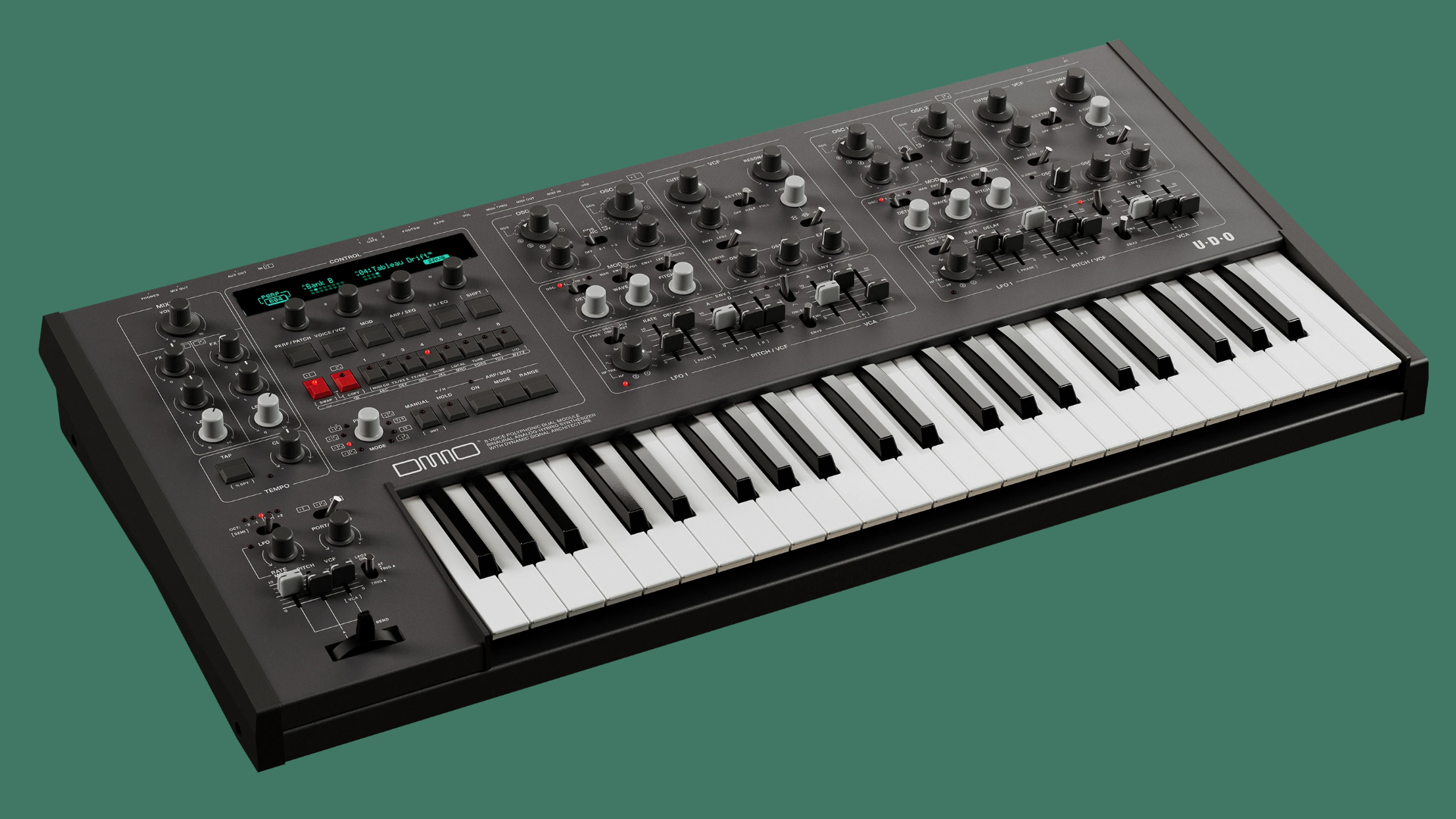
Series, parallel, or stereo configurations are available, alongside a wealth of filter modes that range from classics to more experimental options. The stereo filter on each side is fully tweakable with hands-on parameters, including cutoff, resonance, and modulation.
Don’t forget this is per layer and not for the entire synth. So two oscillators and one stereo analog filter per layer.
On the modulation side, each layer offers a main multi-wave LFO with rate and delay parameters. A second global LFO is available on the left side, close to the joystick.
Further, it has per-layer two-loopable ADS envelopes with an inversion option. It also appears to include an option to enable a third envelope.
A 32-bit DSP digital multi-FX processor chain, featuring delay, reverb, EQ, overdrive, distortion, and chorus, complements the hybrid engine.
The two layers can be conveniently mixed via a panel on the left with dedicated level, pan, and FX sends per level.

Playability
The Oberheim 2-Voice and 8-Voice were not only synths with multiple synths in one, but they also uniquely combined them. UDO also adopts this concept of how the voices are playable in the new DMNO.
DMNO has a unique play mode system that instantly reconfigures the internal architecture at the touch of a single control. You can select from eight modes that redefine how the two timbres interact with each other.
This includes traditional splits and layers, alongside other creative and unexpected configurations, such as random and chaotic arrangements.
Also onboard is a 64-step sequencer with creative features, and a multi-mode arpeggiator featuring smart hold functionality.
Connectivity
On the back side, you can find an input for the internal power supply, a USB port for MIDI and audio, a full 5-pin MIDI interface, and three expression pedal inputs (volume, expression, and single/double).
Exciting is the audio I/O section. It starts with two individual user-assignable CV/gate/clock outputs via 1/8”/3.5mm sockets. Then, it features an analog audio input with a preamplifier, a gate generator, and an envelope follower, providing modulation options.
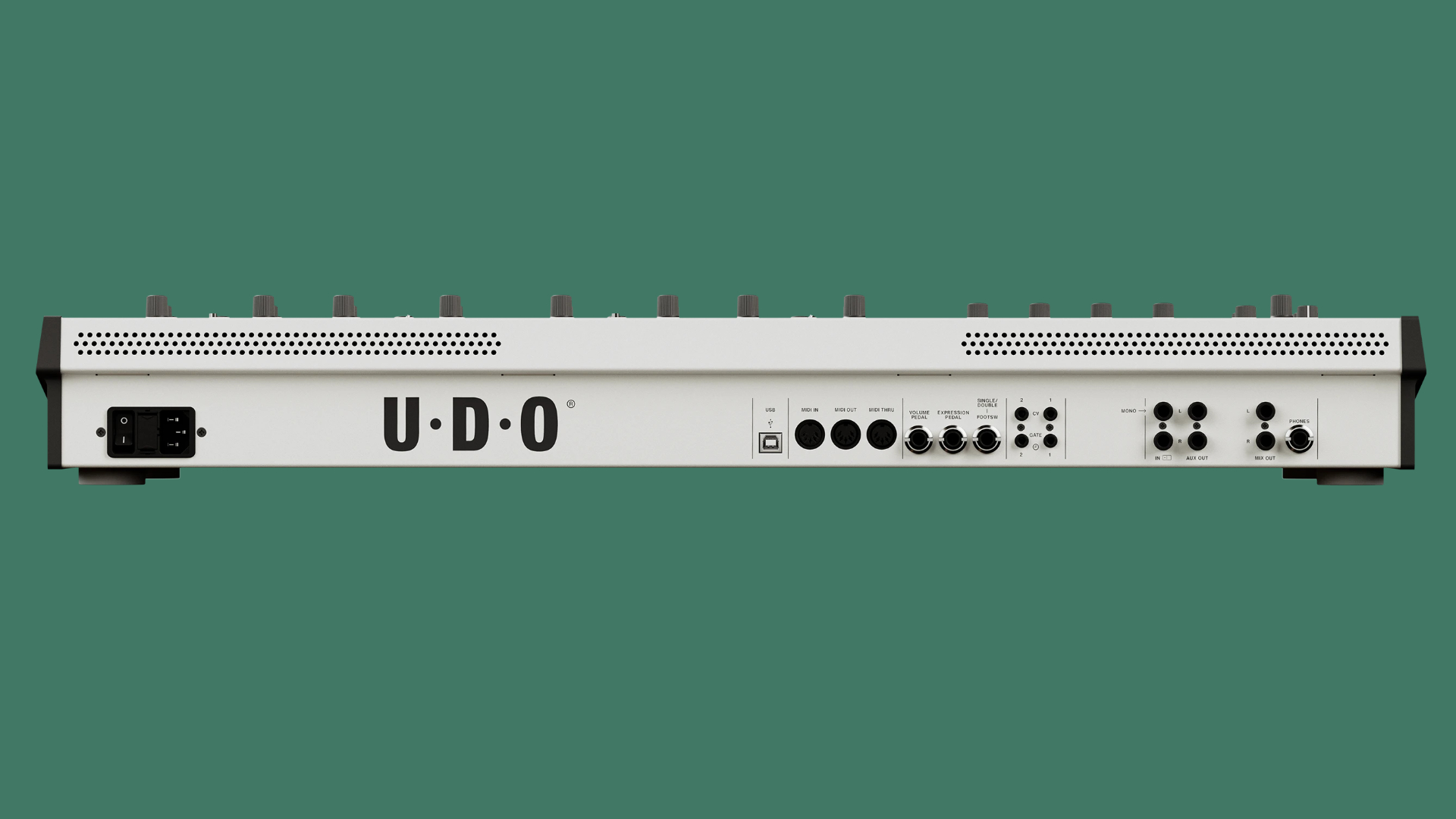
Moreover, the UDO Audio DMNO has a stereo mix output as well as an auxiliary stereo output that can be assigned to either the DMNO 1 or 2 voice. Additionally, the USB port functions as a 24-bit 2-in/2-out digital audio interface, allowing for connection to the host or the effects send bus.
First Impression
This is a huge surprise that probably no one except the developers had on the radar. Yes, hybrid—two digital oscillators and an analog filter—is a recipe from UDO Audio that we’re already familiar with.
However, the new interface and the possibility of combining them look very exciting. Too bad that there is no polyphonic aftertouch, which would have fit perfectly into this “playability” concept. I’m looking forward to the first demos.
UDO Audio DMNO will retail at £2,499/€2,969/$3,500 and will be available early in 2026.
More information here: UDO Audio

$3,500? Yamaha Montage M6, anyone?
Gotta love the OMNI magazine logo homage
Bonjour, ces claviers ont l’air géniaux. U. D. O seront ils présentés au prochain SynthFest(Festival du Synthetiseur) à Nantes ? Merci pour vos réponses
Bonjour, je ne suis pas l’orga du SynthFest 😉
please in English.
Most people don’t understand french.
nothing important here just that I’m not the organisator of the SynthFest France