
Kushview PulseDial DTMF is a telephone signal Synthesizer plugin for macOS and Windows: it’s a FREE download until December 25, 2025.
I’ve played many synthesizers from virtual analog, FM, wavetable, granular, and additive to west coast-inspired ones. But there are also firsts like this one.
PulseDial DTMF is a Synthesizer plugin for macOS and Windows that provides classic telephone keypad tones as a virtual instrument. Good: Kushview offers PulseDial DTMF as a free download until Christmas evening, December 25, 2025.
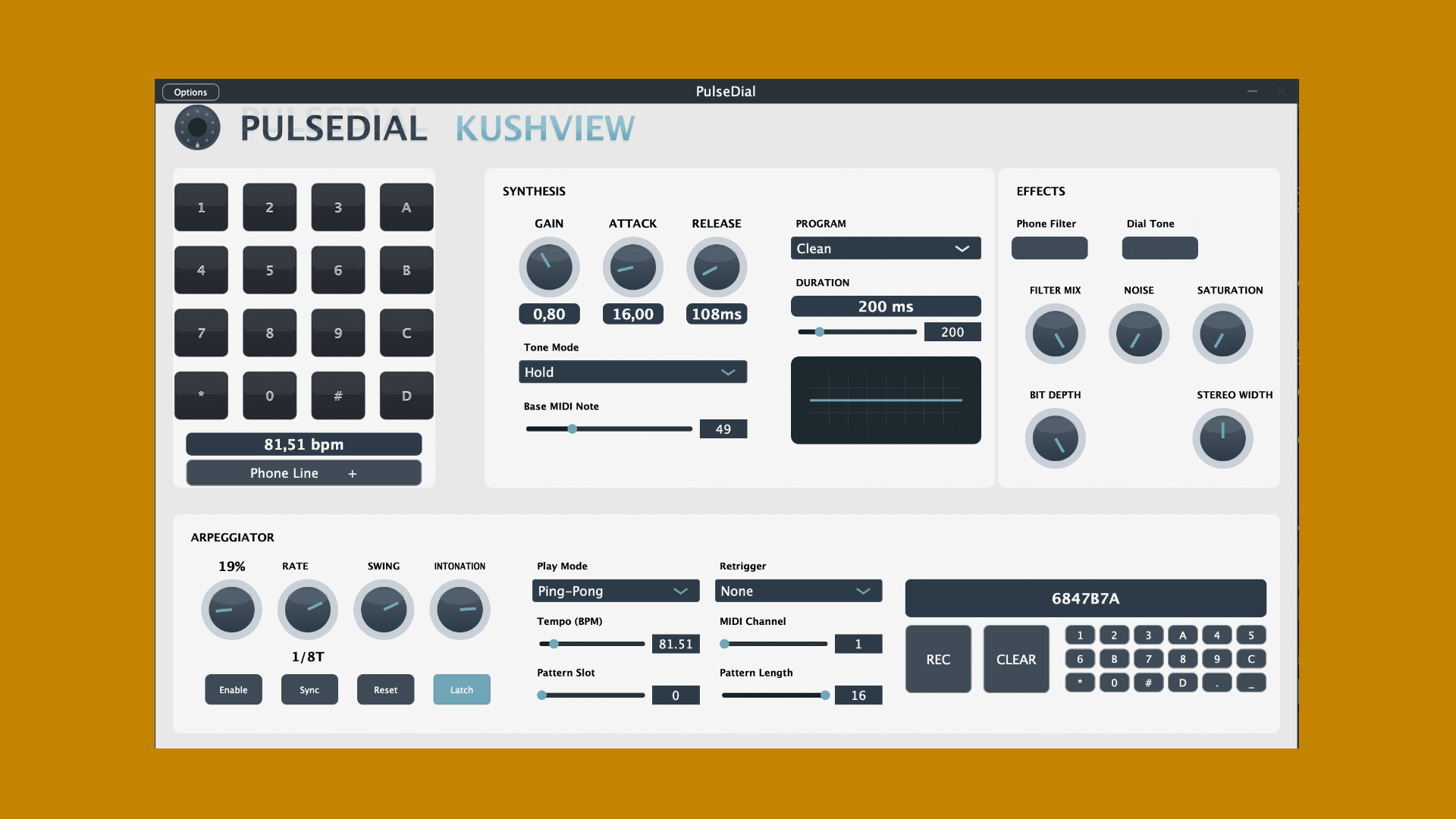
Kushview PulseDial DTMF
PulseDial DTMF is a telephone Synthesizer plugin. Yes, you read that right. Kushview has developed PulseDial DTMF, a Synthesizer that transforms classic telephone keypad tones into a playable music instrument. According to the developer, it’s designed for musicians, sound designers, and telecommunications professionals.
DTMF stands for dual-tone multi-frequency and refers to the synthesis used in this Synthesizer. The plugin uses DTMF synthesis to generate dual-tone frequencies with ±1.5% accuracy, meeting ITU-T Q.23 compliance standards. You can craft your tones with three main parameters: gain, attack, and release. Plus, you can adjust the duration of the sound.
Then, there are three tone modes to explore: Hold, OneShot, and Spec, each with a distinct note behavior, ranging from sustained synth-style tones to strictly timed telephone signaling.
As with a telephone, there are also number keys (0-9, #…). These can be used to trigger the sound. It becomes more interesting with the MIDI note mapping option, which lets you play keypad tones on a MIDI keyboard. Kushivew also implemented an option to stack multiple keys simultaneously for a polyphonic-like tone.
The sound design of telephone signals doesn’t end here. It also features a phone line simulation using a bandpass filter that mimics the limited bandwidth (300Hz to 3400Hz) of real telephone audio. You can apply noise reduction, bit-depth reduction, saturation, and stereo control to shape the sound further.
The built-in arpeggiator is fun. You can program patterns up to 16 steps, save them in multiple slots, and use various play modes, including random, ping-pong, and more. In this step, you can turn your phone sounds into rhythmic sequences and everything in between.
Furthermore, it includes full MIDI support. According to Kushview, PulseDial DTMF has an omni input mode (all channels accepted) with note mapping from C4 (key “1”) across 16 consecutive notes, CC1 for temporary gain boost, CC71 for phone filter mix, and CC74 for saturation amount.
Arpeggiator output can be routed to specific MIDI channels (1-16). Program Change 0-3 instantly recalls factory presets during performance.
First Impression
This is a unique Synthesizer, unlike anything I’ve seen before. I can’t easily imagine using telephone sounds in a production. I’ve spent some time with the plugin, and I can say: the synth is fun, and when the sounds are arpeggiated, some very quirky patterns emerge.
So, as a free download, it’s definitely worth considering. Whether you need the sounds or they should serve only as a basis for deeper sound design is something everyone must decide for themselves.
Kushview PulseDial DTMF is available for free download through December 25, 2025. It runs as a standalone application and as VST3, AU, AUV3, CLAP, and LV2 plugins on macOS (native Apple Silicon and Intel) and Windows.
To get the plugin for free, you have to make a free purchase. It requires 1GB of free disk space.
More information here: Kushview


This needs an expansion with all of the blue box tones (KP, ST, etc.).
What? No ‘Telephone and Rubber Band’ demo? 🙂
https://www.youtube.com/watch?v=EW7dQYIyj6g