
Synamodec Gorse Lathe is a new, unique, experimental Synthesizer designed for exploring the raw essence of sound.
Fans of raw, experimental, noisy sounds are probably familiar with the fascinating developments of Miguel García Blanca, aka Synamodec. Among other things, he has created the Levitate drone synth or the Magnetar, a synth based on a distortion.
His latest hand-crafted and assembled release is Gorse Lathe, and as expected, it is not a traditional Synthesizer that you can find on any store shelf.

Synamodec Gorse Lathe
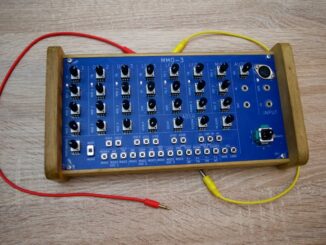
Gorse Lathe looks like a classic analog synth at first glance. At second glance, you can see that other sonic qualities are in charge here.
Synamodec describes Gorse Lathe as an experimental Synthesizer designed for those who explore the raw essence of sound. More, it’s the meeting point between structure and chaos.
At the core is a unique “responsive” circuit that acts as a living system. It offers two distinct generators: a triggerable noise engine and an unusual oscillator.
The noise engine features three distinct sources: white, filtered white, and grain noise, each of which is shapable with filter cutoff and resonance controls. The texture’s density and coarseness are adjustable with the TEX control.
Then, the oscillator is a LEGUS oscillator cluster, consisting of four interconnected oscillators whose frequencies interact in a web of constructive and destructive interferences. Each oscillator and the cluster are fully adjustable from the front panel.
You don’t get the classic oscillator waveforms from it, but experimental textures that can be musically stable or unstable. From here, it goes into a delay section and a harmonics section.

Add Delay and Harmonic Structure
Instead of taking the easy route —putting the mix into the delay and harmonics —you can customize the routing. A switch lets you send the noise engine to the delay and the oscillator to harmonics, or vice versa, giving you a different signal flow.
Synamodec promises that each path in Gorse Lathe feels different, with its own sonic character.
The delay section offers controls for input level, time, feedback, and dry/wet balance. Plus, you have an LFO for animating the delay time, great for adding instability. The delay can generate both classic echoes and infinite resonating textures.
Further, the harmonics module, aka the instrument brain, is a 6-band equalizer and filter that lets you shape the signal to the last detail. You have two dedicated controls for the low, mid, and high frequencies, plus level and feedback controls.
The engine isn’t a loose collection of different features. According to the developers, they work together as a network that can influence one another.
Bass, leads, or even fluffy pads aren’t on Gorse Lathe’s sonic menu. Here, it’s all about experimental sounds, ranging from drones and noisescapes to rhythmic dust.
First Impression
Synamodec stays true to itself and presents another very unique and special interest Synthesizer with its new release.
Amid the vast number of classic synths we have today, it is always a welcome change to report on such fascinating one-man operation projects that create sounds which are not among the usual suspects.
Synamodec Gorse Lathe is available now for 415€.
More information here: Synamodec

Be the first to comment