
Arturia Keystep 37 MK2 and K32 MK2 are two powerful MIDI/CV controller sequencers: this review highlights the differences and why one is a no-brainer.
In early November 2025, after 10 years on the market, Arturia released the successor to their best-selling MIDI sequencer controller, Keystep. The MK2 introduced a redesigned interface, as well as inspiring modern features such as on-the-fly mutation and ARP to the sequencer.
Questions arose about whether Arturia would soon release a Keystep 37 MK2. At that time, I was unfortunately just as unaware as the readers. But now I have a clear answer for you. Somewhat surprisingly, Arturia has now released the KeyStep 37 Mk2 version only three months after the regular Mk2.

Thanks to Arturia for the opportunity to check out and review the new Keystep 37 mk2. They sent it to me for free a month ago, but they have no say over the review and don’t get to see it before I publish it.
Arturia Keystep 37 MK2 Review Summary
Pro
- better connectivity (USB-C, second CV mod, on/off switch)
- big arpeggiator engine boost
- major overhaul and upgraded sequencer engine (pattern chaining, mutation, spice, modulation + ratcheting!)
- CV mods with LFOs and envelopes
- customizability
- build quality
- usable with analog and digital gear (modular synths, analog synths, Mac/Windows, iPad, iPhone…)
- expanded MIDI CC with up to four banks
Neutral
- less menu diving than the 32 MK2
- missing modulation animation
Contra
- personal points: missing playback direction, and probability
- The price difference between the two versions needs to be larger to have a better balance between the models
Unboxing
The Keystep 37 MK2 comes in classic Arturia packaging. Currently, the MK2 is only available in white. It’s unknown whether a black edition, like the MK1 generation, will follow in the future. Until then, you can have anything as long as it’s white.
The packaging includes the MIDI keyboard controller, a USB-C-to-USB-A cable, and paperwork for registering the device and unlocking the software. Like the regular version, it includes a license of Analog Lab Intro and Ableton Live Lite.

As nicely braided as it is, the included USB cable is going straight into my cable box. Sorry, Arturia. Since I’ve completely switched my computer peripherals to USB-C, I prefer USB-C to USB-C cables.
I hope this complete switchover finally reaches the manufacturers. Especially considering computers, iPads, etc., which almost exclusively have USB-C ports now, the included cable makes less sense.
Arturia Keystep 37 vs Keystep 37 MK2 vs Keystep MK2 (Interface)
The Keystep 37 MK1 was released in September 2020, so it has now been on the market for almost six years. A review of it is available online. The Keystep 37 has been a very reliable partner for the past five years, accompanying me in many videos.
The MK2 version is on the desk and, of course, needs to be compared. The new KS design is continued here. Three knobs and the switch that controlled the primary arpeggiator and sequencer functions have been replaced by buttons.
Instead, you now have the clickable rotary knob with the new OLED display. Like on the KS MK2, you also have the additional mutation, chord, and tempo buttons. Pitch and mod wheels remain touch-sensitive.

The keyboard is also identical and offers 37 slim keys with velocity and aftertouch. There’s not much more to say. They’re tried and tested and play well. Yes, the black contrast is gone. Now everything is white, even the four knobs that come with the 37-key version.
I really liked the black contrast in the Keystep 37 MK1; it gave the whole thing a bit of a panda look. It’s a shame they only used white with a blue shift button for some contrast. The lower side offers slightly more contrast, being light blue like the regular model.
There’s also a noticeable difference when you pick up both devices. The MK2 is slightly lighter compared to the MK1 (1.6 kg). It’s not a massive difference, but you can tell the Keystep 37 Mk2 has slimmed down a bit.
Keystep Mk2 Vs Keystep 37 MK2 (Interface)
Let’s also compare it to the regular Keystep Mk2. Like the Mk1, the 37 MK2 has 37 keys instead of 32 and four extra knobs now positioned even further to the right. The five extra keys give you more playability and make scale switch more immediate.
New in the Keystep 37 MK2 are two buttons for managing the extra functionality.

In addition to these interface differences, the Keystep 37 MK2 also offers some extra features not found in the standard Keystep MK2. More on that later.
Connectivity
A glance at the back, with its shimmering blue base, reveals no differences compared to the 32-key Keystep Mk2. You have a power-ON/OFF switch, a USB-C port, and a 5-pin MIDI port (thankfully, no TRS).
Bigger size, more controls, but still bus-powered from any computer, tablet, or smartphone with a simple USB-C cable. And thanks to the on/off switch, you can leave the KeyStep plugged in since it won’t draw any power.

Hardware users will still need a USB-C charger, as a power adapter is not included. Then, you have a sync in and out, a sustain pedal input, and various CV outputs.
Analog Connectivity Taken Further
Analog connectivity is a key feature of the Arturia Keystep Mk2 series. Alongside pitch CV and gate outputs, it now features two CV modulation outputs, enabling new expressivity.
These are powerful. First, you can now set the values of both mod CVs directly on the hardware, without software. In the dedicated CV Mod section of the menu, the Keystep MKII lets you select whether it outputs velocity, aftertouch, modwheel, random, or pulse generator.
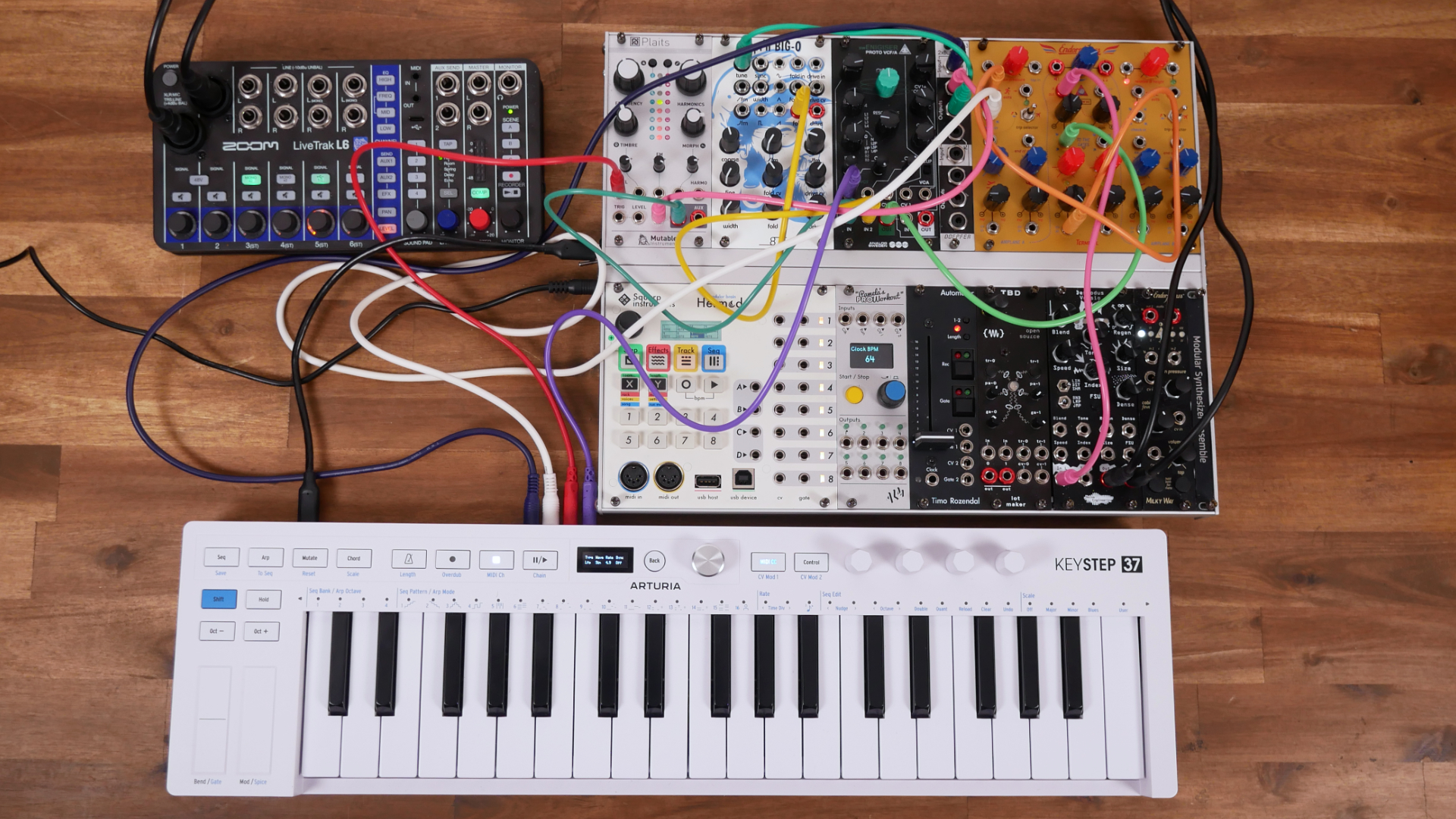
That’s already an upgrade compared to the first generation. Think again! With the Keystep 37 MK2, Arturia has taken things to a whole new level. Alongside the smarter way via the dedicated CV mod buttons, you can now assign even more tools to it.
For each CV mod, you can also use now a syncable multi-wave audio-rate LFO, as an ASR envelope, or as a rise/hold/fall C-envelope—essentially a function generator. This is a killer addition.

If you’re using a semi-modular or compact modular synth, extra modulation is always a plus. With the KS 37 MK2, you don’t need any extra modules; it’s built right into the keyboard, which is fantastic.
This allows you to add more modulation to any analog synth. And audio-rate support makes it even better. A little downer, it looks like it will be an exclusive feature for the Keystep 37 MK2.
The Keystep Mk2 Core With 37 Keys?
The original Keystep feature set has evolved in the MK2 version. This, in turn, is also the core of the new Keystep 37 MK2. However, it differs in a few areas and, in my opinion, adds welcome new features that I already miss in the 32-key version.
Since 95 percent of the functions are identical to the Keystep Mk2, here’s a brief summary of the most important ones. A full review can be found in my KS MK2 review from November 2025.
But let’s start with the features both share. Right from the interface, you can work with various built-in chords and scales. Don’t worry, the beautiful multimode strumming function for playing chords like a guitar is also available.

The KS 37 MK2 benefits from the same upgraded arpeggiator, with 8 new inspiring modes, giving you a total of 16 to experiment with.
Also onboard are the new options to reset the ARP length, change the octave, and time division on the fly. Yes, the super fun mutate (random-based), and spice (altering without changing the pitches) functions that superboost the arpeggiator are also part of the Keystep 37 MK2.
Nine pattern variations are also selectable and, for me, highlight the ability to turn a sequence into a playable arpeggio, which is also usable in the 37 version. The arpeggiator is just as inspiring and playful as the one in 32. Perfect.
Sequence, Mutate, and Evolve
Not only the arpeggiator but also the sequencer underwent an impressive evolution in the Mk2. The one in the Keystep 37 Mk2 follows this and even has a feature we’ve been waiting for a long time.
Let’s start with the feature highlight that docks directly to the arpeggiator. With the Shift and Arp button combination, you can turn any programmed arpeggio into a fully customizable sequence.

The sequencer (mono/poly) itself remains at 64 steps and can be programmed per step or on the fly, in quantized or unquantized mode.
Pattern chaining allows longer sequences, which can be transposed while playing. It also has the same 4×16-bank expanded memory, giving you space for up to 64 patterns.
Evolving a pattern is just as fluid and fun as in the smaller version. It only takes a few control twists, and you can mutate or spice up your steps in your sequences. Use the mutate function to instantly reshape your sequence with melodic and rhythmic variation.
A reset option is included for all eventualities. The moving bar from left to right that displays the mutation dose infused in your sequence is, however, missing here. This was solved more elegantly and flexibly here.

Thanks to the four controls on the right, you can now customize/fine-tune the mutator engine behavior with four parameters, making it more flexible. So, you can craft your personal mutator.
This looks like an exclusive feature of the Keystep 37 MK2, given its four knobs. This also possible to modify the sequence’s gates on the fly.
Finally, Ratcheting and Modulation
New to the Keystep 37 MK2 is ratcheting. A first! This was one of the criticisms raised in the Arturia Keystep MK2 review, and now we have it in the Keystep 37 MK2.
Currently, this is only available in the KS 37 Mk2; it’s unknown whether and when it will be included in the KS MK2. But I have to temper your enthusiasm a bit. It’s a global ratcheting feature with 4 multiplications (1x-4x) that applies to the entire sequence.
Unfortunately, it’s not on a step basis. You can access it via the Control + Seq button combination and control it directly on the fly using the Knob section.

Not to be forgotten is the modulation engine, introduced with the MK2 sequencer. Once activated, you can record pitch and mod-wheel, gate, and spice mounts as modulation automations into a sequence—four in number, with which you can make any sequence dance wildly.
The MK2 sequencer is a huge improvement over the original. Arturia has added the shimmering cherry to the glazy chocolate cake with the Keystep 37 MK2, adding ratcheting and a customizable mutator.
4 Controls And 2 Buttons Make The Difference!
One criticism I have of the Arturia Keystep MK2 is that it requires more menu diving using the buttons and the clickable central encoder. Those who prefer a more hands-on approach should consider the Keystep 37 MK2.
The 37-key version features four additional endless encoders and two buttons. They can do far more than the MK1 version. This is also due to the two additional buttons. The new Control Button is a macro-style button for section functions.
Pressing it together with the Sequencer Button, for example, gives you access to important sequencer functions that can be changed immediately without navigating menus, using the four knobs.
Here you can work with ratcheting, adjust the time division, or even incorporate randomization into the pattern, all in a fluid, performance-ready way. Sequence programming is also significantly more enjoyable with these.
Each knob has one function: pitch, velocity, length, and shift per step. Programming on the KS 32 MK2 is quite simple, but hidden behind button combos. This is much more fun and hands-on.
Decoupling certain functions from the menu system and making them easily accessible is a very clever idea by the developers. There is another button that switches the four knobs to MIDI CC mode. Yes, this is a familiar feature from the Keystep 37 MK1.
In the Keystep 37 MK2, you have four banks of four MIDI CC’s each, for a total of 16 MIDI CC controllers, which can be easily modified individually in the hardware.
Having multiple banks makes far more sense and is a great addition, allowing you to control both hardware and software effectively.
More Settings
Further, you get 5 more keys, which offer a wide playing range and also let you select various scales without going into the menu. The keyboard play function is also onboard, allowing you to run a sequence and play over it on a different MIDI channel.
Lastly, the MIDI Control Center offers more settings options, although most of the functionality is now integrated into the hardware. For example, you have access to the different pattern banks and their settings, as well as the main hardware settings.
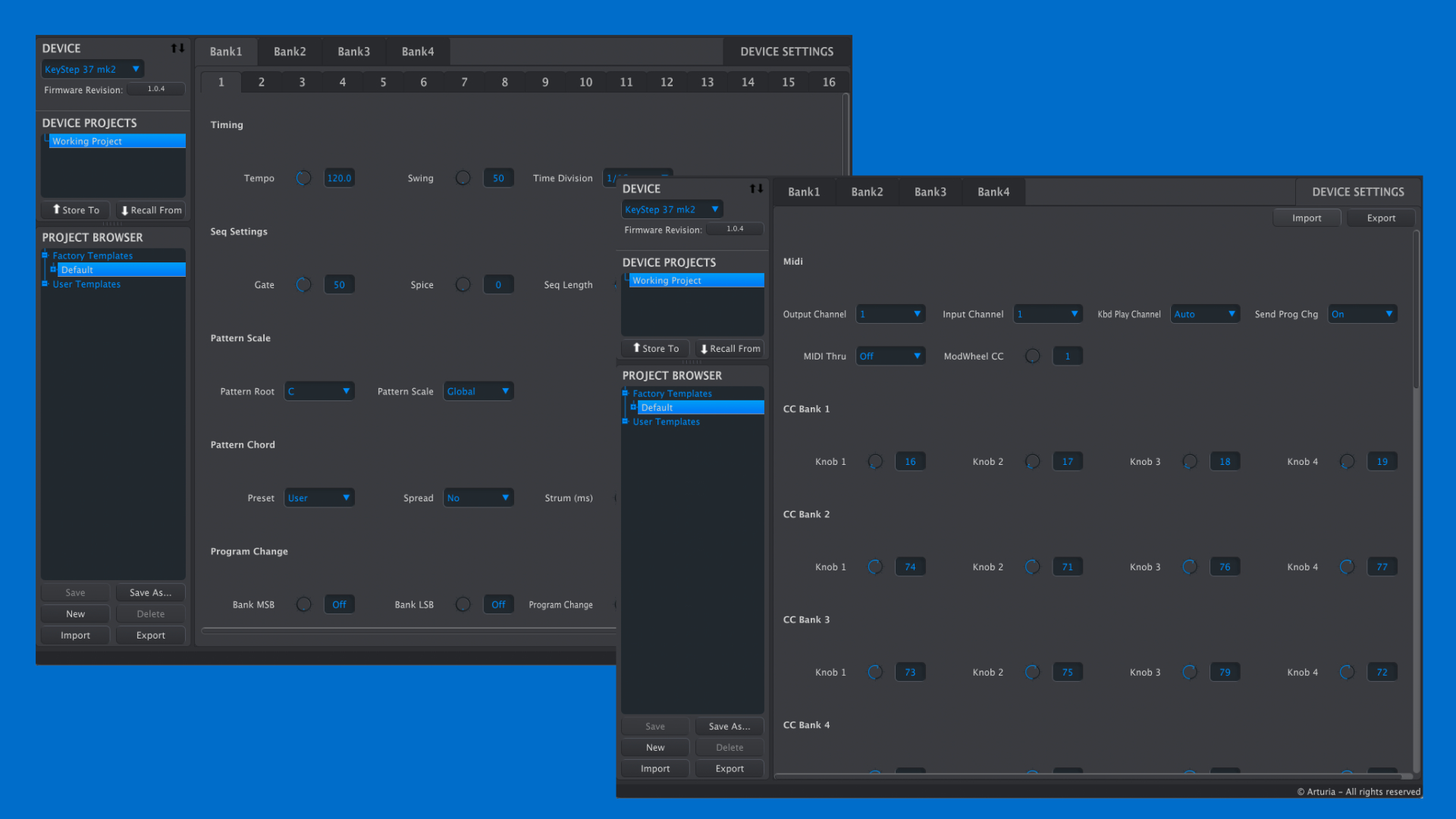
The MIDI Control Center lets you modify the MIDI CCs if you prefer to do so from a bigger screen.
It’s a shame that even with the Keystep MK2 generation, they haven’t managed to integrate a pattern editor into the MIDI Control Center. That way, you could recall and modify your patterns, put them back into the hardware, and so on.
Arturia Keystep 37 MK2 Review Conclusion
The Keystep 32 MK2 is a worthy successor of the original Keystep. With the Keystep 37 MK2, Arturia raises the bar even higher.
With built-in LFOs and envelopes, ratcheting for the mutating sequencer, and more controls at the CV and MIDI levels on top of all the new MK2 goodies, the Keystep 37 MK2 is a real no-brainer for any hardware, software, or hybrid setup.
For €50 more, you get a ton of new features. And that’s where my criticism lies. In my opinion, the price difference between the Keystep 32 MK2 and 37 MK2 is too small. The difference would need to be around €70-75 to incentivize choosing the smaller one.
I expect the market will regulate itself, and the smaller one will fall in price over time, making it clear. With just 50€ more and these super-practical extra goodies, everyone will automatically choose the Keystep 37 MK2 unless they have a very limited budget.
Arturia Keystep 37 MK2 is available now for $199/179€, and the Keystep MK2 for $139/129€.
More information here: Arturia
Available from my partners
Thomann

Be the first to comment