
Waldorf Protein packs the iconic Microwave 1 oscillators into a new compact and affordable multi-layer wavetable Synthesizer.
With this Protein, Waldorf has published a bestseller that remains difficult to obtain in Europe. However, this hasn’t deterred the team from further developing the engine.
Update 1.0.2 is out now, and it introduces new features to the new Waldorf wavetable synth. First, you can use a new ring “dirt” type that adds ring modulation between oscillator 1 and oscillator 2. A great addition.
Then, it brings extended pitch details. In addition to the pitch-bend section, you can set oscillators 1 and 2 on fixed pitches, which don’t react to notes. When you start the device, you will now also see the firmware version.
They also extended the MIDI compatibility. Protein 1.0.2 now supports MIDI bank select (LSB/CC32) for all 360 memory slots. In addition, it includes several bug fixes.
I’m currently testing Protein, and as is often the case, I’ll wait a while before writing the review to see how engine evolves.
The new Protein firmware version 1.0.2 is now available for free download from the official website. Waldorf will also be at NAMM 2026. You can find them in Hall A and booth #11310.
Available from my partners

Update from December 19, 2025
At the end of November, Waldorf released the Protein, a very affordable multi-layer wavetable Synthesizer. Given its four layers, it’s the least expensive. It’s been a success, and the unit is currently in short supply.
Those who already have one can explore the new firmware version 1.0.1, now available. It introduces a new 12dB filter option in addition to the 24dB, giving you more filtering and sound design options.
If you are into creating your own sounds, there is also good news. Waldorf Protein 1.0.1 also expands the built-in memory from 250 to 360 slots, so 110 more custom sounds.
Existing Protein users can also download a new patch library, “Ukrainian Folk Music Instruments,” featuring 20 new sounds created by Ukrainian musician Kateryna Zavoloka, who performed on November 27 at the Protein synth presentation in Berlin.
The new Protein firmware version 1.0.1 is now available for free download from the official website. Don’t forget the introductory price of 329€ is valid until December 31, 2025.
Article from November 27, 2025
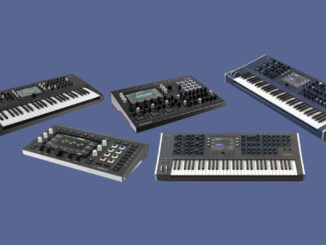
The German synthesizer company Waldorf has a long history. In recent years, the company has focused primarily on higher-priced products such as the Quantum and Iridum multi-engine synthesizers.
However, there is a growing demand within the community for more affordable products like the previous Pulse 2, Blofeld, Rocket, and Streichfett. Waldorf is now responding to this demand with the new Protein Synthesizer. It’s also a brand new format that will bring more affordable instruments in the future.
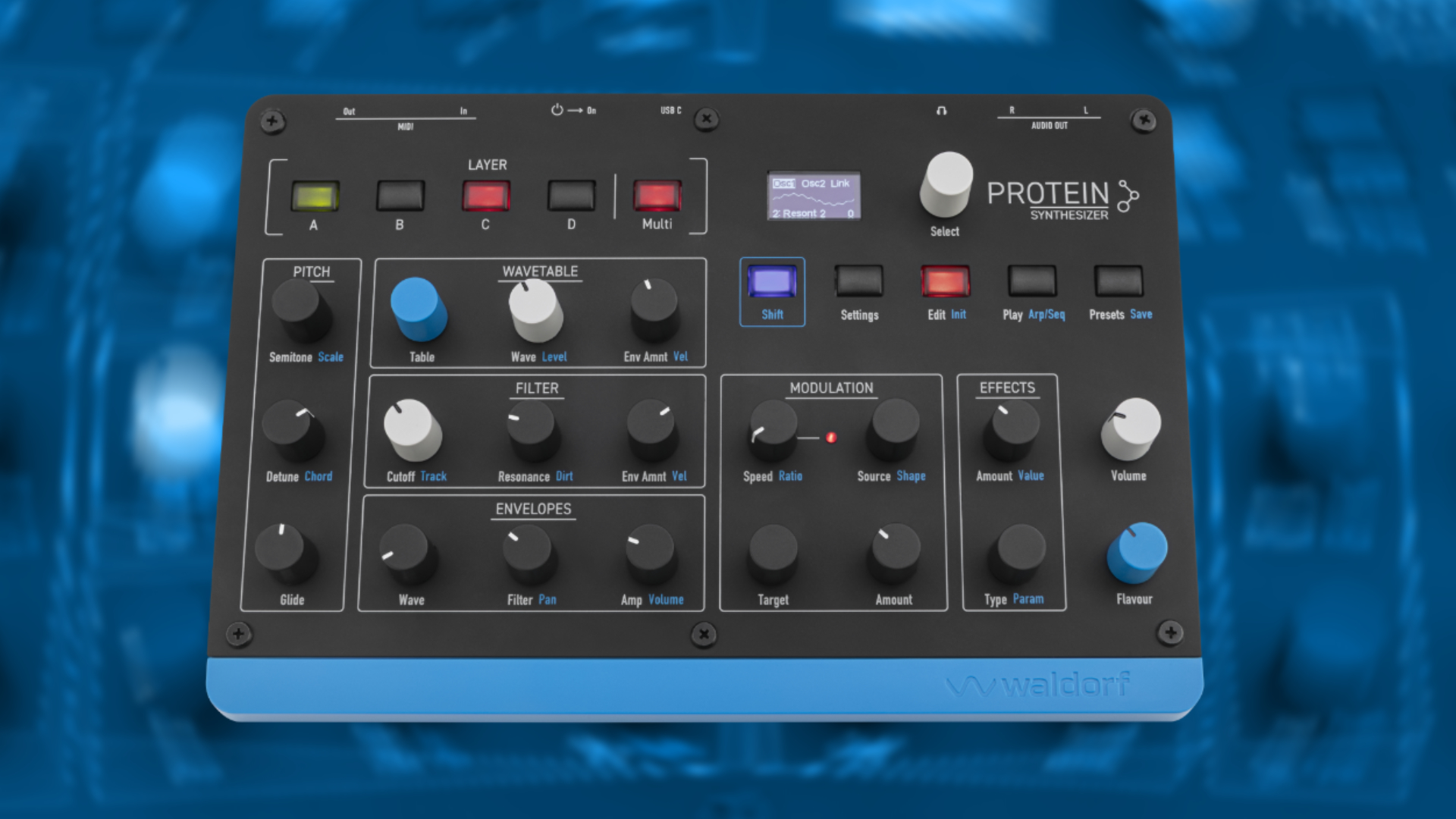
Waldorf Protein
Protein, not a 007 name, is a new compact hardware multi-layer wavetable Synthesizer. With its dimensions of 252 × 170 × 48 mm and a weight of 0.9 kg, the new Waldorf Protein is a very portable instrument that can easily be packed into a bag.
At its core is a 4-part multi-layer 8-voice engine with two wavetable oscillators per layer. The oscillator engine is based on an authentic recreation of the iconic Waldorf microwave oscillators from 1989, which are also available in the Microwave-1 plugin.
For this, they emulated the microwave ASIC chip to achieve the original gritty, beautifully 8-bit-quantized, aliased sound, running at a 250 kHz sample rate. You can hear these iconic characteristic artifacts especially when you play it in lower and higher octaves.
You can choose from various factory wavetables, fine-tune them, and apply a wave envelope. Loading your own wavetables is not currently possible, but this feature may be added in the future, said Rolf Wöhrmann, developer and CEO, in a pre-release chat.
Unlike the original hardware and plugin, it’s possible to load a different wavetable for each oscillator.
Microwave (-1) Features
Important: The Protein is not a microwave-1 plugin in hardware. Apart from the oscillators, the engine was entirely newly designed by Rolf Wöhrmann, CEO of Waldorf Music and designer of the Quantum/Iridium synths.
You can see this by examining the filter. It’s a new multimode filter with various types (LP/HP…), modeled after the CEM analog filters rather than the original microwave 1 analog filter. That’s a difference from the microwave-1 plugin.
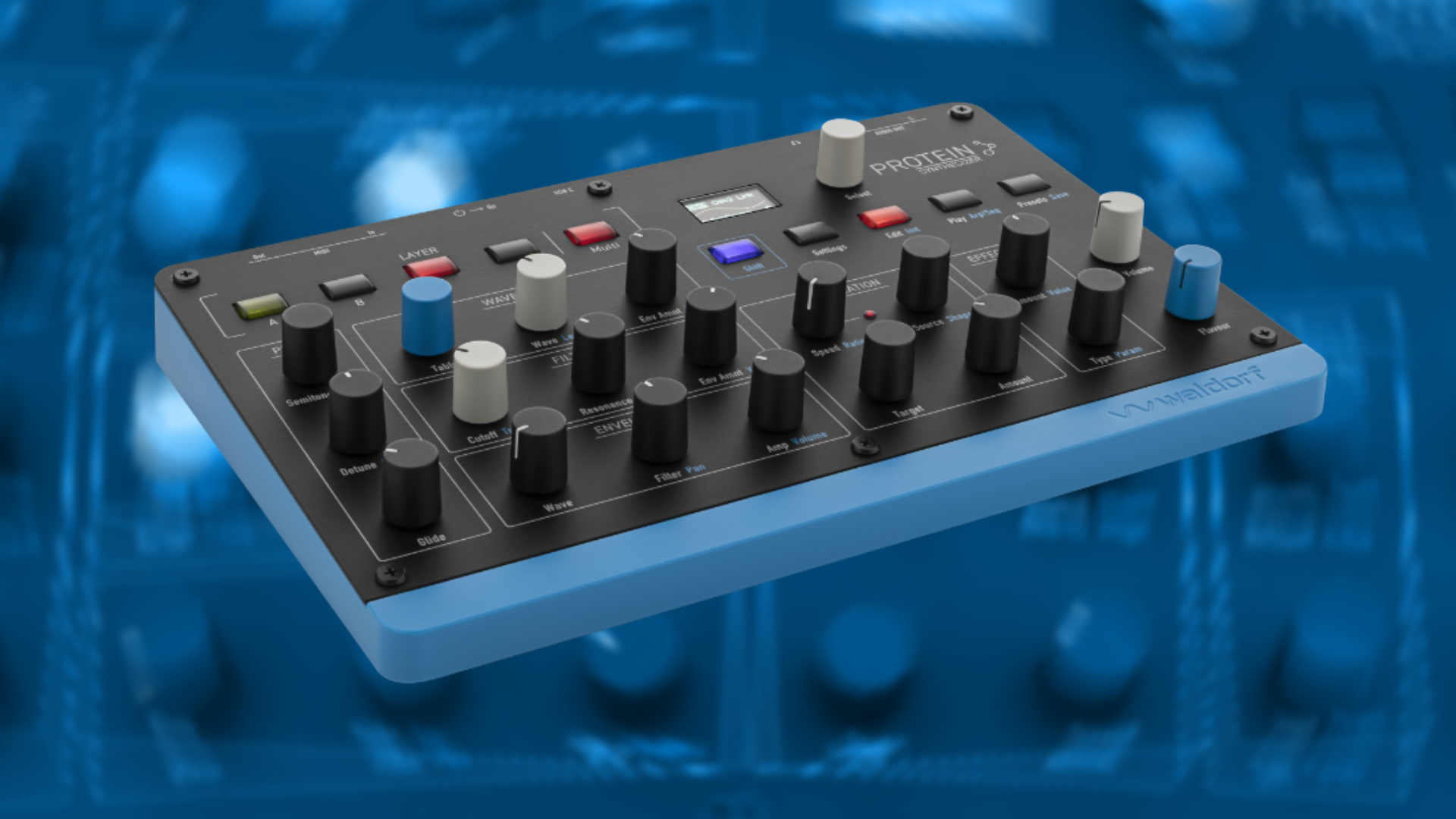
You can tweak it with three main hardware controls: cutoff, resonance, and envelope amount. Additionally, you can activate filter tracking, velocity, and a unique dirt parameter.
It infuses various dirty timbres into the filter character, including noise, crackle, click, geiger, and bursts. This gives it a distinct retro sound. Neat, you can also de-calibrate the filter settings to get behaviors from detuned hardware.
On the modulation side, you have three ADSR envelopes and two multi-wave LFOs with tempo sync and sample-and-hold options.
These also don’t come from the Microwave 1 plugin. However, they do have some small ingredients from the original Waldorf hardware, said Rolf Wöhrmann in a pre-release chat.
Modulation is managed by an 8-slot modulation matrix that also supports modwheel, velocity, polyphonic aftertouch, and MPE.
Additionally, it features a mysterious “Flavour” knob that adds an extra layer of organic behaviour to the sound. They range from micro-fluctuations up to sweet disturbances to make the digital sound organic.
Further sound refinements are possible with two Iridium-based multi-FX slots, including reverb, delay, chorus, phaser, flanger, drive, EQ, compressor, and tremolo. Four parameters (two main + two via shift) give you control over them.
Multi-Layer Wavetable Synthesizer
Waldorf Protein has eight voices that can be distributed across four layers. The layer functionality offers unique round-robin modes and, of course, a simple split functionality by MIDI channel for polytimbral operation.
The layers can be selected individually directly on the hardware using separate buttons, giving you instant access to each one.
Even though 8 voices aren’t many, the layer function lets you create complex layered sounds. Plus, you have mono, poly, and legato modes. Also onboard is an advanced multimode arpeggiator and a step sequencer with up to 32 steps.
Alongside these, you have chord and scale modes, as well as full MPE compatibility.
Thanks to MIDI CC across all parameters, parameters can be easily recorded in the DAW, or an editor can even be built. An official editor is not currently planned, but it may be in the future, according to Rolf.
Waldorf Protein ships with 150 factory presets from professional sound designers. Plus, you can store up to 250 user presets in the internal memory. You can also import and export patches via MIDI Sysex.
Connectivity
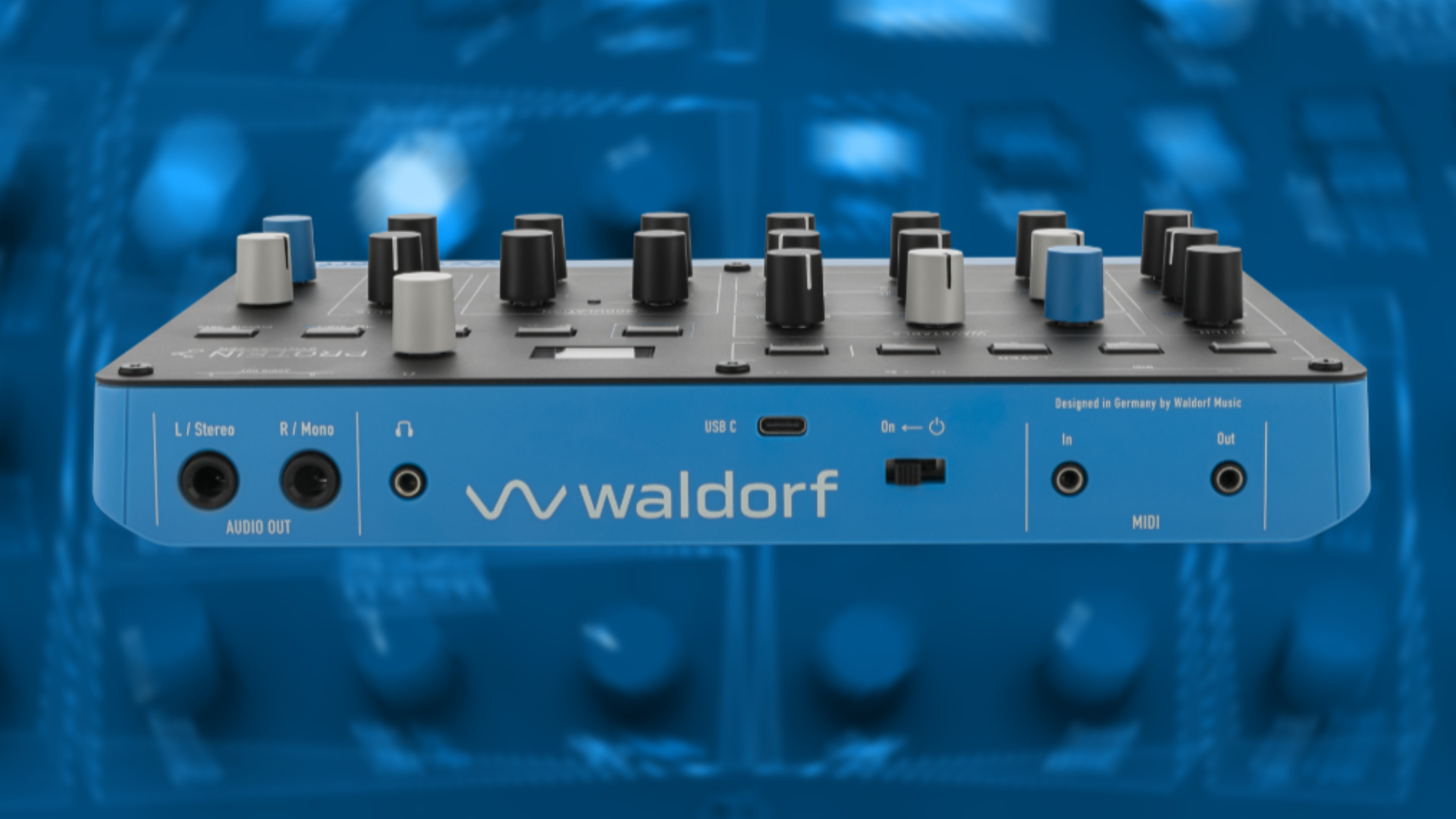
On the back side, you have stereo audio out on 6.35 mm jacks with optional mono and TRS stereo connections, a headphone mini TRS socket, a USB-C port, a power on/off button, and MIDI in/out on mini TRS Type A sockets. Adapters are included.
It can be powered via a standard USB-C power adapter or a power bank. This makes it portable and usable outside the studio as well.
Waldorf Protein First Impression
That’s a real surprise from Waldorf. I think the idea of taking the best parts of the Microwave 1 and packing them into an affordable wavetable synth is brilliant. Although it has a small shape, it features quite a lot of hands-on control and thanks no Blofeld matrix.
I was able to listen to the Protein briefly beforehand, and I like what comes out. It’s charming, retro, and full of character. I hope to be able to give you a review soon. But I’m sure this synth will be a great seller. The price and features are a perfect match, especially now with the intro price.
Waldorf Protein is available now for an introductory price/Black Friday price of 329€ (incl. tax) until December 31, 2025. It will rise thereafter to 379€ (incl. VAT). In the US, it’s $499. It’s made in Italy.
More information here: Waldorf
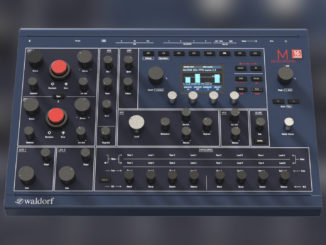
I know this is a budget synth but even my vape has a better display. Also, if you usb for power and midi, would it introduce noise like the Roland boutique line?
I asked Rolf (developer) the same question and he said they made it so that the noise is minimal. They includes a USB isolator in the box for all cases. I will check out this when I review it.
how Big ist your vape? can it run Doom? 😎
wow! No brainer i guess!
waiting for the Tests!
It’s an annoyance and hopefully won’t be an issue for this with an internal isolator, but for most usb powered hardware this issue is fixed pretty easily with a usb power/data splitter. I haven’t used a usb c splitter, but the usb b splitters work great. You just need a wall wart for power.
it includes an external USB isolator for any cases. I will check if it’s an issue in the review
You know what I miss about the old rack system? Standardisation of size. Can’t the synth manufacturers get together and agree on a bloody format so it’s easy to combine all these different mini synths?
Trying to fit Volcas, Aria Compacts, Boutiques, Circuits etc without taking up a football field is like trying to play Tetris if all the block shapes were drawn by a three year old.
I mostly ignored this announcement because my initial knee jerk reaction was “I’m not looking for a $800 digital synth right now” but recently saw the Protein while browsing Sweetwater and was shocked at the $400 price tag.
It’s now on my wishlist. It’ll climb that wishlist if Waldorf add custom user created wavetables. Maybe through WaveEdit?
I’ve only just received my protein but i’m impressed. I think the build quality is very good. Bit odd that the usb isolator is usb a-a when the cable they provide is c-c, but for the price i shouldn’t complain.
I’m not getting any ground/usb circuit noise from the outputs.
I like the sound of the device
I was expecting my Protein to be made into in Italy because of your article, but it is not.
it’s made in Italy/Tunisia by FATAR. They have factories in both countries
nice.
Need to Update!
Like Like it.
the Dub Techno Presets especially.