
Musician and YouTuber Andrew Huang has commissioned designer Love Hultén for the “Refraction Engine” multi-FX box.
Anyone can get their hands on a synthesizer, drum machine, or effects pedal from a store shelf. Not so with gear from Love Hulten. The Swedish designer creates one-of-a-kind instruments and effects from regularly available music tech products.
He repackages several devices so they become completely new tools. For example, the one-off Deckard’s Dream. Andrew Huang has now also taken advantage of Love Hulten’s fascinating service.

Andrew Huang Love Hulten
Andrew Huang tasked Love Hulten with building a new multi-effects box using well-known, popular effect pedals. The result speaks for itself. It’s a large, white, rather clean box with many knobs and buttons. Yellow buttons add some contrast.
Andrew Huang hasn’t given the multi-effects box a name yet, but calls it the “Refraction Engine”. It consists of five popular effects pedals: the Empress Echosystem, Hologram Microcosm, Red Panda Tensor, Red Panda Raster, and the Empress Reverb.
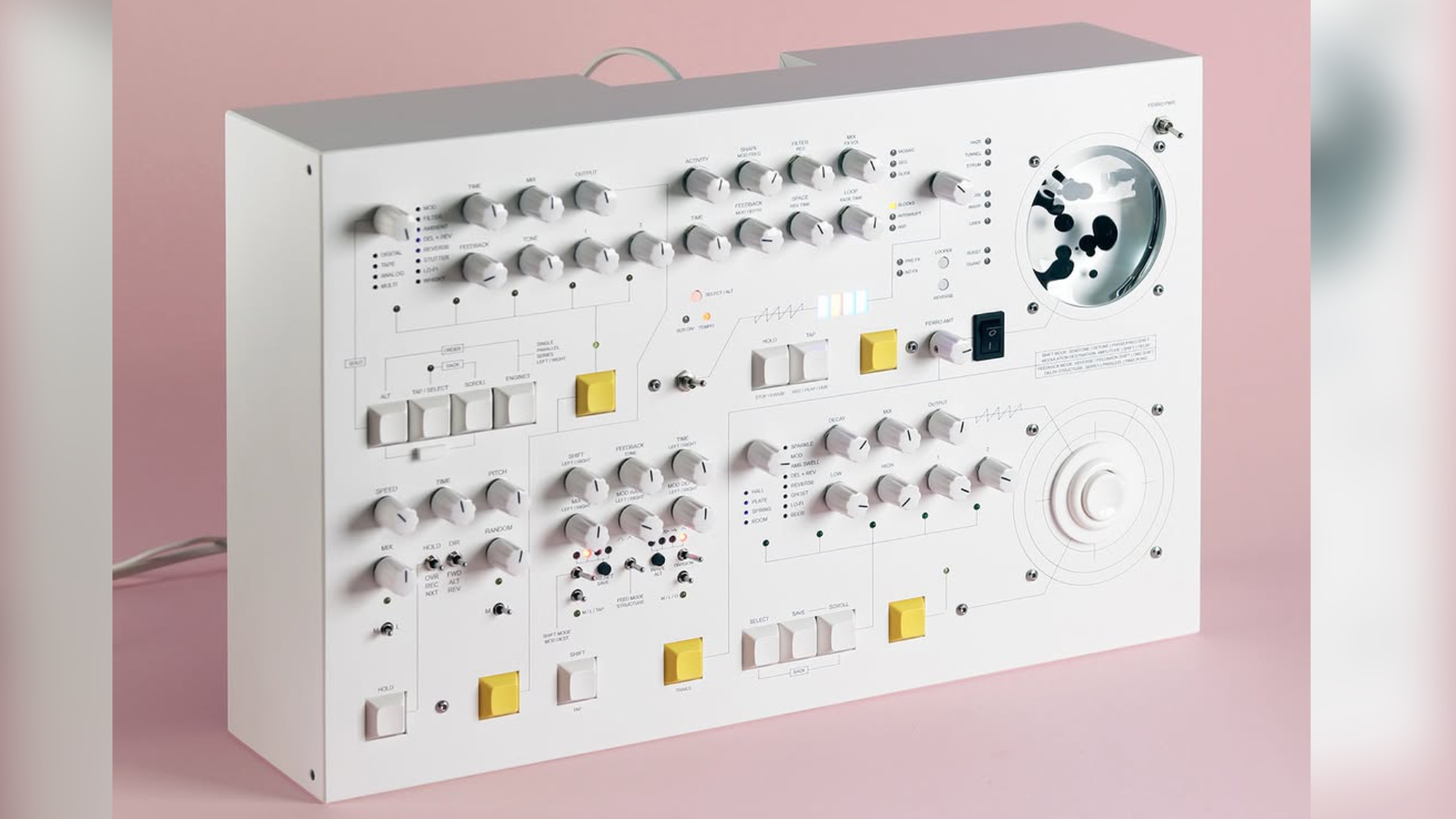
Interestingly, his Ghost effect, which he created with Endorphin.es, is not included in this box set. If you look closely, you can still see the individual pedals in the hardware. The new design includes several changes requested by Andrew Huang.
One prominent change is that the effect pedals no longer have footswitches but now feature clicky buttons. For example, each pedal has a yellow button that bypasses the effect. The big arcade-style button is a kill switch for certain functionality of the multi-FX box.
Andrew Huang’s “Refraction Engine” by Love Hultén is a commissioned product and is only available once. It cannot be bought. Nevertheless, it’s always incredibly exciting to see what the Swedish designer can create from off-the-shelf products.
More information here: Love Hulten
The pedals are available from my partner
Thomann


I hope the pedal companies are watching along and come to the understanding that desktop models also sell really well.
pedals work just fine on the desktop. artists have been using pedals with synths for decades
unfortunately, not all work perfectly with synth levels because many pedals clip pretty quick as they support guitar level and not line level properly. Some pedals have a switch where you change it
There’s a volume knob on a synth for a reason. No need to push audio at max volume into a guitar pedal.
A pedal has a built-in engine that reacts to incoming sound. If this engine is primarily designed for guitar levels, it often results in very different outcomes for synths or other signals. Less dynamic, and not as pleasing, as I’ve observed in some pedals. You can work with a volume knob but it doesn’t change much what the outcome is.
As SA explained it’s not about turning a volume knob.
Pedals are designed for on the ground and slight tweaking as well while desktop units can be a total different design.
Maybe they dont :). And i think guitar market is just so much bigger.also more companies though