
Bananana Effects Quimera is a new, powerful, multi-oscillator polyphonic Synthesizer in a pedal for guitar players and MIDI keyboards.
Synthesizer pedals that can be played with a guitar have undergone a transformation in recent years. The engines are more powerful than ever, do not require extra pickups, and trigger sounds over a narrower millisecond range.
A beautiful new example of modern, mighty synth pedals is the Quimera from the Japanese company Bananana Effects (not at NAMM).

Bananana Effects Quimera
Quimera is a new Synthesizer pedal that can be played with a guitar or a MIDI keyboard. An ARM Cortex M7 32-bit MCU provides plenty of power, allowing you to also create advanced sounds.
Let’s start with information for guitars. The Bananana Effects Quimera supports polyphonic tracking with near-zero latency (around 5ms). Ten years ago, that would have been very difficult to achieve.
More importantly, you don’t need any extra pickups; the pedal simply tracks the sounds from your playing. You can use different tracking modes: fundamental with filtering harmonics, transpose, and quantize. There is also glide (portamento) and sensitivity support.
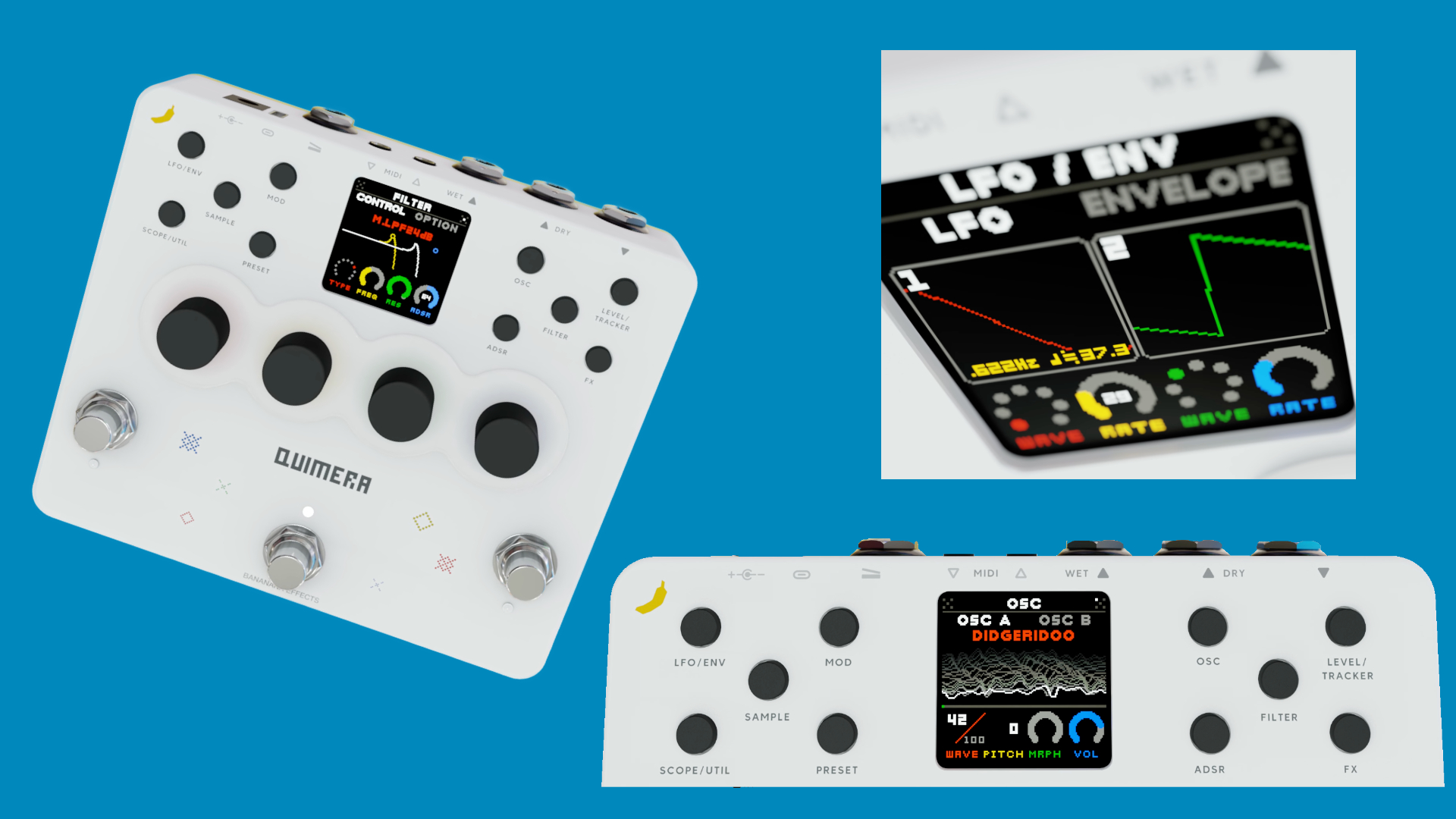
On the synthesis side, the Quimera is a full-featured digital Synthesizer at home in the subtractive world. The core consists of two independent oscillators with morphing and hard sync. Both can be controlled manually and with the built-in modulation engine.
The user can choose between three different synthesis options: classic virtual analog with 20 waveforms, wavetable synthesis (30 tables + user import) with morphing, and sample playback. The latter is surprisingly versatile.
Right out of the box, it has 30 samples. Alternatively, you can import your own samples via the USB-C port. It has classic controls like pitch and volume. Exciting is the multi-directional playback engine.
You can choose from different modes, including forward, backward, loop, and more unique ones like random, forward reverse loop…
Granular playback isn’t included, unfortunately, but I reckon you can do a lot with the 10 modes. I haven’t seen many guitar synths that let you trigger samples.
According to the developer, you can also record up to 2 minutes and 40 seconds into the synth and use these recordings as sample content.
Filtering, Modulation & Effects
Like a traditional Synthesizer, it also comes with a multimode filter that features lowpass, highpass, bandpass, and formant modes. You can tweak it with classic cutoff and resonance controls.
Modulation is also onboard. You can work with two independent multi-wave LFOs, three ADSR envelopes (amp, filter, mod), and an envelope follower.
The latter is particularly important for guitarists, as it allows you to create dynamic envelope modulations with the guitar’s input signal. You can modulate every parameter of the engine, like the oscillator morphing or sync.
Bananana Effects Quimera is not just a Synthesizer but also a multi-FX processor. Sounds can be programmed with up to 4 effects simultaneously, one in each slot.
There are drives (soft clip, hard clip, bit crush), modulations (flanger, chorus, vibrato), delays (analog, digital, reverb), and reverbs (warm, large, small, bright, tiny). The pedal can store up to 128 presets across three banks, accessible via three footswitches.
Connectivity
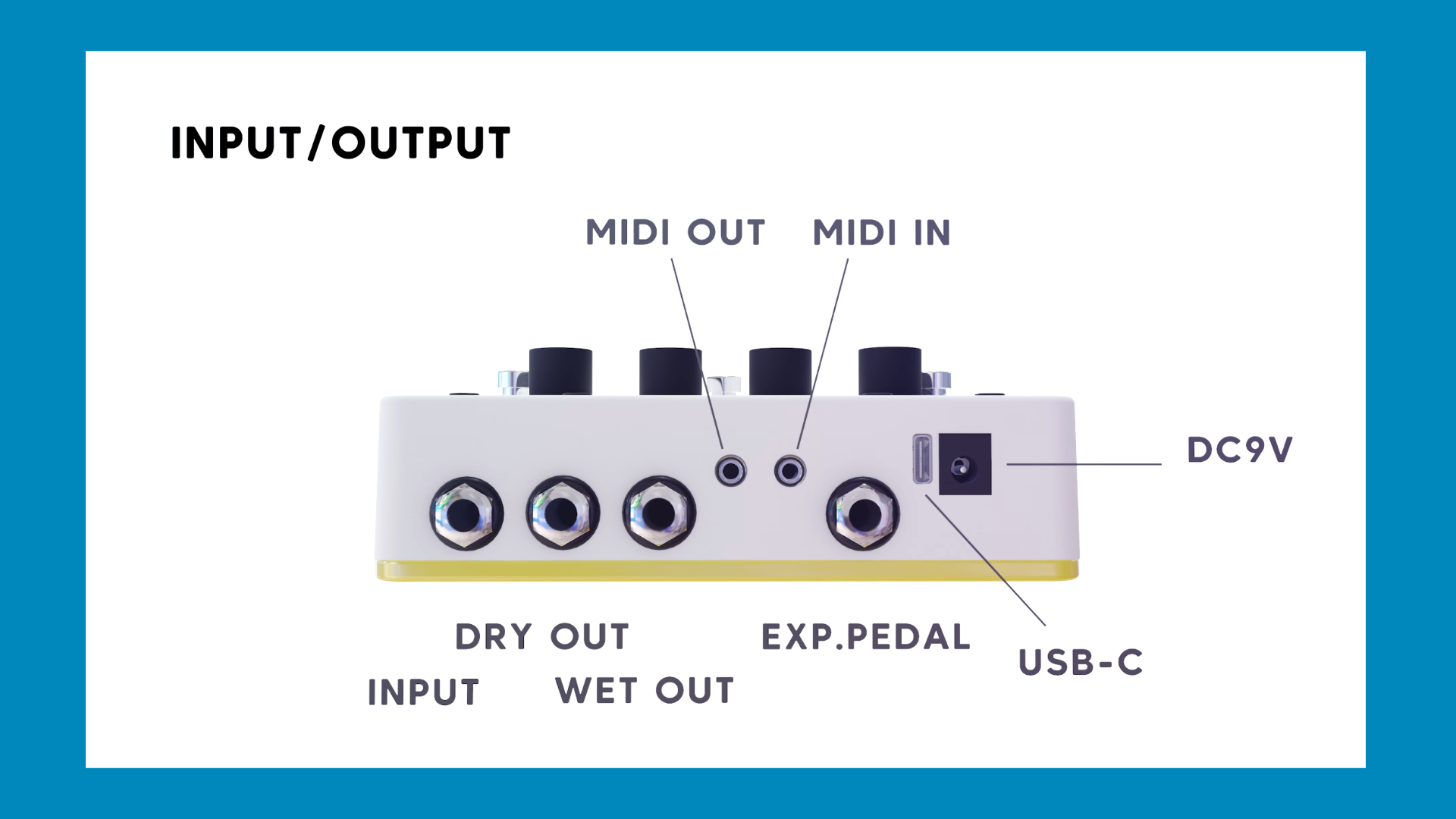
On the back side, you have a mono input for your guitar, a dry out, and a wet out. It has TRS mini MIDI in and out ports, allowing you to use the pedal as a synth with a MIDI keyboard. The engine also supports MIDI CC, so you can map parameters to a MIDI as well.
Next to this is an expression pedal input with which you can control up to four parameters at the same time. USB-C handles firmware updates, sample/wavetable import, and MIDI duties. Finally, you have a DC9V input
First Impression
From a non-guitarist’s perspective, this looks like a very powerful synth pedal that lets guitarists explore their synthy soul.
While it’s certainly not the most powerful synth when played via MIDI, it’s still a solid synth, especially with the option to use a waveform and a sample oscillator.
Bananana Effects Quimera will be available in March 2026. Price is TBA.
More information here: Bananana Effects

Looks nice. Pity it’s not Stereo…
I don’t get the lack of Stereo there
guitar market is more or less just mono
Maybe a future firmware update will convert the dry out to another wet out. However guitar synths are generally placed near the front of a pedal chain so they receive a nice dry signal. A stereo delay or reverb after it will work to spread the sound.