
Michigan Synth Works MSW-820 is a new Roland-style desktop analog Synthesizer based on the MSW-830 with a 16-mode filter.
In 2024, US-based company Michigan Synth Works announced the MSW-830, an extended version of the Roland CMU-810 analog mono synth. According to MSW, the development of this project is now on hold.
Instead, they’ve another project in development that now gets its full attention. Michigan Synth Works has announced the MSW-820, a new, more compact desktop analog synth based on the MSW-830.
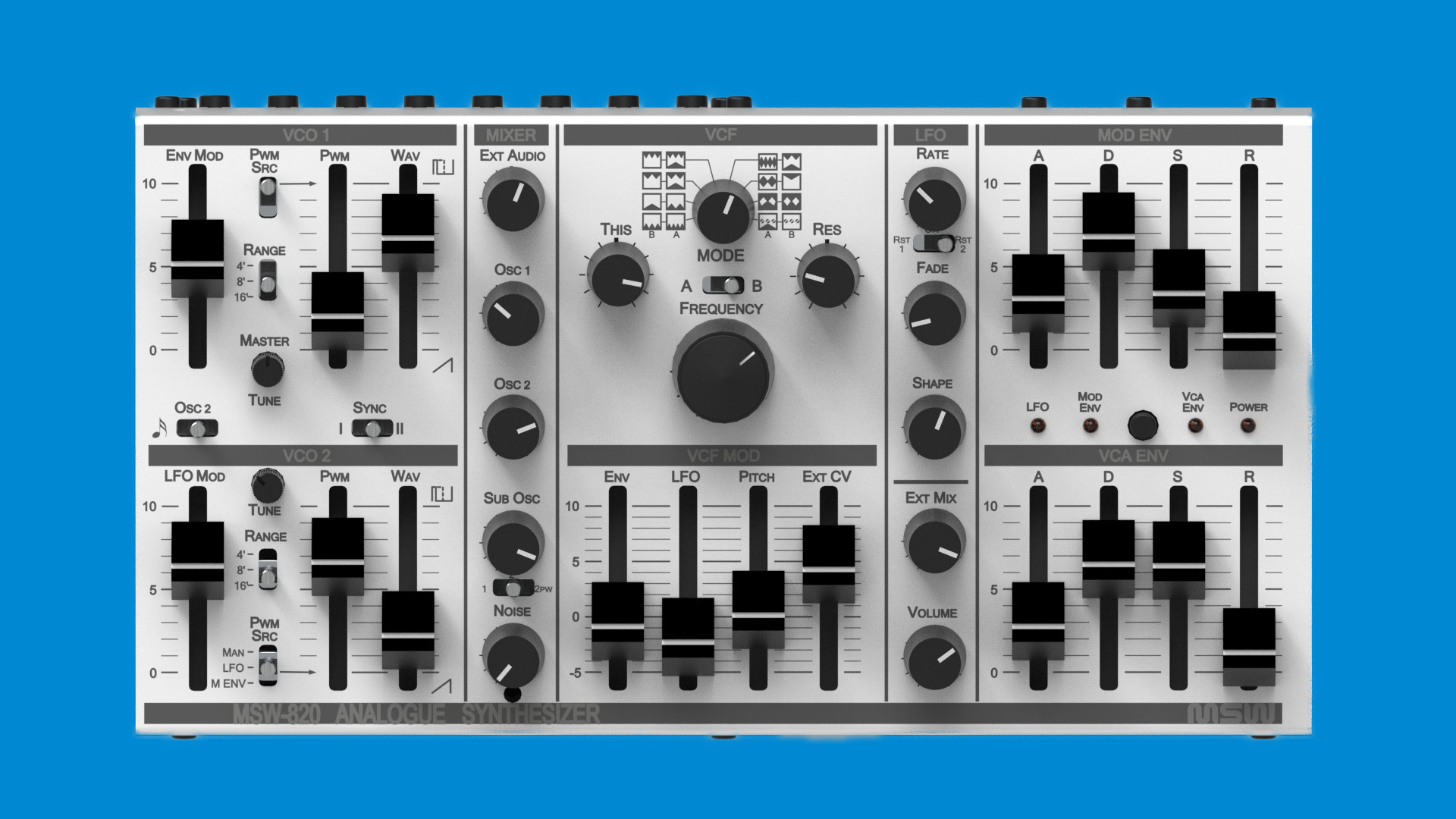
Michigan Synth Works MSW-820
The MSW-820 is a new desktop monophonic Synthesizer based on the analog section of the MSW-830, which in turn is based on the Roland CMU-10. The design is very classic and subtractive, but with some neat extras.
The interface has a combination of faders and knob. I like that it has many faders, giving it a fresh look compared to the other knob-only synths.
At the core of the Michigan Synth Works are two VCOs, each with selectable saw and pulse waveforms. Since a fader controls the waveform selection, this may be a continuous shape that morphs/mixes between sawtooth and pulse modes. However, this isn’t confirmed, which would be nice.
Each oscillator has a switchable range between 4′-16′, a tune control, two-mode sync, and PWM with an adjustable amount on a fader. On oscillator 2, you can also choose the modulation source for the PWM: MAN, LFO, and mod envelope.
Additionally, you can route modulation instantly to the oscillator, either envelope mod (OSC1) or LFO (OSC2).
In the dedicated mixer section, you can mix both oscillators together, add a 1/-2 sub-oscillator, and work with noise. Plus, you can bring in external audio.
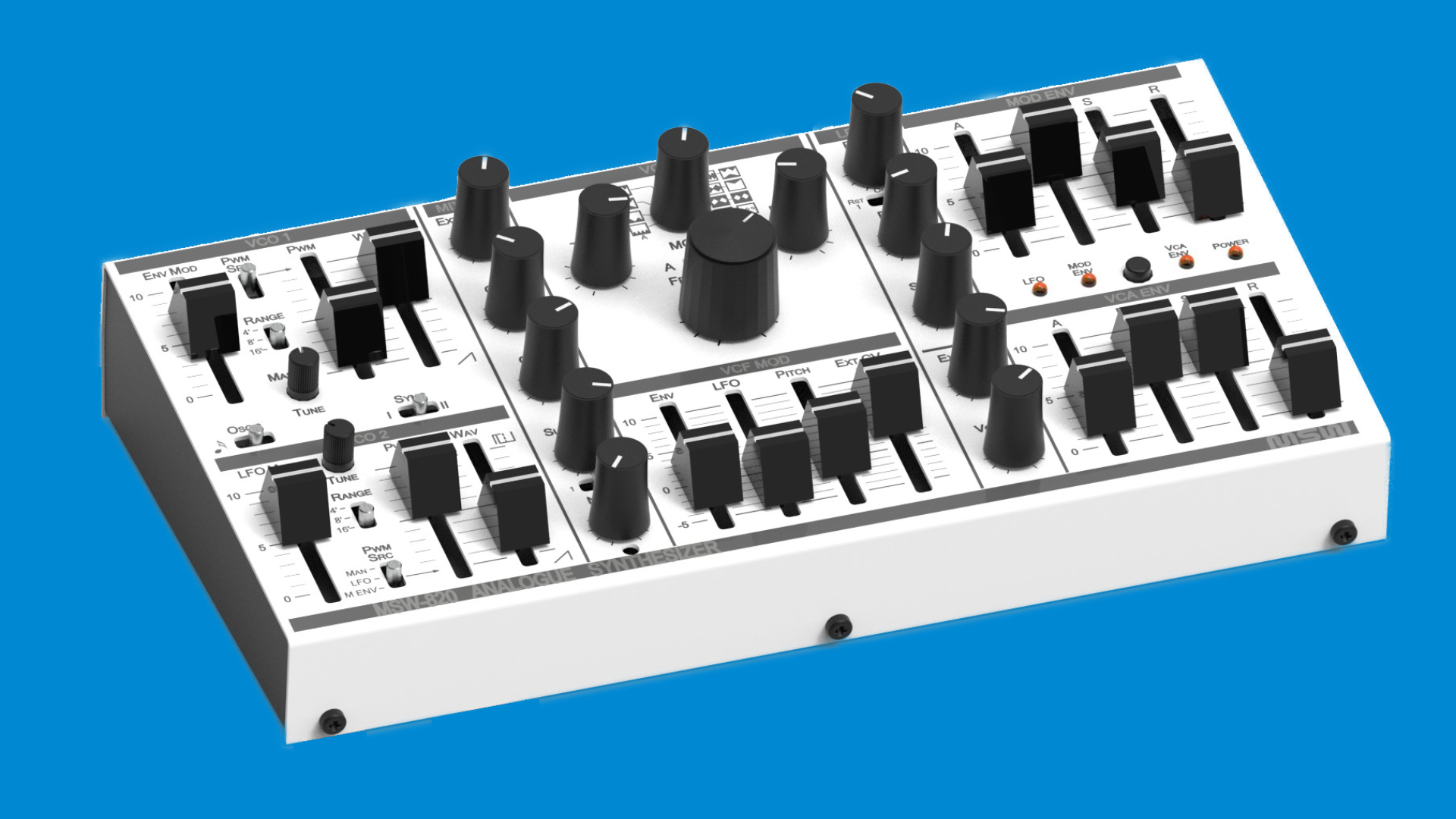
16 Mode Filter
From here, the five possible signals proceed to the filter section, the real highlight of the new MSW-830 mono Synthesizer.
It consists of a 16-mode analog filter based on the Caveman Totem Filter module, based on the 3109 OTA chip used in classic Roland synths (SH-101, MC-202, Jupiter-8…).
These are available modes split into two categories:
- (A) 24dB LPF, 12dB LPF, 12dB HPF + 6dB LPF A, 18dB HPF + 6dB LPF, 24dB BPF, 12dB BPF, 12dB Notch + 6dB LPF, and 18dB Allpass (phase) + 6dB LPF
- (B) 18dB LPF, 6dB LPF, 12dB HPF, 18dB HPF, 12dB HPF + 6dB LPF B, 6dB HPF, 12dB Notch, and 18dB Allpass (phase)
An impressive filter section that enables a wide range of sounds. Alongside classic cutoff and resonance controls, it also features a “This” parameter, which may allow you to blend through all filters, although this is not confirmed.
Modulation is classic. It has two ADSR envelopes (mod, and amp), adjustable with individual faders, and a single multi-wave two-mode LFO with shape and fade functionality.

Furthermore, it features a dedicated VCF mod section, providing hands-on fader control over how you want to modulate the filter: envelope, LFO, pitch, or external CV.
On the back side, you have a USB-C port, a line output, an external input, MIDI, and CV connectivity. The exact configuration of connections is not yet known. Plus, it’s possible to mount it into a Eurorack case.
First Impression
Today, it’s safe to say that the market for monophonic analog synthesizers is saturated. To stand out from the vast sea of mono synths, you have to do something different.
In my opinion, the MSW-820 is quite classic and doesn’t necessarily stand out technically from the crowd of mono synths. It’s not a game-changing mono synth. However, I think the synth looks very lovely, and the 16-mode filter, along with the predominantly fader design, makes it very intriguing.
Michigan Synth Works MSW-820 is available soon, and the price is TBA. Since the company is known for its very affordable concepts (see Xena 6 or Totem Filter), I think this one will also offer excellent value for money.
More information here: Michigan Synth Works

I am stoked for this. Michigan Synth Works makes a great product!