
With Absynth 6, Native Instruments resurrects its popular soundscape Synthesizer and makes it available to modern producers in an evolved form: review.
The leak that appeared online a few days ago is accurate. Native Instruments has resurrected Absynth. After discontinuing Absynth 5 in September 2022, much to the community’s dismay, the journey through its rich, evolving soundscapes continues in Absynth 6.
The best news is that NI has teamed up again with the original developer, Brian Clevinger, who also recreates plugins under the Rhizomatic Software Synthesis brand.
“Our very first product – nearly 30 years ago – was a synth”, says Simon Cross, Chief Product and Technical Officer at Native Instruments.
“Returning to Absynth brings us back to the heart of what inspires us. It remains one of the most singular instruments in electronic music, and we always knew its revival could only come with the involvement of Brian Clevinger himself.”
Thanks to Native Instruments for giving me early access to the Absynth 6 beta for this review.
Native Instruments Absynth 6 vs Absynth 5? (in short)
Here is a summary of the new and improved features compared to Absynth 5
- full scalable HiDPI interface (UI redesign and rewrite)
- 2D preset Map with an AI patch analyzing engine
- code rebuilt from scratch
- new ladder filter generation
- improved granular oscillator/FX with high-density mode (HQ)
- improved sample editor with more audio files and a visualized loop editor
- dry/wet control for insert modules
- Absynth 5 preset backward compatibility
- MTS-ESP tuning
- 415 new instrument presets, 30 new MFX presets + 266 new samples

Native Instruments Absynth 6 review
One thing to note upfront: since many of the Absynth 6 features are familiar from version 5, I won’t delve into the engine’s intricacies. That would make the review unnecessarily long with information we’ve known for over 10 years.
This review will focus more on the new 6.0 features, but don’t worry, I will also provide a summary of the most essential features of it. Like all NI plugins, Native Access handles the registration and installation of Absynth 6.
New UI
Ok, let’s dive into the new Absynth 6, and you will notice a massive upgrade right when you launch it. The cryptic, alien-like low-pixel UI is a thing of the past. Bye, hard to read parameter values, bad feedback, etc.

The user interface for the new Absynth generation, now HiDPI, has been completely redesigned from the ground up by Hannah Lockwood.
Everything is streamlined and straightforward, yet it retains a bit of the original’s alien green charm. Green, yes, but a softer, more pleasing shade.
The window layout has slightly changed and now has seven tabs: browser, patch, effect, wave, envelope, LFO, and assign instead of eight. The Perform window was merged into the overall UI and other components.
Part of this redesign is also a remake of the synth engine interface, which massively accelerates the workflow and makes it more intuitive to use. Don’t worry: all the features are still in the same places, but they look more modern.
Some of the menus are still tiny, but are now much clearer and easier to work with. For example, the sample menu where you adjust and loop them. It’s night and day compared to the original.
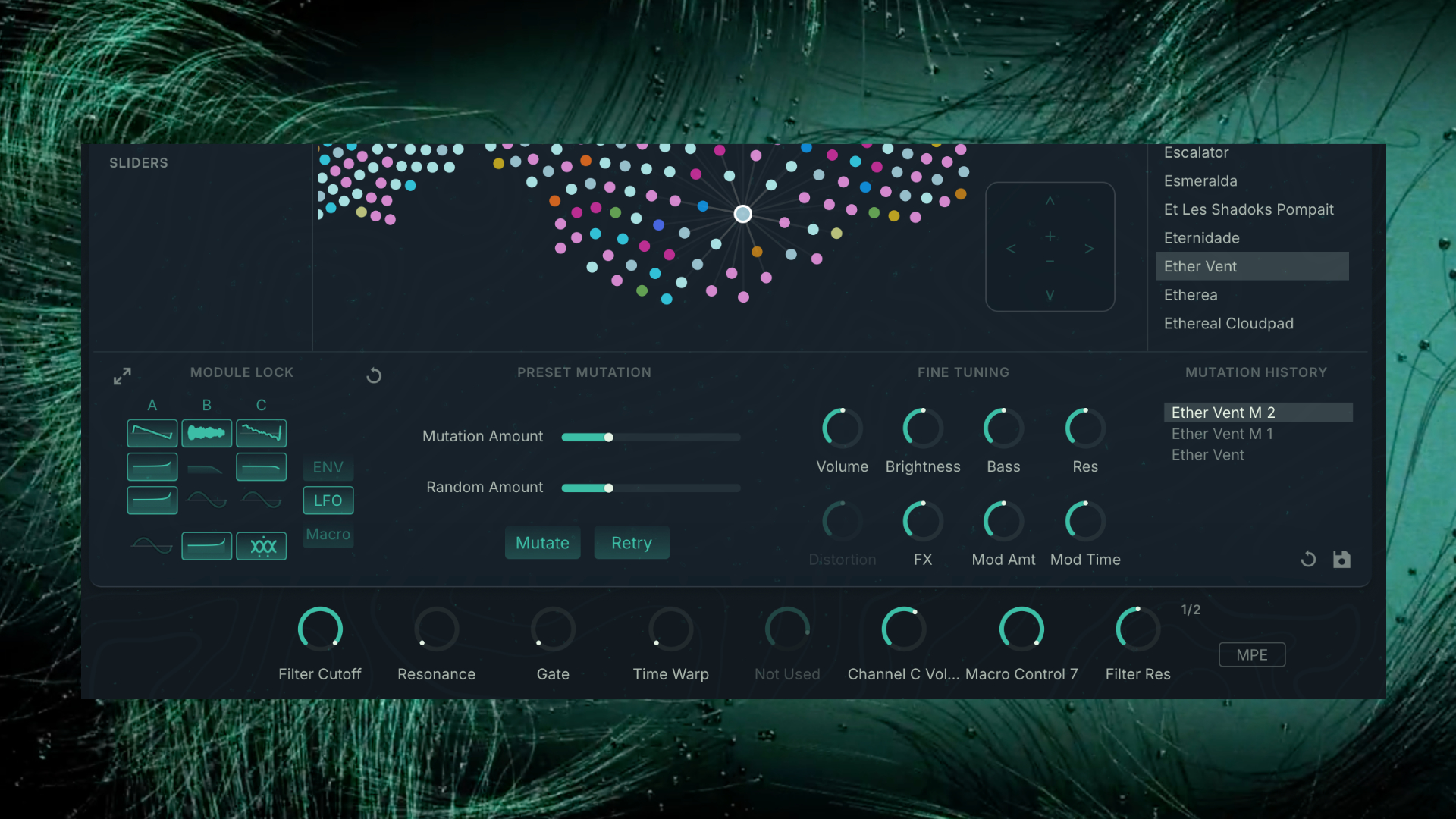
The heart of the new UI is an AI-powered interactive preset browser and explorer with an audition option. It uses a deep-learning model that analyses the timbral qualities of every preset, arranging the library into an intuitive color-coded visual map.

Guided Tour De Sound
AI handles the complexities while users can seamlessly browse through the sounds from Absynth 1 to 6. Each sound type has its own color in the map. For example, Bass and synth leads are blue, bowed strings are yellow…
With a click on a dot, you get a taste of the sound, and with a double click, the sound loads. Filters let you adjust the path of your sound surfing tour. Of course, you have the classic banks, types, and characteristics.
Alternatively, you can use slider-based preset characteristics (dark/bright, soft/aggressive…) to modify the browser engine’s results. Based on your selections, the engine generates a list of presets that match your chosen characteristics.
In testing, it was a lot of fun. It adds a playful and enjoyable element to the classic linear preset browser. It gives you an intelligent navigator at your side, guiding you through the sonic forest and showing the sound you’re looking for.
This, in turn, leads to faster work and a smoother overall workflow. The intelligent preset browser also supports third-party libraries.
Absynth 6 has undergone a true metamorphosis. The ugly duckling has transformed into a modern-looking Synthesizer. Of course, beauty is in the eye of the beholder, and there were certainly users who found the Absynth 5 UI absolutely beautiful.
I definitely wasn’t one of those users. I really enjoy the new UI because I can scale it to fit modern screens. Most importantly, it makes designing custom sounds much more enjoyable. Too bad, it’s not freely scalable and only possible in steps (75%, 85%…).
Mutating & Macros
Don’t worry, the beloved Mutator function from the original Absynth is also part of the new browser. It still offers the same features, including the module locking matrix, two main parameters, and a fine-tuning section.
There are no changes to this; however, the UI makes mutating sounds way more user-friendly. And saving individual mutations is still a killer feature after so many years.
Alongside this, each preset also features 16 macro controls that can be freely assigned from the “assign” page—no sliders but now circular knobs. The new design is much cleaner, but honestly, I do miss the old Absynth macro sliders interface. RIP.
Upgraded And Improved Absynth Engine
I can put your minds at ease if you’re worried that Absynth 6 is a different Synthesizer or even a differently sounding plugin. Brian Clevinger and Native Instruments have taken the original Absynth core and integrated it into the new Absynth 6 framework.
The codebase was rebuilt entirely from the ground up, but the engine core is on par with Absynth 5. This was done to ensure compatibility with all preset libraries from Absynth 4 onwards.
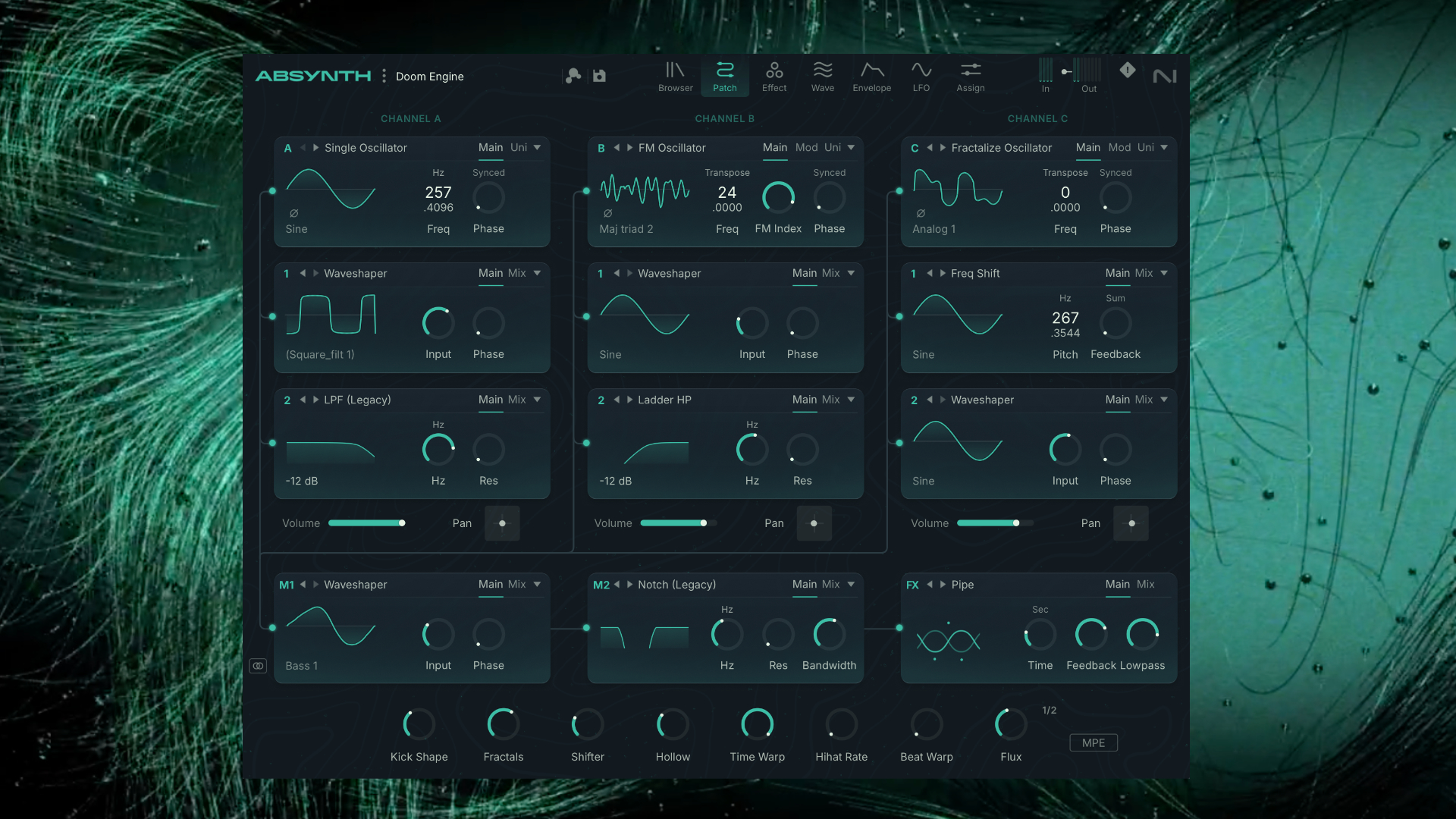
Absynth 6 houses all the semi-modular synthesis features of Absynth 5. Additionally, Brian Clevinger enhanced and expanded the engine in various areas to bring it up to more modern standards, including polyphonic aftertouch/MPE support.
A patch still consists of three channels, each with a multi-synthesis oscillator, and two FX blocks that can later be processed through three effect blocks in the mix.
Improved Oscillators
The oscillator still offers nine engines to choose from, including virtual analog, FM, ring mod, fractalize, granular, and samples. They are identical, but there are some detailed improvements.
A change can be explored in the granular engine. It still has the same features but offers a higher-density mode that now goes up to 32 (vs 8 in Absynth 5).
This significantly increases the number of grains that can be played simultaneously, resulting in higher-quality grain clouds. Since the original value setting (8) is still onboard, you can replicate the same granular behavior found in v5 patches in Absynth 6.
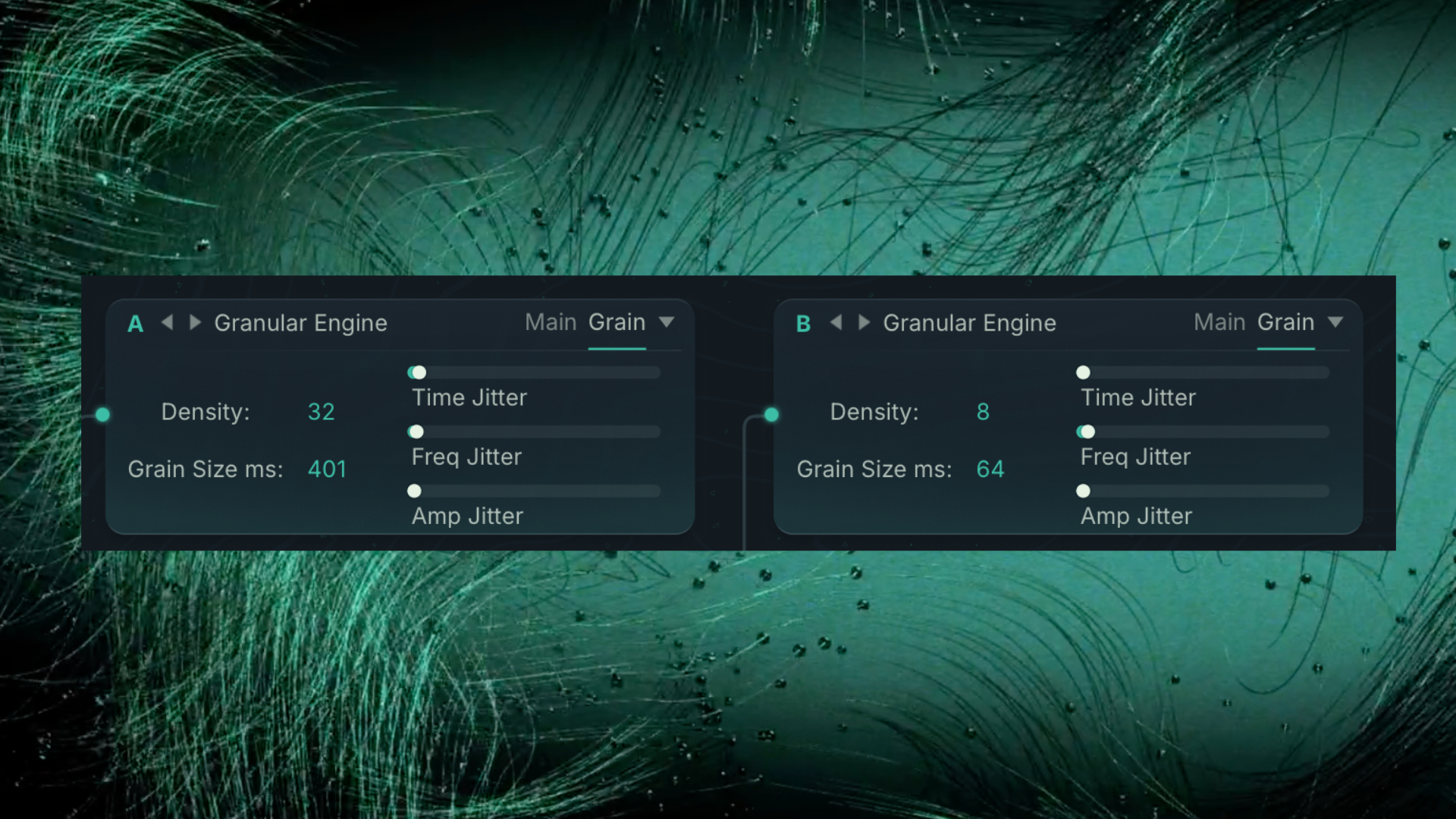
Cracking the density up from 8 to 32 for AB5 patches primarily results in a noticeable difference in quality. On my basic Apple MacBook Air M4, this doesn’t cause any significant CPU spikes. That would have been different 10+ years ago.
I find it a shame that there’s no visualization of the granular process even in 2025, but there is one for the sample playback editor.
First, it now supports more audio file formats. Alongside WAV and AIFF, you can now work with MP3, OGG, and FLAC files, making sample management more flexible.

Then, they revised the editor with visual feedback of the sample waveform, including the loop start and end points. This allows you to set more precise loop points and simplifies the workflow.
Better Shaping
From the oscillator section, we move to the two shaping slots, where you can find classic filters as well as special ones, such as the original Supercomp, Allpass Feedback, and the Cloud filter.
Absynth 6 ships with a new generation of ladder filters, including low-pass, high-pass, band-pass, and notch. The notch is inspired by the ARP 2500. These are higher quality and smoother than the previous ones. Don’t worry, the original ones are still available, but they’re now called Legacy.
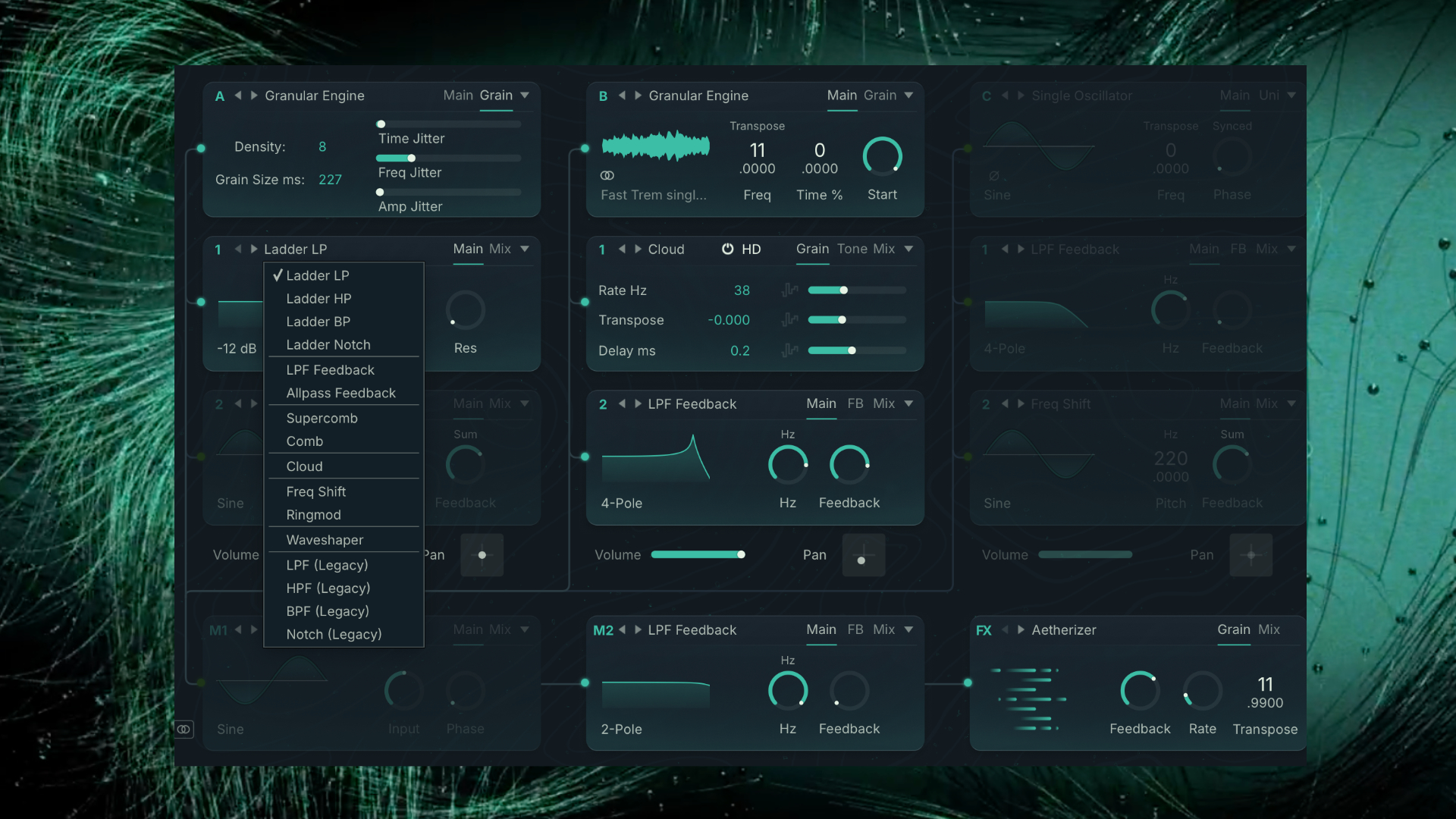
In addition to the new ladder filters, Brian Clevinger also updated the original Cloud filter with a switchable high-density mode.
The original granular delay-based filter now delivers richer, denser results without unwanted artifacts while offering the same features.
Updated FX
From there, the mix of the three channel flows into two further filter/shaper slots and finally into an effect. The first two contain the same algorithms as the previous ones.
These can be used to further spice up the signal or to filter/polish the sound before it goes into the master section. The last one contains six outstanding, unique effect processors that contribute significantly to the actual Absynth sound.

We can welcome back all the original algorithms: Aetherizer (deep granular delay), Multicomp (modulation FX powerhouse), Resonators, Pipe (physical qualities of resonating bodies), Multitap (multi-tap delay), and Echoes (classic echo effects).
No new algorithms have been added. Only the Aetherizer now features a high-density mode, enabling higher-quality, richer-grained effects. Additionally, there are now dry/wet controls for the insert modules, which is a handy new function.
Don’t forget: like Absynth 5, Absynth 6 is also an independent multi-FX processor plugin, allowing you to use these beautiful, sound-design-focused effects with other plugins and external signals.
With version 6, they are finally back. The effects also benefit greatly from the new UI, making them significantly easier, more fun, and inspiring to use. Neat, they are also built into the surround feature natively, which was previously only available via a detour.
Modulation Anno Absynth 5 Or Not?
In terms of modulation, everything remains the same. The star feature is still the multi-segment envelopes with up to 68 breakpoints, which allow for absurdly far-out parameter movements.
These are also the central elements that make Absynth the king of evolving and complex synths. Very few synths offer so many envelopes with such depth. This section also benefits from better graphics and easier programming.

Three LFOs remain the maximum number of low-frequency oscillators the plugin can handle. That’s a bit low for the 2025 standard. A doubling to 6 would be welcome.
The mapping of envelopes, LFOs, etc., remains unchanged. There is no modulation matrix or drag-and-drop functionality. Like the predecessor from 2009, it uses drop-down submenus in the dedicated modulation menus.
I was kidding you a little, saying there’s nothing new. There is a bigger upgrade. The initial aftertouch function has also been upgraded to handle polyphonic aftertouch and MPE data.

In the assign tab, you can now map polyphonic aftertouch as a modulation source to parameters. The macro control section also includes a dedicated MPE option that lets you map the MPE pressure or slide input to the 16 macro controls.
This opens the possibility of performing with multiple parameters using MPE and discussing performance and playability. It also supports embedded MTS-ESP tuning, giving you the freedom to play your Absynth patches in different scales.
With its highly experimental nature and often unusual sounds, the addition of alternative scales is a perfect fit.
New & Old Sounds
As mentioned before, Absynth 6 can import patches from Absynth 4 and 5. But there is no need to import them. Native Instruments includes all the original libraries from the past in the factory library, including those from Absynth 4.
In addition, a team of professional sound designers has created an entirely new library comprising 415 instrument presets and 30 MFX presets. Plus, there are 266 new samples to explore.
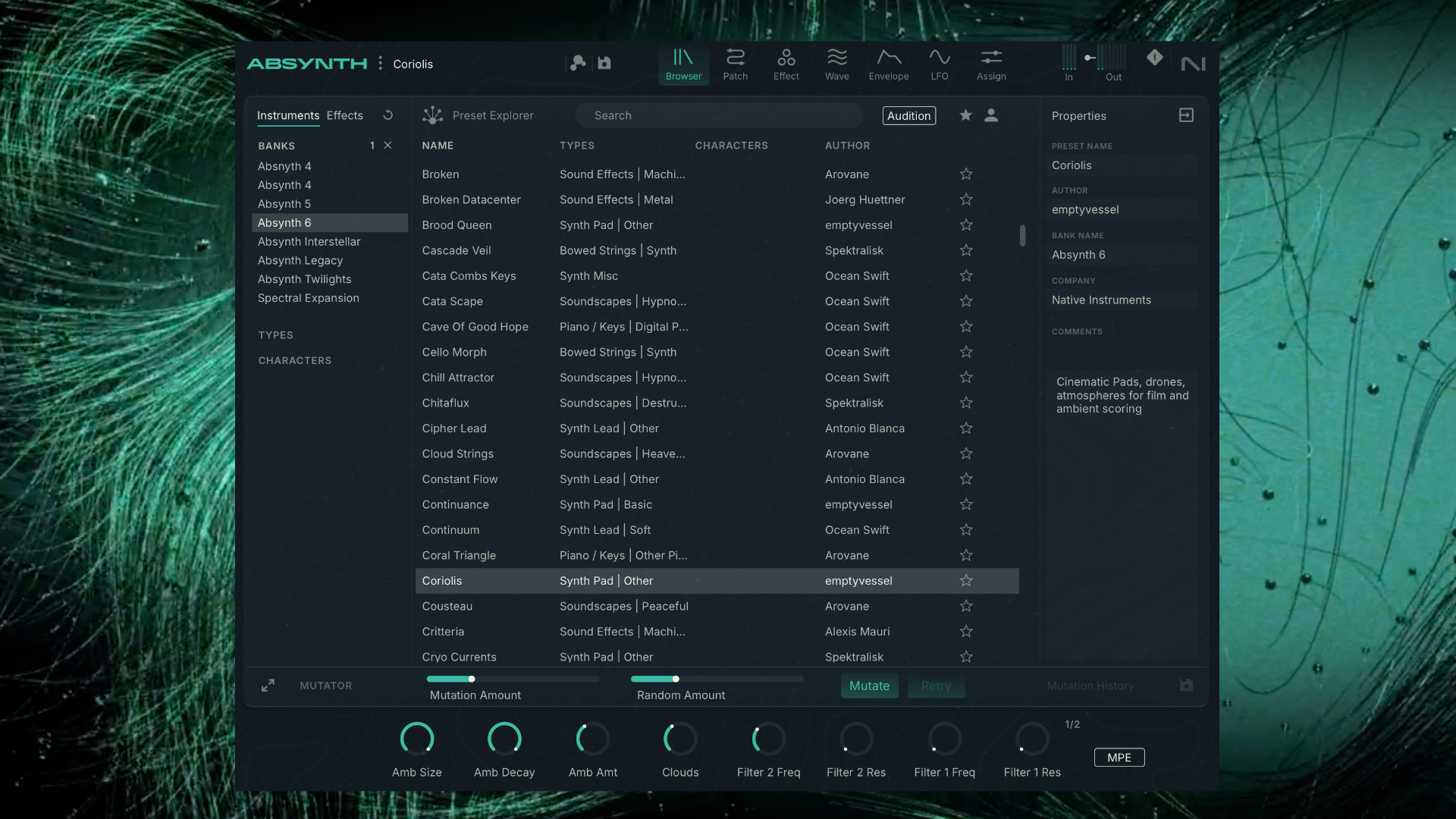
The patches all feature up to 16 macros. During testing, I noticed that the MIDI CCs for the macros are preset-based and not applied to the entire plugin (beta version).
When switching presets, the MIDI CC mappings are lost, which isn’t ideal, especially if you want to explore presets by tweaking parameters. I can’t say whether that’s been changed in the official version.
Alternatively, NKS support automatically provides the mapping. It’s a shame it’s not NKS 2.0 like Kontakt, where it’s directly integrated and doesn’t require Kontrol software.

The new sounds are fun and cover a wide range of sonic textures. From gritty basses and classic synth leads to epic, evolving soundscapes and complex rhythmic textures, precisely what you’d expect from Absynth.
The new factory content also reveals the age of former Absynth. The sounds now seem fresher, more modern, and closer to 2025.
From the sound design perspective, the new version is still on par with Absynth 5, as the engine is at that level, plus the improvements. Thanks to polyphonic aftertouch and MPE, however, it’s more expressive to play.
Native Instruments Absynth 6 Review Conclusion
The news that Native Instruments has revived Absynth deserves extra points. It’s terrific to have Absynth back in our sound and FX processor arsenal, now updated to run on modern systems. Thanks, Native Instruments and Brian Clevinger.
Given the scope of what Absynth 5 users receive in Absynth 6, I’m honestly a bit disappointed with the update so far. New features like PolyAT/MPE support, the AI browser, the new streamlined UI, and the engine tweaks are great and welcome.
It’s important to remember that Brian Clevinger did a complete code rebuild for Absynth 6. That costs a lot of time that must be paid.
However, many of the new additions are now standards in the synth plugin world; Some features were expected from the Absynth 5 update, including native Apple Silicon support and an improved user interface.
This smaller feeling of disappointment grows a bit when you compare it to the asking upgrade price. NI is charging 99€ to upgrade from Absynth 2-5 to Absynth 6. That’s a bit too much, and I’ll explain why, in my opinion.

Just look at Absynth’s competitors: Arturia Pigments, UVI Falcon, Xfer Serum 2, Spectrasonics Omnisphere 3, and others. All these companies, large and small, have consistently pushed their synth plugins forward with new features over the past years.
Some offer free updates for 10 years, while others charge an upgrade fee every few years. The difference is that these weren’t almost dead plugins, and the paid updates were much more comprehensive than those for Absynth 6.0.
After disappointing the community back in 2022/2023, I would have really appreciated a “compensation” update. I’d say 29€- 49€ max to get people back on board. For 99€, however, I expected much more.
But it’s also possible that I had too high expectations when I first heard about Absynth 6 at a press briefing. I’m pretty sure for many, 99€ isn’t an obstacle, and they’ll be on board anyway, as Absynth is a mind-blowing synth in version 6 as well.
Nevertheless, it’s positive to see that Absynth with Brian Clevinger is back. Native Instruments laid the foundation with Absynth 6.0 and an entirely new codebase, and I hope they’ll continue to expand the plugin throughout 2026, further increasing its versatility and flexibility.
Pro
- Absynth is back!
- modern UI (long overdue for Absynth 5)
- compatible with modern systems (long overdue for Absynth 5)
- AI preset browser
- polyphonic aftertouch/MPE
- updated engine (new filters, granular tweaks)
- Absynth 4/5 preset compatibility
Neutral
- MIDI CC mappings are preset-based and not global (maybe updated in the future)
- Some bugs here and there (probably fixed in the next updates)
Contra
- upgrade price
- new features vs asking upgrade price
- NKS support, but not natively built-in like in Kontakt 8
Native Instruments Absynth 6 is available now for $199/£179/199€. Existing Absynth 2-5 users can upgrade to the new Absynth 6 for $99/99€. It’s not part of Komplete 15, but it will probably be in a future Komplete release.
Absynth 6 runs as a standalone application and as a synth/FX VST3, AU, and AAX plugin on macOS (native Apple Silicon and Intel) and Windows.
More information here: Native Instruments


After disappointing the community back in 2022/2023, I would have really appreciated a “compensation” update. I’d say 29€- 49€ max to get people back on board. For 99€, however, I expected much more.
I salute the news to revive this, but for long term users, the upgrade price is too harsh as you say.
Also, no NKS2 shows how half arsed the Komplete Kontrol S MK3 integration is and how they have defunded the Komplete Kontrol Teams.
It’s a pity as there is so much potential
Continuation is nice, esp. for Abysnth 5 users. Preset compatibility also is nice. But feature wise it seems to me a little to small to make it interesting for new users, esp. for 200€… Then you could buy Wavesequencer Hyperion, Melda MSoundFactory (135€ currently!), Serum 2, Phase Plant (99€ currently!!). Also 99€ for the grannies and grandpas seems quite high…
Not only is this too expensive an upgrade, but it looks like so many other soft synths. I know that the Absynth 5’s appearance needed a refresh, but there is no classic Absynth DNA in the new one.
I’ll wait thanks.
Three wrongs don’t make a right. Withdrawing it. Waiting too long. Charging too much. Granular is better for sound scapes – IMHO.