
ASM Diosynth is a new expressive wind Synthesizer powered by Hydrasynth synthesis and a new sample-playback engine.
Synthesizers are versatile musical instruments. Not only due to their deep-sounding engines, but they are also versatile in how they can be played. Often, people think that synthesizers must be played with keyboards to be considered synthesizers. However, in today’s music world, synthesizers come in many different forms.
Ashun Sound Machines, the Chinese company behind the Hydrasynth, also demonstrates this with their new, surprising product. With Diosynth, ASM presents a new Wind Synthesizer powered by its best-known engine plus extras.
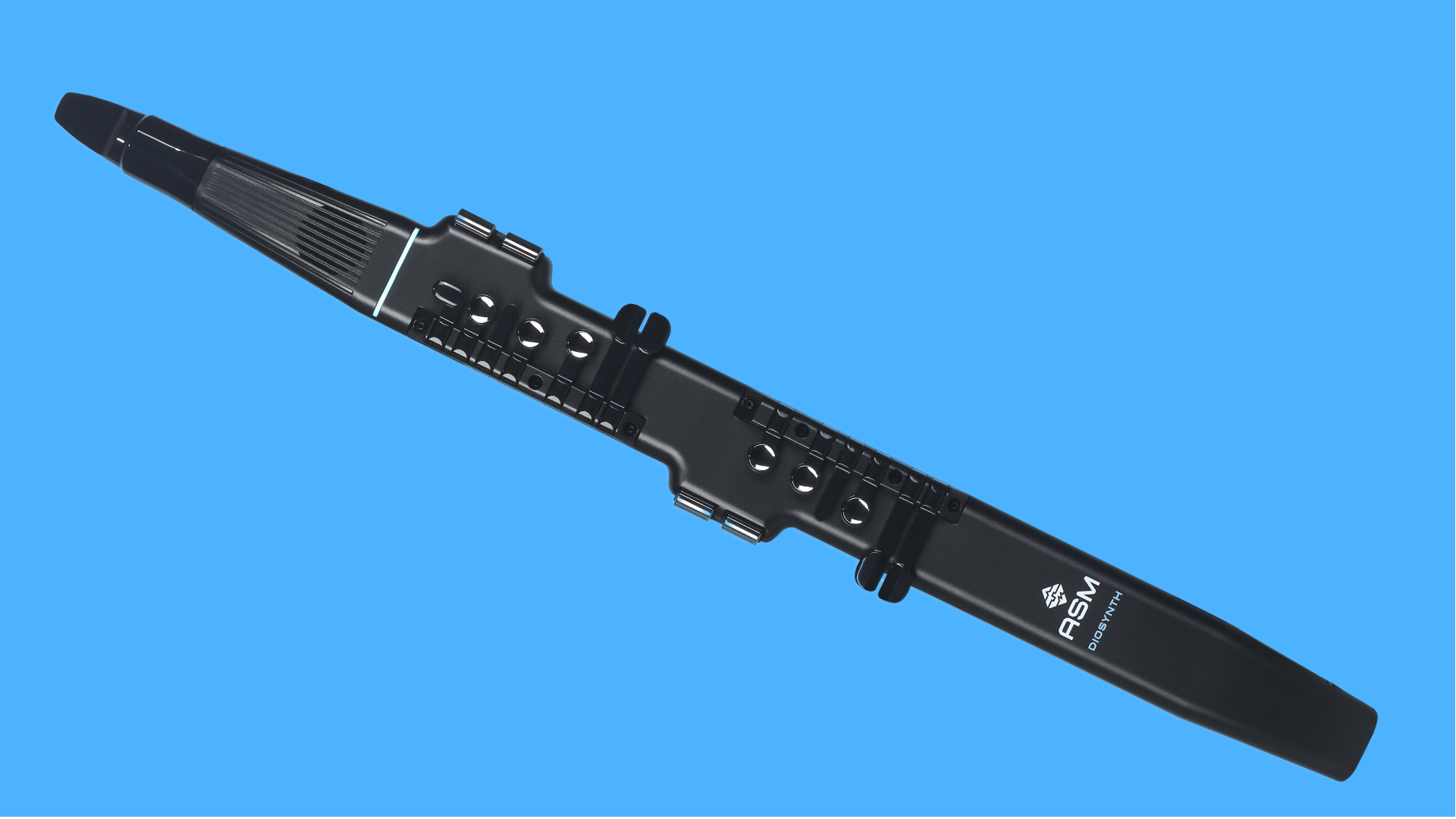
ASM Diosynth
Diosynth is a new, expressive wind Synthesizer from the makers of the Hydrasynth. For ASM, this marks their first foray into new territory after the various Hydrasynth derivatives. Instead of keys, the sounds are now blown.
At the core of the ASM Diosynth is both familiar and new technology. It uses ASM’s renowned Hydrasynth engine, with the addition of a sample-playback oscillator.
The synthesis section features two powerful Hydrasynth wavescan oscillators with controls for wavescan, tuning, pan, and more.
Alongside this, you have a new sample engine that features 128 timbres, including reed, brass, fipple, and string-based sounds. It includes rare instruments such as the contrabass flute, Ebu Tubax, and Peruvian llama whistle.
A highlight is the ability to blend realistic acoustic instruments with the unique wavecan oscillator and further process them.
From here, it goes into a 16-mode filter and into a multi-FX processor with an EQ and various effects, including ensemble, reverb, and more.
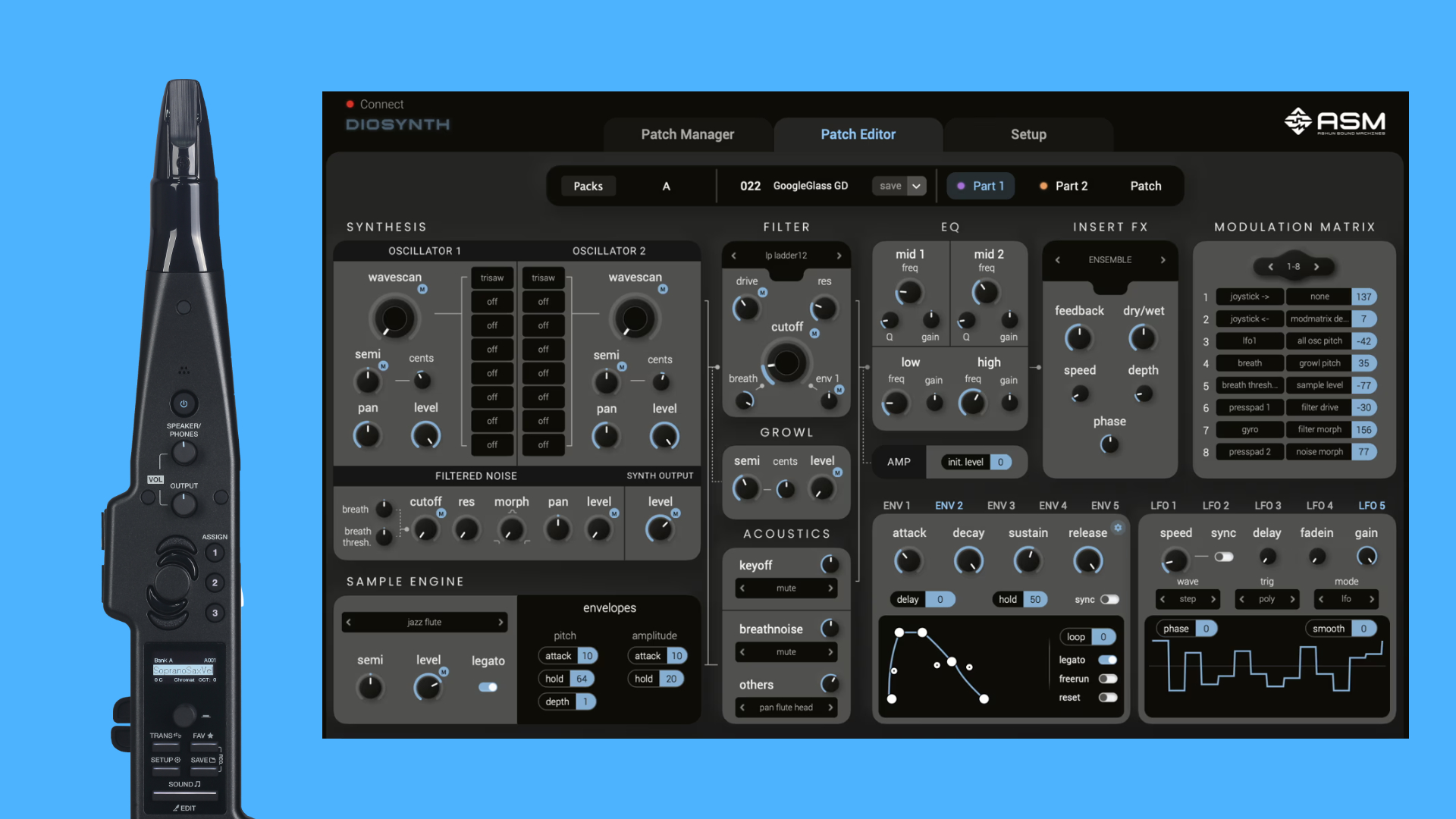
For adding motion, it also includes a powerful modulation engine with five flexible, feature-rich envelope generators and five multi-wave LFOs. All this is managed by a modulation matrix, which lets you map parameters to modulators, giving it even more expressivity.
The Diosynth can also layer or split two sounds at once, combining four Hydrasynth oscillators and two sample-based voices for highly expressive patches. The new dedicated software editor (macOS, Windows, iOS, and Android) makes it easy to program sounds.
It ships with 384 factory patches and 768 total patch locations, covering everything from traditional wind instruments such as saxophones, trumpets, and flutes to synth leads, basses, and tempo-synced electronic textures.

A Synthesis Powered Wind Instrument
ASM Diosynth features mechanical keys that replicate the feel of real sax and wind instruments—avoiding the flat button-style controls found on other wind synths.
Multiple fingering modes, scale/key locking, and octave keys covering over eight octaves provide a familiar and versatile playing experience.
For expression, Diosynth also hosts breath and bite sensors, an internal gyro, an X/Y joystick, two pressure pads, and three programmable switches.

On the connection side, it features a ¼” stereo output, ⅛” headphone jack, both with dedicated volume controls, MIDI DIN In/Out, and USB MIDI & Audio In/Out.
Additionally, it has Bluetooth MIDI In/Out and Bluetooth audio-in for playing along with music streams. Thanks to the MIDI in/out connectivity, you can also use the Diosynth to control other external synthesizers and sound sources.
There are also built-in speakers so you can listen to your sounds instantly. Diosynth is powered by the included USB-C adaptor or by two 18650 rechargeable batteries (not included).
Each unit comes with a hard-shell case, cables, and accessories, along with a stand for convenient storage.
First Impression
Wind instruments are not my area of expertise. However, I find it exciting that ASM is now making this step and the Hydrasynth accessible to musicians with other instrument skills. This is an instrument for Pedro Eustache and others.
ASM Diosynth will be available in December 2025 through ASM’s authorized deals worldwide for $1349 USD (MSRP), $1099 USD (MAP), £1249 GBP (MSRP), 1449€ (MSRP), and $1649 CAD (MSRP).
More information here: Ashun Sound Machines
I’d love to try it. It should be fairly easy for me to play (sax player by trade), it all depends on octave keys. These could be a dealbreaker or not.
It’s the hardest thing to master.