
Syntesla Giorgio III is a new massive modular Synthesizer custom-built for Hans Zimmer’s Next Level Tour 2025/2026.
Last Sunday evening, the new Hans Zimmer The Next Level Tour kicked off in Oberhausen, Germany, with a big international lineup of musicians. Spoiler alert: the concert begins with three musicians, including Hans Zimmer and sound designer Kevin Schroeder, playing with a giant wall unit with illuminated lighting throughout.
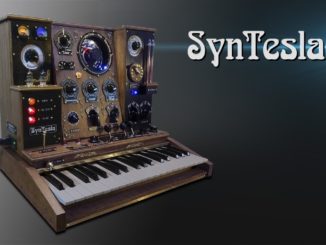
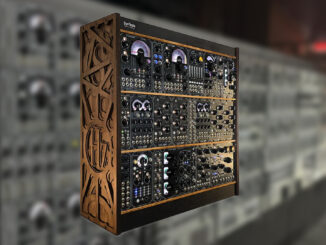
This is not just an impressive light case; it’s Giorgio III, a fully-fledged 5U modular Synthesizer, custom-made by French developer and designer SynTesla for Hans Zimmer.

Syntesla
SynTesla is the brainchild of Pierre Jean Tardiveau, a developer and designer from France. His creations, in which he gave off-the-shelf synthesizers a new, unique Steampunk look, were particularly in the spotlight—for example, the SynTesla IX, or the VII.
He has been working on his own modules and synthesizers for some time now. For the electronics, he’s enlisted prominent developer help from Yves Usson, the developer of the MiniBrute/MicroBrute, modular synths, and more.
SynTesla also shared insights into the development of its first Eurorack modules on forums in October 2024. Back then, he showcased a diode ladder filter, an LFO with 16 waveforms, another lowpass filter, and more, all with its distinct retro designs.

SynTesla Giorgio III
After the announcement, things have been quiet for the developers. This is likely due to two reasons. First, Pierre and Yves are busy developing the first commercial modules, and second, they received an unplanned request from Hollywood.
Hans Zimmer has commissioned SynTesla to plan and design the Giorgio III modular Synthesizer for the new The Next Level Tour.
Development and production were handled in France by Syntesla and Yusynth over the last 10 months, while the system’s assembly was done in Los Angeles at Hans Zimmer’s studio. From there, they shipped to Germany for final assembly on the tour stage.


According to Yves Usson’s post on FB, he created 80% of the electronics of this monstrous modular synth:
Et voilà, la tournée est lancée, voici quelques photos officielles sur lesquelles on peut voir GIORGIO III le monstrueux modulaire dont les modules ont été fabriqués par Syntesla ( Pierre Jean Tardiveau) et dont j’ai assuré la conception électronique à 80%. Je pense que P-J et moi sommes en droit de bomber un peu le torse et nous la pêter


Monstrous Configuration
According to Pierre, it consists of 12 cabinets measuring 5 x 5U + 1 x 3U in height, with only 10 installed on stage, with two others serving as backups behind the scenes.
This monster synth features 23 types of modules, all designed and produced in large numbers. It is composed of three separate units of four voices each, for a total of 12 voices, with 2 VCOs, 2 DCOs, 2 filters, 6 DADSRs, 6 VCAs, 1 resonator, and 4 LFOs.
It also has buffered multis, logic, attenuators, attenuverters, mixers, wavefolders, gate delays, summing mixers, and much more. All these modules have the lovely SynTesla design signature with VU meters, big old-school knobs, etc.
Pierre shared more details on Gearspace: The electrical part of the cabinets was also designed and built by SynTesla. It includes an oversized power supply with a 10-amp capacity, with an active filter that provides a perfect, stable, and clean voltage.

The power distribution board is in SynTesla and DotCom formats and also includes an integrated voltmeter and ammeter. The whole system has several levels of safety.
Each cabinet is connected to a solid-state relay socket controlled by a DMX from the lighting console. The device’s robustness allows the entire system or part of it to be switched on and off in sequence, depending on the pieces being played on stage.
And for those who ask how this thing is used on stage. Each module has a CV and gate bus that allows for internal pre-patching. It is connected to a custom module that changes presets by pushing some switches. Ultimately, you only need a few connecting cables to make it work.
New Modules?
SynTesla announces this special partnership on its website, with a counter pointing to a release on November 1st, 2025. More than this, the project will postpone the opening of its boutique and the release of the products by several months.
Whether the SynTesla Giorgio III project with Hans Zimmer will be unveiled or the modules themselves on November 1 is unknown.
Dear friends. Over the last few weeks, something important has happened, and I’m extremely honored to have been chosen, along with my fledgling company, to work on a monumental project with one of the biggest names in the music industry.
This is a rare opportunity for me, a real boon for SynTesla, and I’ve chosen to devote myself fully to it.
This will mean postponing the opening of the SynTesla boutique and the release of related products by several months.thank you for your support and understandingand understanding
I linked my interview from SynthFest France 2025 with Yves Ussion in case you didn’t see it yet.
The Tonto was previously considered one of the world’s epic Synthesizer systems. I think the Giorgio III certainly belongs to that category—a very fascinating project from the French developers.
If you visit the Hans Zimmer Live European tour (12 October 2025 – 01 April 2026), look mainly at the middle of the stage, where the SynTesla Giorgio III is located.
More info about the tour here: Hans Zimmer Live
No presets so you have to wait for Hans to repatch every sound. Looks fun and totally impractical.
In fact every modules has a CV and Gate buss that allow a complete internal connectivity with selection via some dedicated custom modules, you just need a few patch cables to configure the whole machine, and presets can be activated within a minute.
So why are there jack sockets on the front of all the modules? To make it look good, or to use them the correct way? I think Zimmer is trying to share his success and promote the talent that created this thing in the hope that it may become commercial. A free advert and a monetary grant to give-back in a way that keeps the analog ways alive. Of course they are pretending to fiddle with the controls on stage. It’s a performance. A good one, which can only get better once Zimmer has spent a few hundred hours working out how to get the best out of this monster. Meantime, it’s just a prop perhaps.
look at the number of modules, he doesnt have to repatch anything. One song one synthcase, just moves on to the next one with a new song
If the synth comes with Hans, I’m all in!
Fictional rant: “I am disappointed! It is called the “The Next Level Tour” and there are no kryptochained AI Cyborgs on stage, who use all this gear for Mr. Zimmer. I want my money back!”
Good post, an AI partner will be fantastic if it acts as a co creator that really gets what the goal the human artist sets.
when’s it coming as VST?
Just saw the video on youtube. Incredible! Part synth, part epic stage prop.
Same price as the TR 1000. I’m in 🙂
Love how this adds a billion lights which also works for showmanship in concerts and to see where in the stuff in the (most of the time) dark stage. Uli has a challenge with this one lol