
Cherry Audio Trident MkIII is an authentic souped-up emulation of the Korg Trident MkI/MkII multi-timbral Synthesizer from 1981 – review.
The Japanese company has a long history of Synthesizer development. Many of their vintage synths are rare and expensive. However, we live in a time when many analog replicas or digital emulations are available for your DAW.
Some have been recreated frequently (MS-20…), as have other rarer ones. One of these is undoubtedly the Korg Trident from 1981. Full Bucket Music is the only one to date to emulate this multi-timbral ’80s classic, and even for free. With the Trident MkIII, Cherry Audio now also offers an emulation of this unique Korg synth.

Cherry Audio kindly sent me a version in advance to test. I can’t comment on the authenticity or accuracy of the plugin. I neither own it nor have I spent much time with the Korg Trident.
Cherry Audio Trident MkIII Review
The Trident MkIII is an emulation of the Korg Trident MkI and MkII, produced in 1981 and 1982. With the Trident MkIII, Cherry Audio not only recreated the features and sound but also took it further into the modern era.
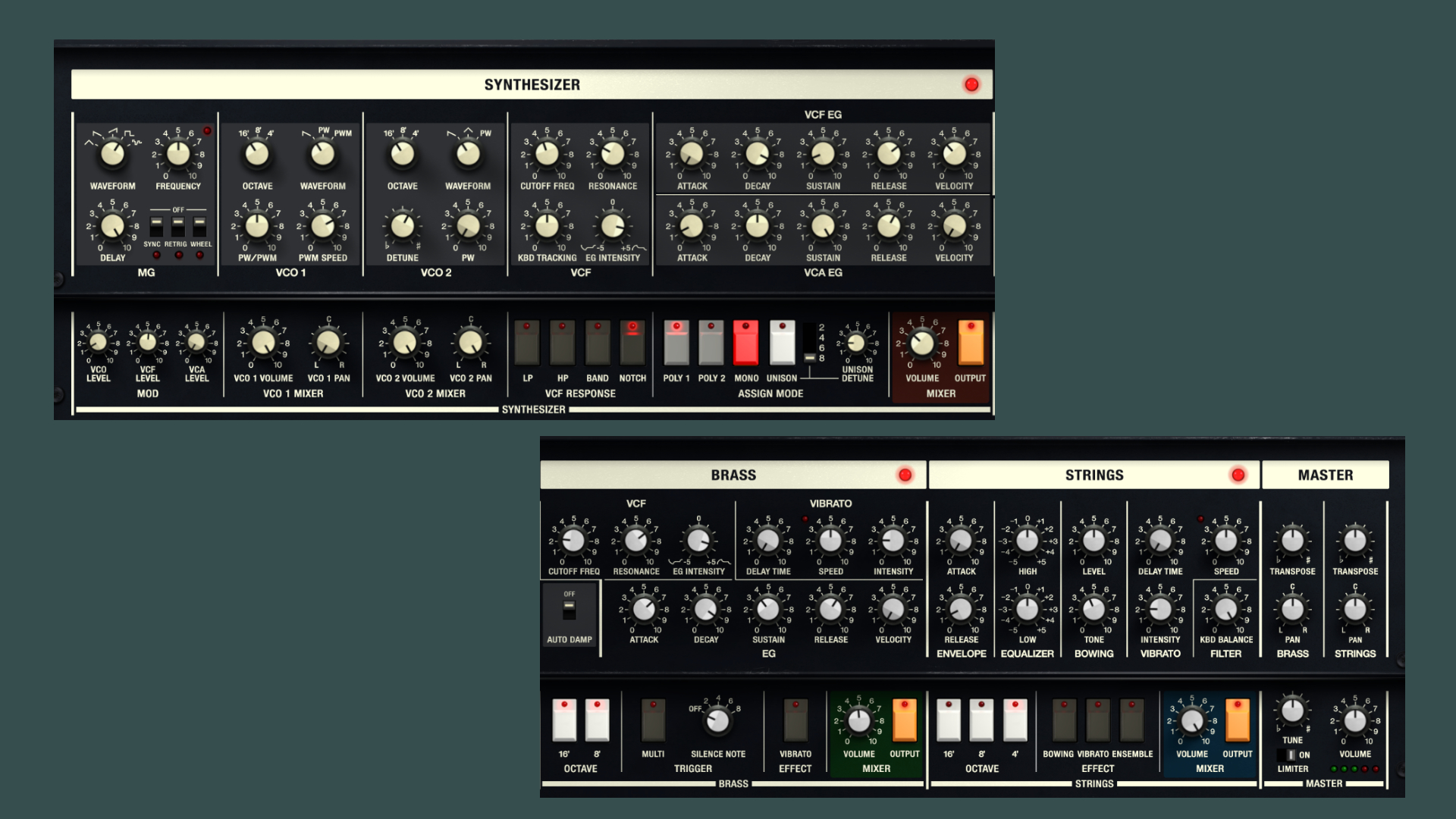
Like the original, it’s a multi-timbral Synthesizer based on the same structure: three dedicated 100% synthesis-based instruments/sections: Synthesizer, Brass, and Strings. Each section offers dedicated volume settings and an output button.
On the second page, they can be layered or split as desired. Thanks to color coding, this task is straightforward. With the built-in split presets, you can work even faster.
On the voice architecture, the primary difference is that each has up to 16 voices, instead of the original 8, for all three. This allows for more flexibility in sound design and playability.

Analog Modeling
The Synthesizer part consists of a classic subtractive voice recreated using analog modeling techniques. The Korg PolySix is basically a one-oscillator version of the Trident, so you get a 2-oscillator Polysix emulation here as well.
Two oscillators with different waveforms and PWM control, joined by a mixer and a multimode filter that includes bandpass and notch, lay the foundation.
The two standout modes are fantastic additions, allowing you to delve much deeper into sound design. Some excellent patches in the factory library demonstrate these features. Remember: the originals only had an SSM lowpass filter.
Next to this, you have two ADSR envelopes with velocity control, and a multiwave LFO with delay and retrigger functions. Also onboard are the positive and negative intensities for the envelopes, similar to those on the 1981/1982 synths.
Sonically, I really like the results of the synthesizer part. From fat PWM basses to beautiful, soft leads up to juicy pads, it’s a virtual analog all-rounder. Although I can’t prove or disprove whether it’s on the original Trident.
Brass & Strings
Then, move on to the second part, the Brass section. It’s significantly smaller but also has 16 voices in the emulation. It features an independent filter with cutoff and resonance controls, an ADSR envelope with velocity sensitivity, and a vibrato effect.
The latter may not sound like a significant sound design feature, but it is for some sound cases. It is helpful if you want to create a sound that evokes a feeling of a human brass section.
Part of this section is also a recreation of the trigger section. Part of it is the unique silence note section that lets you mix in the brass sound depending on the playing. For example, set it to 2, and only two-note chords will make the brass sound.
The third and last sound source is the strings section that outputs all kinds of string machine sounds, lush pads, and or even choir-like timbres. It houses many of the same features as the other sections, including an envelope (AR in this case), an EQ, and a vibrato: no filter but a unique bowing element with level and tone control.
Bowing emulates the accented attack of a bow hitting a string. It’s perfect for adding realism to cello or violin timbres. One step further, you can transpose and pan both the brass and string sections.
Building multi-layer patches with the three sources is very easy and fun. It doesn’t require a deep dive. The ability to use parts flexibly, in particular, allows you to experiment with all sorts of combinations. Unison with the strings and brass sounds fantastic to me.

Colorful Multi-FX
You can now use the sound faithfully with the Bowing, Vibrato, and Ensemble effects like in the original Korg Trident hardware. Alternatively, you can take it further with a built-in multi-FX processor—or rather, four, since each instrument has its own, plus a global one.
A multi-FX processor consists of five customizable slots with 17 selectable effects modules. The Trident MkIII utilizes many well-known effects that are already available in other Cherry Audio plugins, such as digital delay, flanger & chorus, and galactic reverb.
Like in the other plugins, these are convincing in both sound and functionality. They can all be fine-tuned, mixed, and even modulated. Each layer has a multi-wave LFO for modulating a parameter. Another one would be nice, too. A like also goes to the option to save effects chains. Often overlooked, but can be very helpful in sound design sessions.
Having a multi-FX per layer was a good decision, as you can edit the sounds individually, and no sounds collide with effects that don’t fit. I particularly enjoyed using the ring modulator in the CS-80 look and the colorful Lo-Fi effect. Both quickly introduce strange, broken characteristics, which somehow fit nicely with the dry Trident MkIII sound.
In Motion
Between the keyboard and effects is the motion section, which is supposed to set everything in motion. Not modulation, but two arpeggiators and a flexible sequencer. With dedicated orange select buttons, you can select which voice is triggered by which section. This allows you to run two arpeggiators together with the sequencer.
The arpeggiators are familiar from other CA plugins. Alongside classic features like patterns, direction, and range control, there are also chance and feel settings to add variety and evolving movement to the results.
A highlight is the ability to switch between operation modes. You can choose whether the arp plays directly from the notes you hold on the keyboard or takes its orders from the step sequencer, giving you more ways to experiment with the arpeggiators.

Although it is rarer, this Cherry Audio plugin also features a sequencer with inspiring capabilities. This includes various playback directions, real-time recording with accent, and tie per step, and various arranging options with A + B patterns.
A positive aspect is that you can transpose on the fly and route the sequencer to everything or a specific level. Ratcheting or probability, however, is missing, which is a shame.
Other Things To Know
In addition to per-layer modulation, there is also velocity and detailed polyphonic aftertouch support. Indeed, something that wasn’t present in the original hardware.
An impressive range of factory presets (370+ in 14 categories) is also onboard, courtesy of professional sound designers. Among others, you can find classic bass, leads, pads, and vintage string machines in it, perfect for any synth pop production.
Also, it has plenty of triple-sound patches that benefit from the multitimbrality of the instrument, which gives you a little orchestra under your fingertips. Unusual but fascinating, and my favorites are the experimental tones that throw a different light on the Trident mkIII.
Cherry Audio Trident MkIII Summary
Trident MkIII is a juicy and pleasingly sounding plugin with a wealth of sound design possibilities. The added features make sense for an instrument from 2025 and harmonize well with the modeled features.
Whether the Cherry Audio Trident MkIII is the perfect emulation of the original Korg Trident MkI/MkII, I can’t confirm or deny. I don’t want to throw glitter in your eyes, and ultimately, it’s not true. I’ve never played the original, let alone touched it, only heard it on YouTube demos.
That is something the Trident owners have to decide, and there are not that many of them. However, if you want the workflow and a sound that follows the multi-timbral concept of the original instrument from 1981, including synth, brass, and strings, then this is the right place.
All in all, a successful multi-timbral synth plugin for macOS and Windows modeled on the Korg Trident, but without confirmation of its 100% authenticity.
Cherry Audio Trident MkIII is available now for $69. It runs as a VST, VST3, AU, and AAX plugin on macOS (native Apple Silicon + Intel) and Windows. The Momentum sound pack, featuring 100 extra presets by James Dyson, is now available for separate purchase at $9.99/9.99€.
If you buy the Trident MkIII plugin at AudioDeluxe or Plugin Boutique, you will receive a plugin for free as part of their monthly giveaways.
More information here: Cherry Audio
Available at my partners


Be the first to comment