
Knobcon 2025: Rainy Day Cumulus is a new battery-powered hardware sampler that turns your samples/loops into fully-controllable multi-layer soundscapes.
Otem Relik has launched numerous exciting hardware synthesizers in recent years, which sold out in a very short time. He then established his own company, Rainy Day Electronic Instruments, which enables him to produce instruments in larger quantities.
Hailstorm was Otem Relik’s first project under the new company. This week, Rainy Day unveiled its second release called Cumulus, a sample-based instrument.
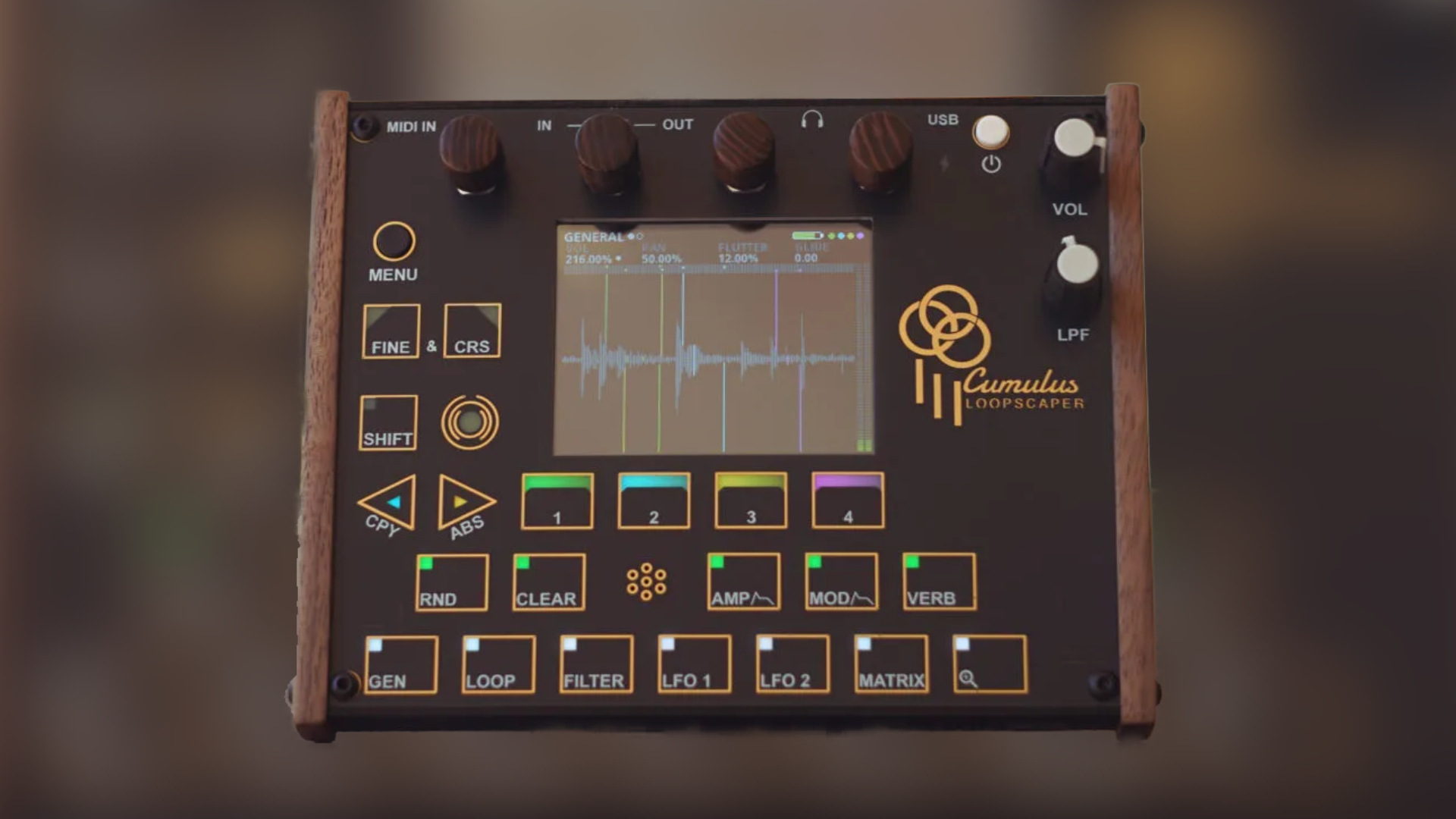
Rainy Day Cumulus
Cumulus is a new compact hardware multi-layer sampler with a unique, hands-on concept. Spoiler: it’s not a traditional sampler.
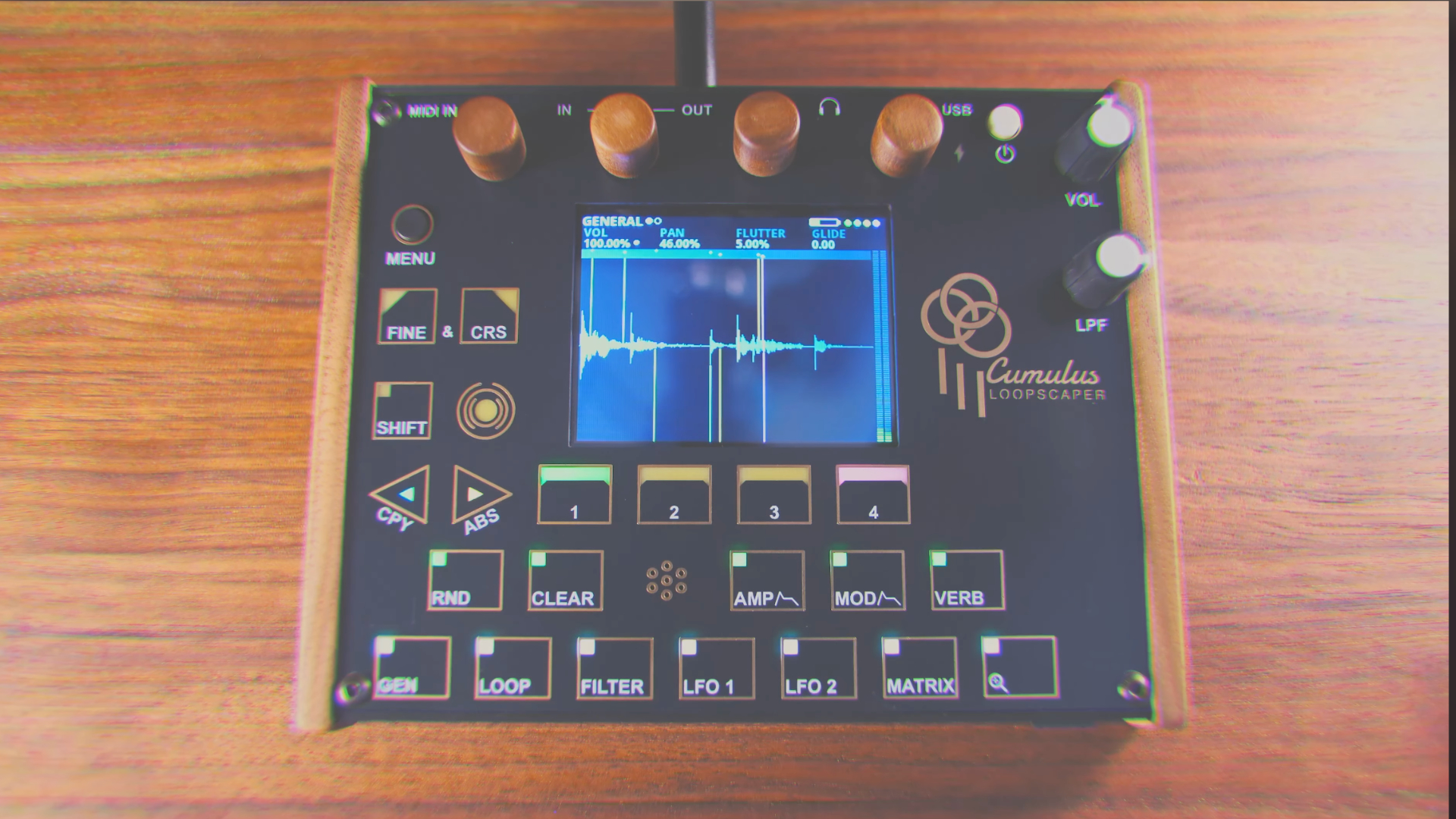
At its core, Rainy Day Cumulus consists of four independent tracks, each equipped with its own playhead. You can record from a line input, via the built-in microphone, USB audio, or resample Cumulu’s own output.
According to the official details, the maximum recording time is limited to 45 seconds per sample (44.1kHz, 16-bit). That would be very little compared to other hardware samplers.
However, since Cumulus isn’t a traditional sampler but rather a “loopscaper” that generates soundscapes from four layers, the sample time could be sufficient. Once sampled, you can play and edit the samples/loops in various ways.
You can play them via MIDI, the onboard keyboard, or via the track play buttons. Then, it’s possible to adjust the loop start and end points individually or simultaneously, and set the playback speed for each track.

Otem Relik of Rainy Day also incorporated different play modes, including unison (all tracks together), poly, MPE (polyphonic aftertouch and slide), and polych that splits each track on a separate MIDI channel.
There is also a latching tracks option, which allows you to sustain notes indefinitely by playing a note and tapping the corresponding track.
By combining the four tracks and using the same or different loop points and speed settings, you can create soundscapes/loopscapes. It also looks like you could use all four playheads on one sample.
Loopscapes Design
Currently, there are no in-depth sample manipulation options, such as granular, spectral, or other techniques. However, Rainy Day Cumulus offers other ways to manipulate sounds on the fly.
First, it has a stereo per-track resonant lowpass filter with controls for cutoff, resonance, and drive. Filters can also self-oscillate in high resonance settings.
Then, there is a global multimode filter that affects all tracks with lowpass, bandpass, and highpass types with adjustable resonance.
From here, it goes into a global reverb that is at the end of the audio chain, with adjustable size, diffusion, lowpass, and mix parameters. The effects engine is also a bit weak for me; more effects could be included.
More complexity and versatile sounds make the modulation engine possible. Each track offers two syncable multi-wave LFOs, two loopable 6-stage envelope generators, and a dedicated modulation matrix.
Each per-track modulation matrix allows you to modulate all internal sources and MIDI sources to modulate 32 mod destinations simultaneously with positive and negative amounts. If the loop points are included, then the loopscaping fun really begins.
As a bonus, Rainy Day also incorporated a live mode, turning Cumulus into a real-time effect processor. In this configuration, the incoming audio replaces the samples with an adjustable buffer size and feedback.
Further, you can randomize parameters for an entire mode or select tracks that give you instant new sounds.
Connectivity
Cumulus is fully controllable with a touch screen, tactile potentiometers, and encodes as well as dedicated buttons and touch sensors.
On the backside, it has a comprehensive I/O section, including 3.5mm TRS-A MIDI input, Line level audio input and output, and a headphone output. Yes, USB-C is also onboard for audio input, power, battery charging, and MIDI input.
You read that right. It is powered by a single 18650 battery (not included), and with a 2,500mAh battery, you can play around 10.5 hours without charging it. Cumulus can charge the battery during operation and features an auto-save function for low battery situations.
Additionally, you have a micro-SD card for managing your samples and presets. They can also be adjusted by the internal patch manager. According to Otem Relik, there will also be a web-based patch editor for fine-tuning every parameter remotely.
Rainy Day Cumulus First Impression
At first glance, it is an intriguing new multi-layer sampler instrument. The concept bears a resemblance to the Torso Electronics S-4, but without the granular and resonator components.
It remains to be seen how versatile it ultimately is and how it will be developed further. For example, whether it will receive new sample playback engines or effects in the future.
Rainy Day Cumulus will be available for $475 in walnut or wenge wood side panels. Shipping starts on October 1st, 2025.
More information here: Rainy Day


Be the first to comment