
Future Retro has revived the 777 analog bassline Synthesizer with new circuitry and new features: it’s now on Kickstarter.
Three years ago, shortly after the company’s reboot under new management, Future Retro announced the launch of the popular 777 bassline synthesizer. The plan was to release it in 2023, but that never happened.
Almost three years after this announcement, there’s now good news. Future Retro has launched a Kickstarter campaign to fund the production of a modernized version of the 777. You can now support it with a pre-order.
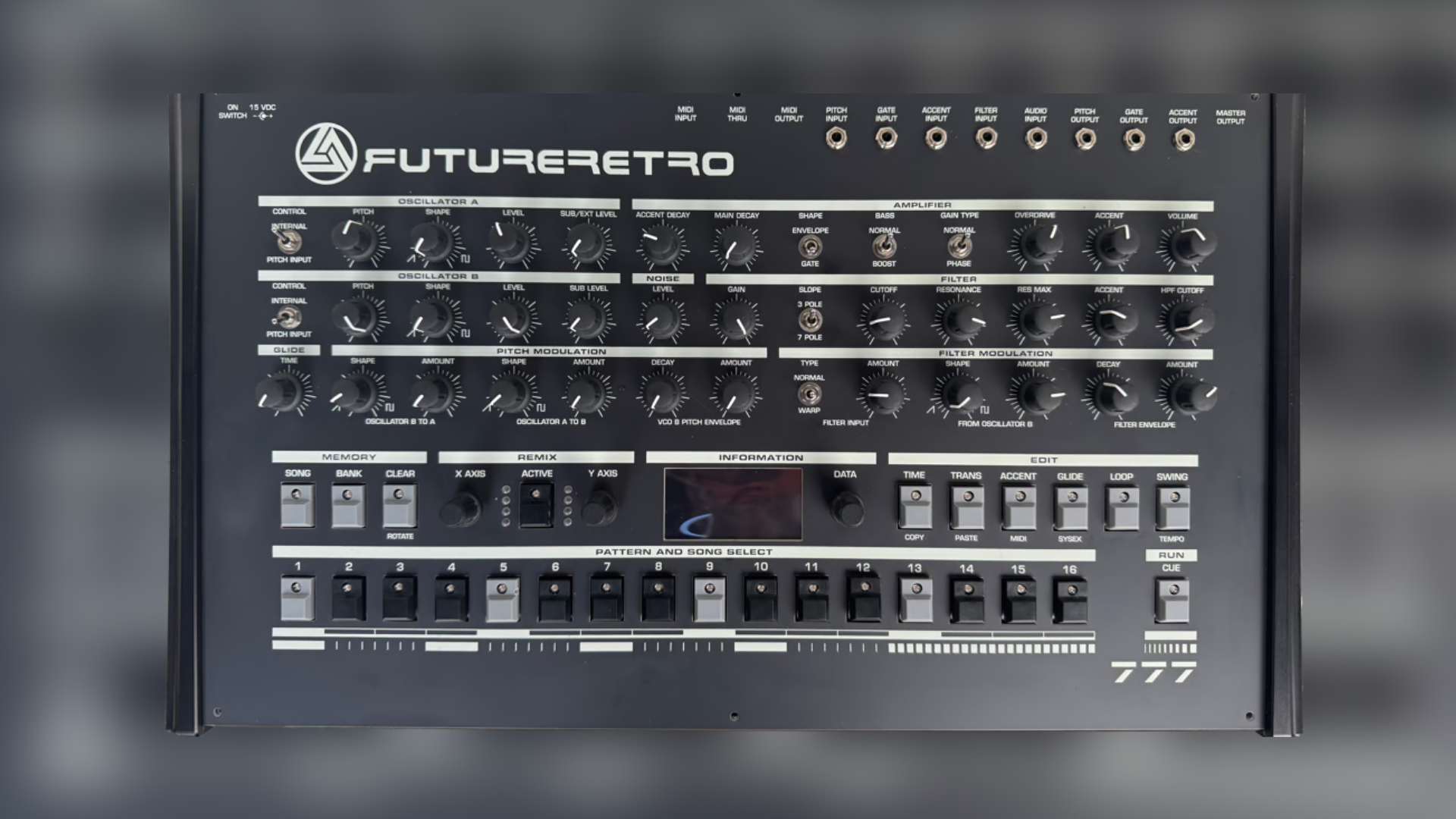
Future Retro 777
When the name “bassline synthesizer” is mentioned, one immediately thinks of the legendary Roland TB-303. However, there were other well-known bassline synthesizers early on. One of them was the Future Retro 777.
Like the original version, the modern 777 is also a monophonic analog Synthesizer that is heavily inspired by the legendary Japanese bassline machine. Important: it’s not a clone/replica of the Roland synth.
It’s a further development with enhanced functionality, allowing you to create analog percussion, lead synth parts, and wild sound effects. Let’s call it a 303 on steroids. According to the developers, it offers an updated analog circuitry.
The 777 core consists of two analog VCOs with saw and square waveforms with FM option, a white noise generator, and a sub-oscillator. It also includes a decay envelope to sweep oscillator B’s frequency.
Then, the signal flows through a resonant lowpass filter with a switchable 3- or 7-pole lowpass filter and a non-resonant high-pass filter. Also onboard is an input overdrive.
You have the choice of three sources to modulate the lowpass filter: CV (either the CV from the sequencer or via input), oscillator B frequency, or the decay.
You can also add juice to the sounds using the overdrive/distortion circuit in the amplifier section. There is also modulation onboard in the form of an envelope and three multi-wave LFOs.
Updated Features
The modernized version of the Future Retro 777 also hosts an updated sequencer newly coded by Amos Gaynes (ex-Moog). You can assign to each step the note value, gate length, accent trigger, glide, and a loop point for setting the last step of the sequence.
Popular modern features like probability or ratcheting are missing. However, there is a new remix function with which you can adjust the X and Y axes of an existing pattern.
According to the developers, the results can bring interesting musical variation to your sound patterns and allow the user to keep patterns dynamic.
On the connection side, it has a full 5-pin MIDI interface (IN, THRU, OUT), a master output, an audio input, CV inputs (pitch, gate, accent, filter), and CV outputs (pitch, gate, accent).
The synth has full MIDI functionality with receive and transmit MIDI patterns to or from external gear, making studio integration very easy.
You can manage pattern memory via the display, which provides real-time feedback. The former version can save up to 256 patterns, which can be linked to form up to 16 songs and remain in memory. It’s unclear if this feature has been expanded in the new version.
First Impression
It’s nice to see the 777 returning in a modern version. However, it’s a shame that the production is limited, so you have to participate here if you want to get one of these modern reissue units.
Future Retro 777 will be available very soon to support and pre-order on Kickstarter. The first 150 units will be available for $777 + VAT + taxes + shipping (original price of 1999), and go up to $1049 for the last 150. The retail price will be $1199.
The Kickstarter starts on September 12th, 2025, 12 PM EST and ends on October 10th, 2025. Keep in mind that crowdfunding campaigns can involve risks. See for this, the project site for details.
More information here: Future Retro / Kickstarter
I wish them well. I was interested until I saw the new design.
why?
Maybe it will be easier to tune than the original? MAYBE??
The sounds in the demo video are absolutely woeful. Is that really the best it can do? I’m amazed anyone would create such a video in the hope of sales.
the 777 v2 is in development but you can check out the demos of the 777 v1 as the main sound character remains the same as there are no additions to the analog core