
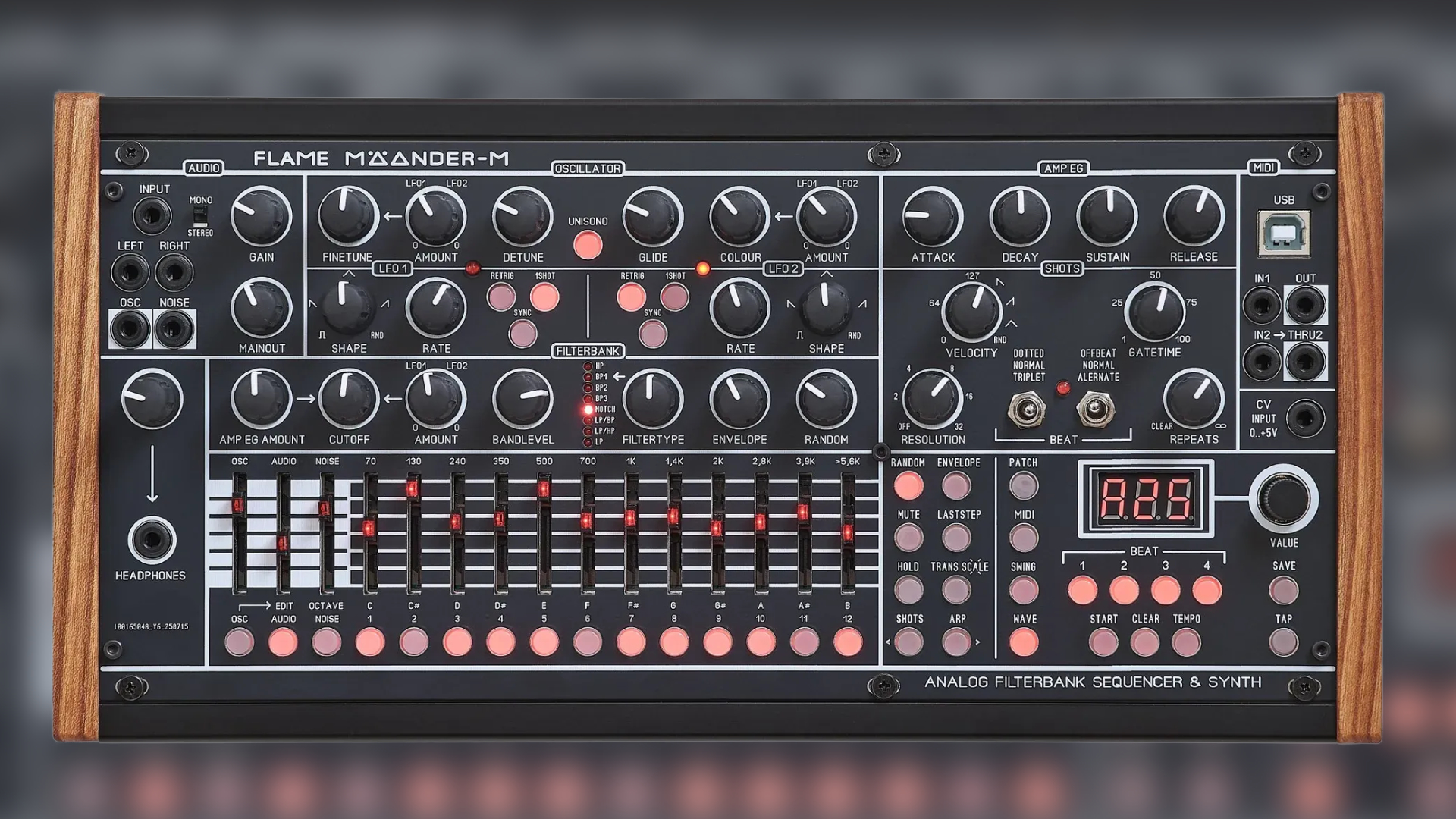
Flame Instruments Mäander-M is a successor of the original Mäander and is now a Eurorack wavetable synth with an analog filterbank and sequencer.
At Superbooth 2025, the German company Flame Instruments announced the return of the unique Mäander filterbank Synthesizer. Instead of the white desktop look, the new Mäander-M offers the same features as the original synth, but in a Eurorack module with some refinements.
Good news! The new Flame Instruments Mäander is now available.
Feature Overview
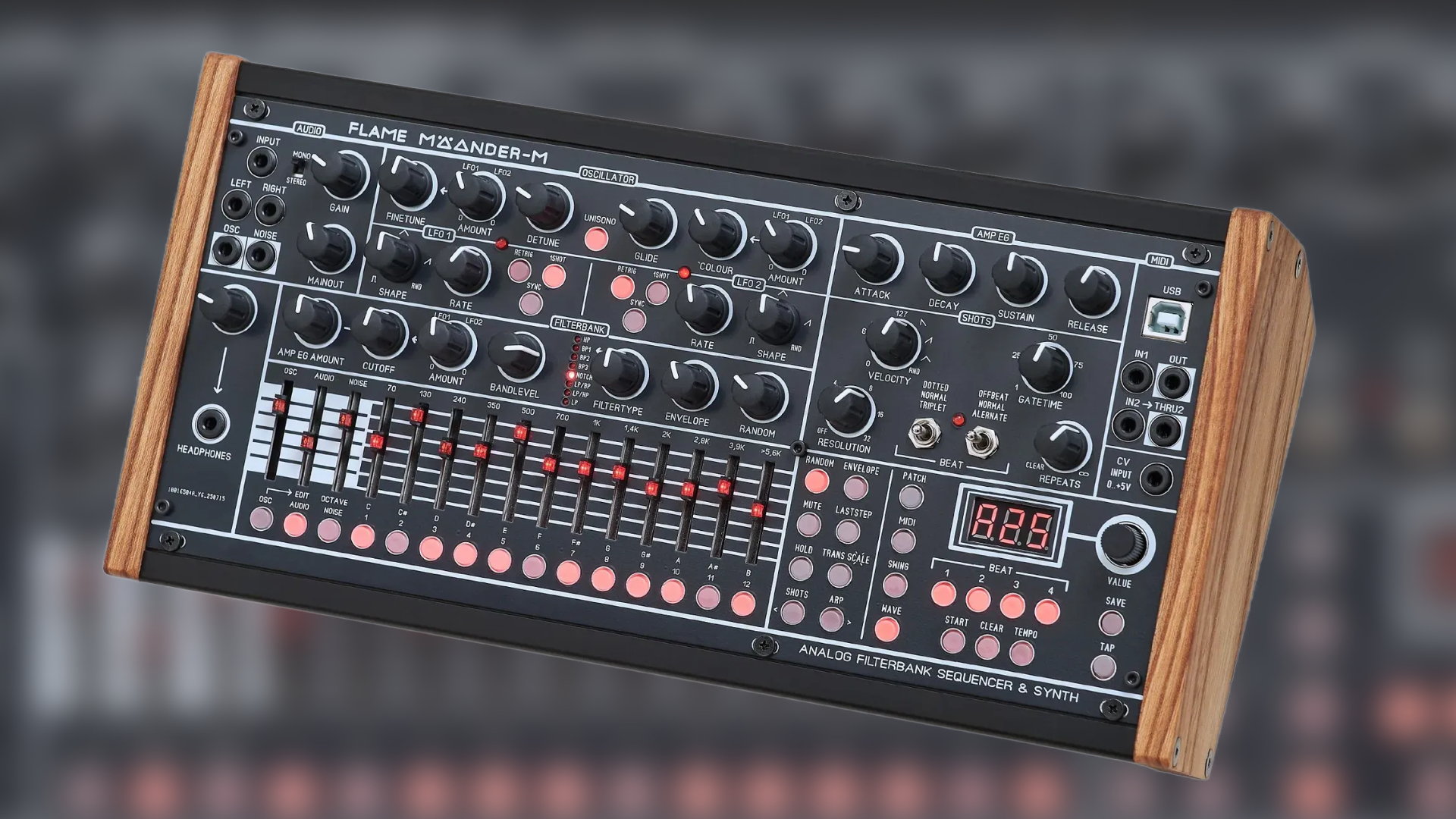
The Mäander-M offers a 4-voice polyphonic wavetable Synthesizer engine. The unique feature is that the wavetable engine feeds into an analog 12-band filterbank, fully adjustable via a slider for each filter band. The features are:
- hybrid synth voice
- 4-voice polyphonic engine with unison
- wavetable oscillator/FM oscillator
- noise generator
- 12-band fixed filter bank with a 24dB slope per band
- different filter types
- 2 BPM-synchronizable LFOs
- amp ADSR envelope
- sequencer
- external input for the filterbank
- stereo output, headphone socket, audio outputs for oscillator & noise
- Freely assignable CV input
- MIDI In 1, In 2, Thru & Out via TRS adapter
- USB-MIDI
Flame Instruments Mäander-M is available now for 889€
Available from my partner

Article from May 17, 2025
The Mäander from Berlin-based Flame Instruments is or was a special desktop Synthesizer. It combined wavetable synthesis with an analog filterbank as an engine and offered a sequencer. A later update added an FM engine and more wavetables. But then the Mäander was discontinued in desktop form.
Good news: For Superbooth 2025, Flame Instruments revives the Mäander synth as a Eurorack synth voice, called Mäander-M.

Flame Instruments Mäander-M
Mäander-M takes the sound engine of the original Mäander desktop synth and packs it into a Eurorack module.
The core comprises multiple sound sources fed into an analog filterbank and controlled by a sequencer. They include a polyphonic wavetable and FM oscillator, an analog white noise generator, and an external audio input.
Like the original desktop, it has 4-voice polyphony and offers unison modes and controls, such as color and glide.
The filterbank is again fully analog, has 12 channels, and offers eight different morphing types: lowpass, LP/BP, LP/HP, highpass, three band pass modes, and notch. Individual faders are available for the bands to control the filter bank. Like the desktop unit, it can process external audio.

Two multi-wave LFOs with three modes (retrigger, 1-shot, sync) and ADSR envelopes serve as modulation sources. A VCA is also onboard.
Sequencer
Further, Flame Instruments Mäander-M hosts a sequencer with one polyphonic note track (Mäander desktop) with up to four chords and 14 mono tracks for the audio input, the white noise source, and each filter channel.
Patterns can be created and saved as patches, and played live with ease. The built-in arpeggiator and keyboard scaler make the Flame Instruments MÄANDER-M a powerful tool for live jamming and generative sequencing. Updates, patch management, and wavetable loading are handled conveniently via MIDI SysEx.
New in the Eurorack version is a direct oscillator output, stereo noise output, and stereo audio input. Mäander comes fully mounted in a powered 56HP wooden skiff to get started right away.
First Impression
The Mäander synth was a very unique and special interest synth. I always wanted to try the Mäander, but then it disappeared. I’m happy to see it’s coming back as a module.
Flame Instruments Mäander-M availability and price TBA. You can explore the module at booth B044 at Superbooth 2025.
More information here: Flame Instruments
Hopefully he ‘s able to correct some of the labels in time for production:
“FEINTUNE” => “FINE TUNE”
“MAINOUT” => “MAIN OUT”
“LASTSTEP” => “LAST STEP”
feintune, it’s very German 😉
Can the bands be feinpanned in the stereofield? 😉
On the desktop it didn’t work, so I assume it will also not work here
Any indication of how the CV input is used? I’m hoping it is configurable and that it could be a clock input. One drawback I saw with the desktop edition was that it was MIDI clock only, which limits some ways I would want to use it; it would be nice if the modular form came with the ability take in a modular clock/sync. If this is still a prototype, I’d love to see clock/sync in and out added and still keep the CV input for other things.
I couldn’t see a DIN midi socket? What type of midi connection does it have?
it has TRS MIDI
Thanks Tom