
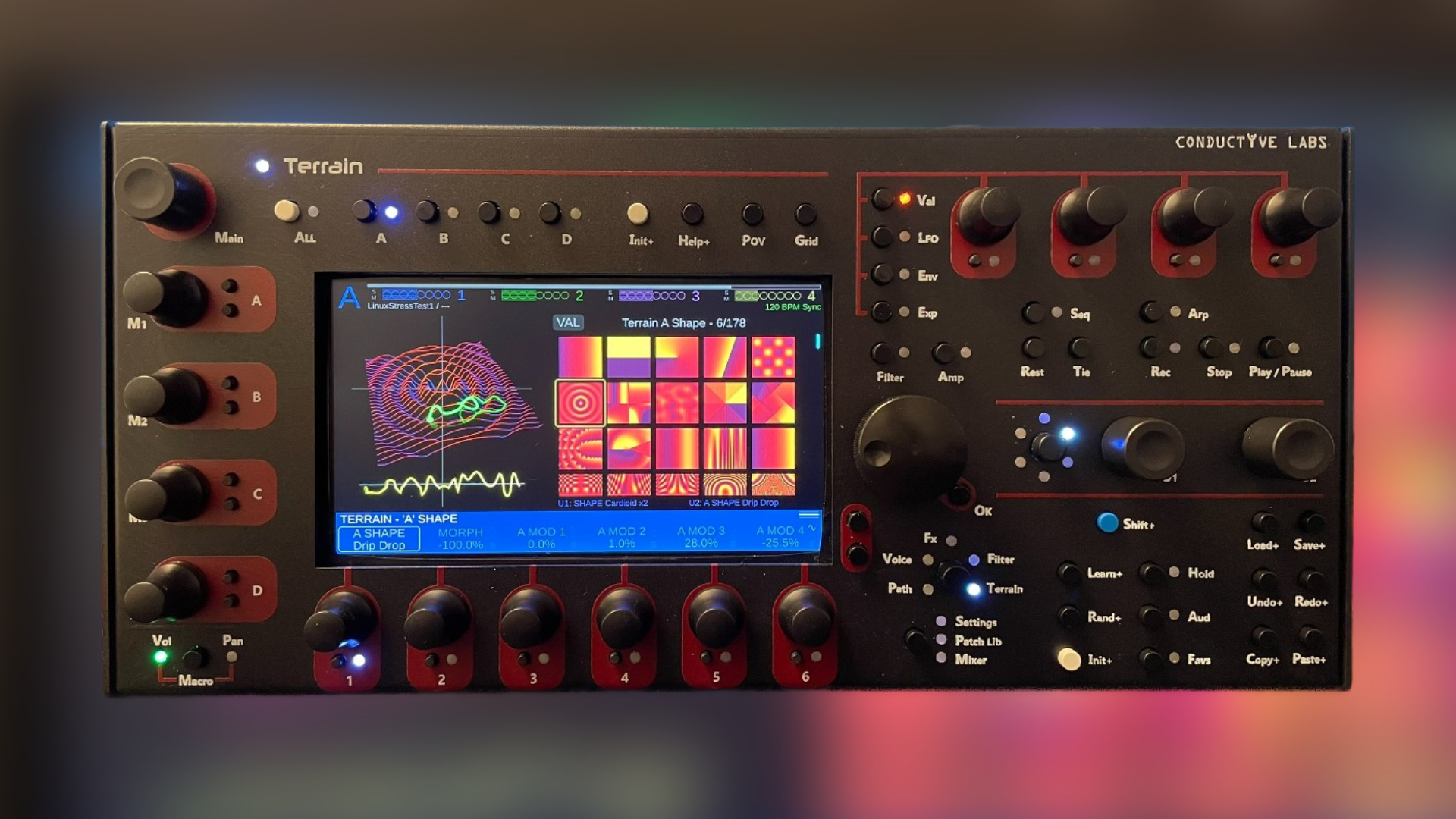
Knobcon 2025: Conductive Labs unveiled Terrain, a new, powerful, multi-timbral, morphing terrain hardware Synthesizer.
After Conductive Labs made the first preview for their new Terrain Synthesizer at Knobcon 2025, they have launched the Kickstarter campaign for it.
You can support the project by pre-ordering it for a special price of $949/808€ + VAT + tax + shipping. Shipping is planned for May 2026.
Keep in mind that crowdfunding campaigns can involve risks. See for this, the project site for details.
More info here: Kickstarter

Article from September 6, 2025
There are many synthesis forms. The most popular are analog/virtual analog, FM, and wavetable synthesis. There are also more experimental or specialized ones, such as granular or Terrain synthesis. The latter became more of a topic with the last firmware of the MI Plaits oscillator or with the free open-source Terrain synth plugin.
Now the synthesis forms get a big boost. At Knobcon 2025, Conductive Labs, the creators of the NDLR or MRCC MIDI router, introduced Terrain, the first flagship Terrain hardware Synthesizer.
Terrain Synthesis?
Terrain Synthesis is an advanced form of wavetable synthesis. In wave terrain synthesis, a sound is produced via a 2D trajectory scanning over a 3D surface, or terrain.
In this synthesis, the timbre produced is dependent on the shape and parameters of the trajectory, as well as the shape of the scanned terrain. Both trajectory and terrain parameters can also be modified at audio rate.
Easy say: Imagine you have a complex wavetable, but instead of scanning it only from bottom to top and vice versa, it is a 3D terrain that can be scanned from all sides and not only linearly (top to bottom) but also in a circle or on a path
To get a first look at how this works, I recommend checking out the free Terrain synth. Now, back to the new hardware.
Conductive Labs Terrain
With Terrain, Conductive Labs presents the first-ever hardware flagship desktop Synthesizer based on this unique synthesis form. Terrain is a 4-part multi-timbral Synthesizer that can be split or stacked. It has up to 32 voices of polyphony, with eight voices per layer.
At its core are two morphable terrains oscillators per voice that use terrains (3D surface) and 2D trajectories for scanning them. The synth offers 17 math-based terrains with infinite resolution and dozens of image-based terrains right out of the box.

Alternatively, you can load your own images and wavetable terrains in various file types (.jpg and .png, .wav) into the hardware, giving you unlimited terrains to explore and work with.
To scan through these terrains, 2D trajectories are used. Conductive Labs Terrain features 18 morphable paths with infinite resolution, which can be applied to the terrains. All this is fully programmable from the hardware with selectable terrain view angles and color schemes
To add more complexity, the oscillator engine also has oscillator sync, phase distortion, mirroring, and windowing. Plus, you can work with up to 7x unison for each voice, two additional sub-oscillators per voice, and a colorful noise generator (white, pink, blue, and brown).
Classic Synth Features
Alongside these unusual oscillators, Conductive Labs also added more traditional synth features to the Terrain Synthesizer. A dedicated mixer lets you mix all four layers perfectly together.
There are various colorful filters in the engine, including ladder, SEM, diode, comb, and format, with different filter modifiers: morph, slope, and vowel.
Then, it also has a comprehensive modulation engine with an LFO, envelope, and expressive matrix per parameter. We will likely see a detailed picture of this in the coming weeks and months.
To refine your sounds, it also includes a multi-FX processor with various algorithms: delay, ping-pong delay, reverb, shimmer reverb, chorus, flanger, phaser, stereo phaser, overdrive, and decimator.
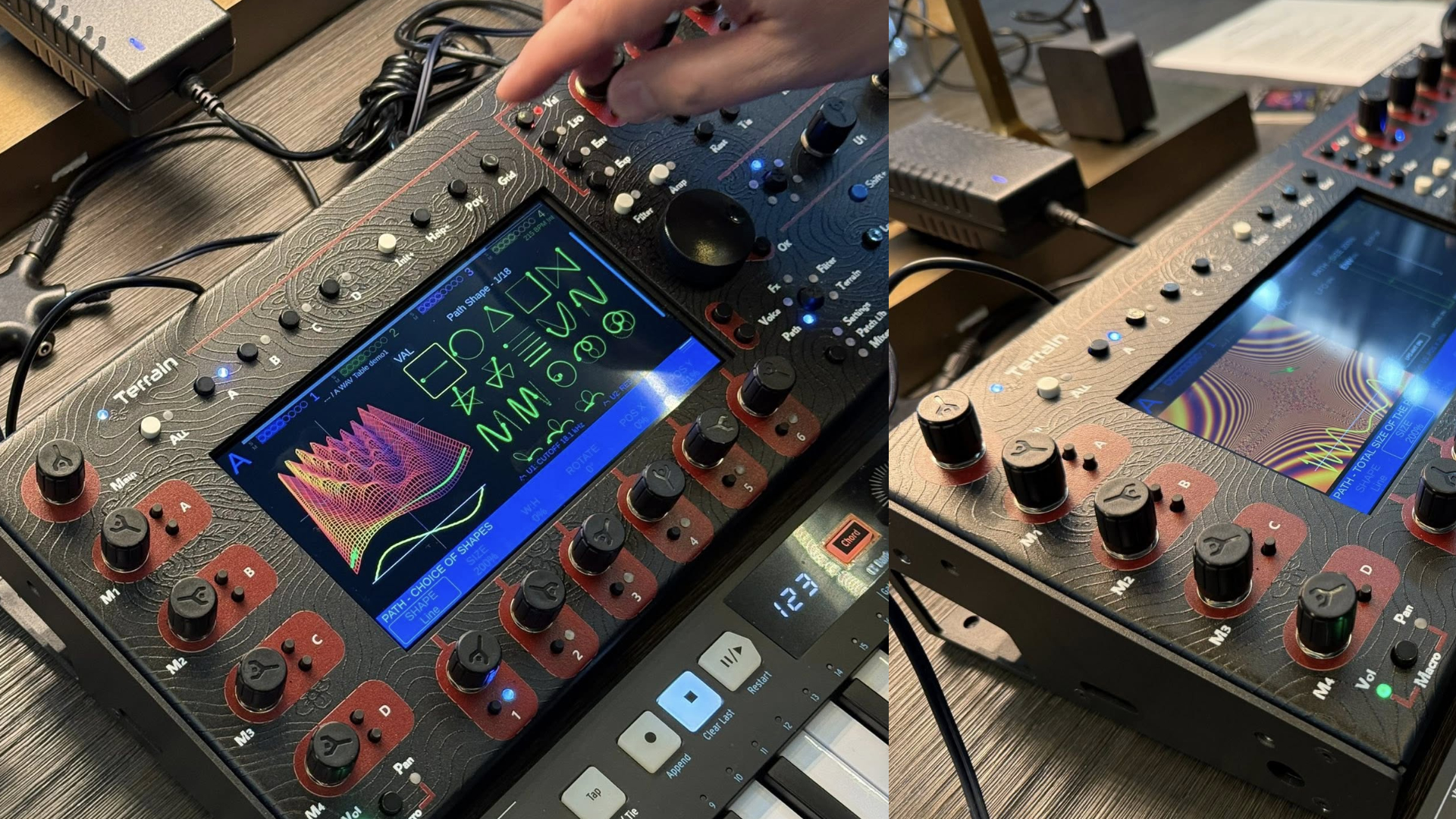
Also onboard is an advanced sequencer, arpeggiator, and audition buttons, although I’m unsure what the last one should be.
Right out of the box, it comes with hundreds of sortable presets and an onboard preset librarian. Plus, there are 36 quick-access patch favorites (6×6).
Hardware
On the hardware side, it’s a desktop unit/4U rack Synthesizer with a 7-inch IPS display for full color sonic visualization.
The engine is fully controllable with black and white buttons and infinite encoders for the mixer, menu, modulation, and user modules.
Let’s take a look at the backside. It has a left/right balanced stereo and headphone (w/ vol control), 6x CV/Gates, and 3x expression pedal inputs. Too bad there is no audio input with which you can make some audio-to-terrain experimentations.
Conductive Labs are famous for their MIDI tools, so it is no surprise that Terrain also has full MIDI I/O via 5-pin DIN, USB host, and USB device ports.
First Impression
This new announcement comes as a complete surprise. I’m pleased to see that Terrain Synthesis will soon be available in a flagship synth. Although many sounds aren’t audible yet, what I’ve heard so far makes me want more.
If the sound spectrum is as promising as the animations of the Terrain synths, this could be an inspiring, unique synth. I’m very curious about further updates.
Conductive Labs Terrain premieres this weekend at Knobcon 2025. You can support the development of the synth with a pre-order soon on Kickstarter.
More information here: Conductive Labs

So firmly in Waldorf Iridium area, let’s see how it competes on price!
Steve was unofficially talking price at the show; if they hit their target, it will actually be quite competitive compared to a Waldorf.
Sounds like the new Dawsome Synth-VST KONTRAST
https://www.youtube.com/watch?v=RruYK3-0Xk0
Heh, came to post the same thing. It will be intersting to compare te two takes on the concept
Reminds me a bit of that most beautiful of mac/ios programs, VOSIS Pro. Whose UI frankly I prefer to this physical machine. That’s almost never true for me, but working with a images it seems nicer to have a touchscreen.
reminds me of the beetlecrab audio Vector synth 🙂 I like this form factor. maybe one day I’ll get my hands on a vector or iridium core.
$1,600 is a no go.