
ASM Leviasynth is a new 16-voice hybrid algorithmic Synthesizer that offers a modern, reimagined hybrid take on 8-operator FM synthesis.
The name Leviasynth has been circulating online for a year now. Back in January 2025, Medeli Electronics, a Chinese keyboard manufacturer that also owns ASM, filed a trademark for this exact name.
Speculation was soon refuted by Glen Darcy (ASM CEO) himself. The tables turned over the weekend with a leak. Now it’s official.
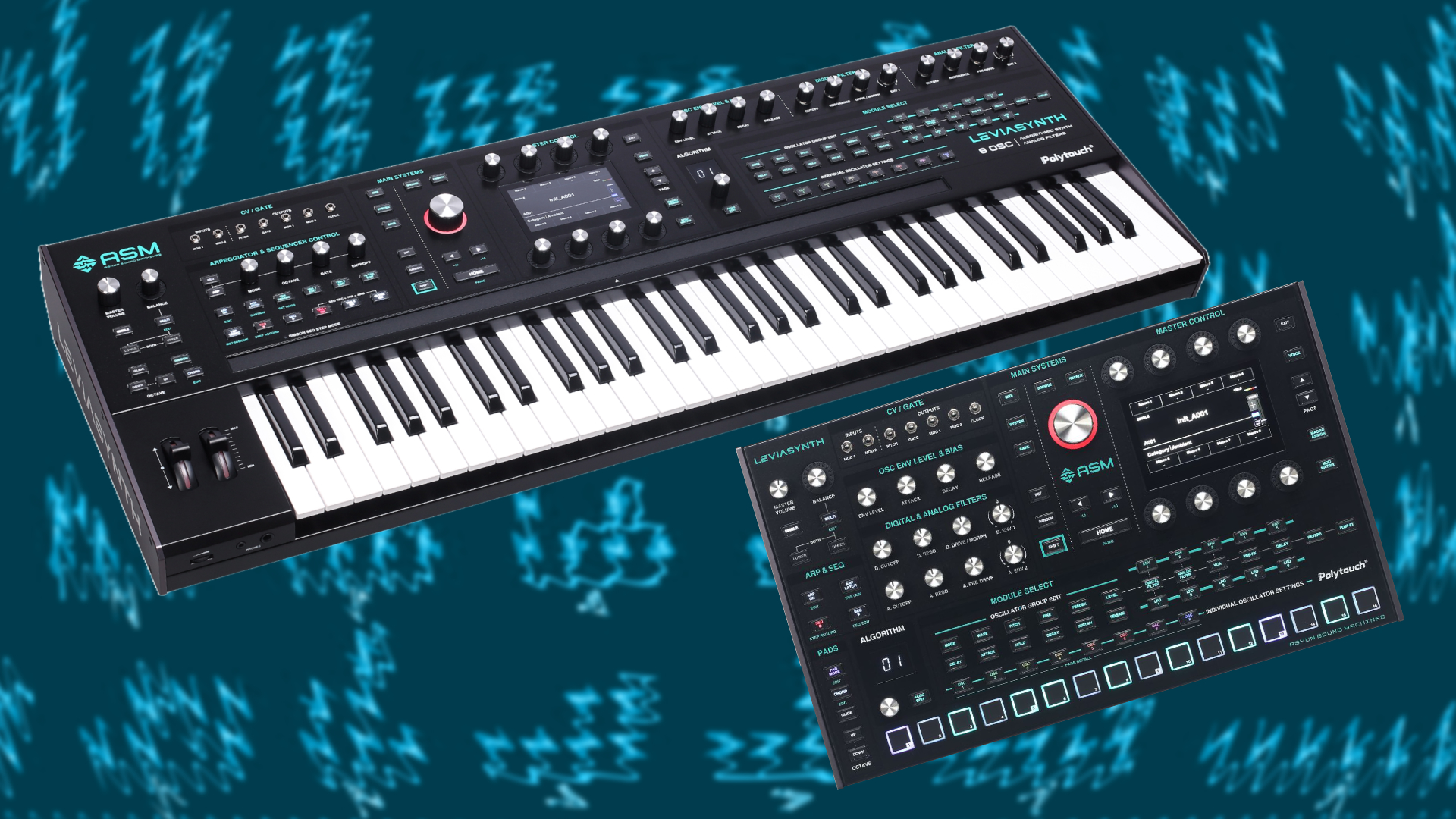
ASM Leviasynth
Ashun Sound Machines, or ASM, the makers of the Hydrasynth, released the Leviasynth today. After various versions of the Hydrasynth and the Wind Synthesizer Diosynth, the portfolio has expanded with an all-new Synthesizer.
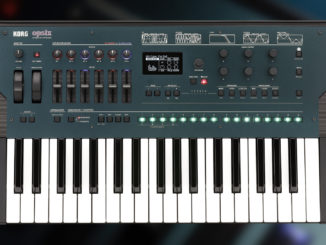
In recent years, FM synthesis has made a major comeback in many different forms, always with modern approaches. A good example is the Korg opsix that made FM synthesis more accessible and programmable.
The new ASM Leviasynth also joins this new wave of FM synthesis instruments. It is, however, officially not described as an FM synth but as a new hybrid algorithmic Synthesizer. You can get a 61-note keyboard and a rackable desktop version.
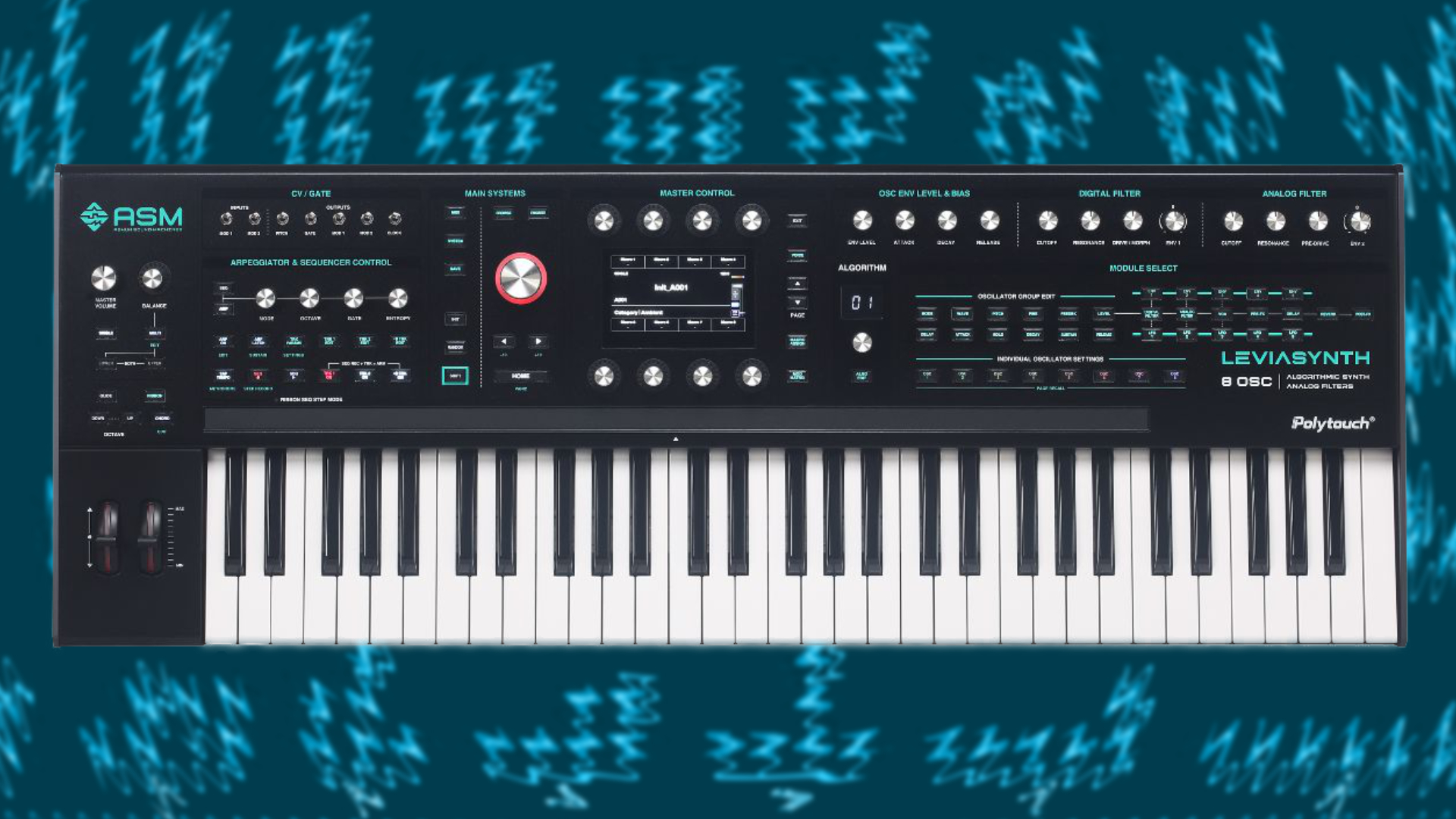
The differences are simple. The Leviasynth keyboard version offers an updated 61-note Polytouch® polyphonic aftertouch keybed with a 4-octave ribbon controller.
On the other hand, the desktop version lacks all that, but it’s cheaper and offers the same engine control elements. This includes many knobs, a Hydrasynth-style hands-on button matrix, as well as a new multi-color touchscreen
Not in the keyboard, but exclusive to the Levia Desktop, are 16 Polytouch polyphonic aftertouch pads with on/off velocity sensitivity. They are also shaped differently from the ones in the Hydrasynth.

Reimagined FM Synthese
Leviasynth offers 16 voices with 8 oscillators per voice and a combination of analog and digital Hydrasynth filters.
It has two voice operation modes: single mode with all 16 voices or multi mode, where you can allocate the voices into two parts of eight voices each, making layers or splits easy to set up.
In classic FM terms, Leviasynth has 8 operators arranged in groups, known as algorithms, that define their relationships. The Ashun Sound Machines designers didn’t just dust off FM synthesis from the ’80s; they reimagined it.
This can be seen in the algorithm configurations. There are 144 preset algorithms available that take the often cryptic aspects of FM synthesis out of the equation. So more than the usual 32 and no algorithm nightmares.
For the FM nerds, it also has an algorithm that can be customized per patch. A highlight is the ability to morph algorithms, offering you nearly unlimited configurations for the oscillators.
Talking of oscillators. They are operators and thus are more than just a traditional generator. The starting point, however, is a waveform. The classic sine wave plays only a minor role here, since you have over 300 distinct waveforms to choose from.
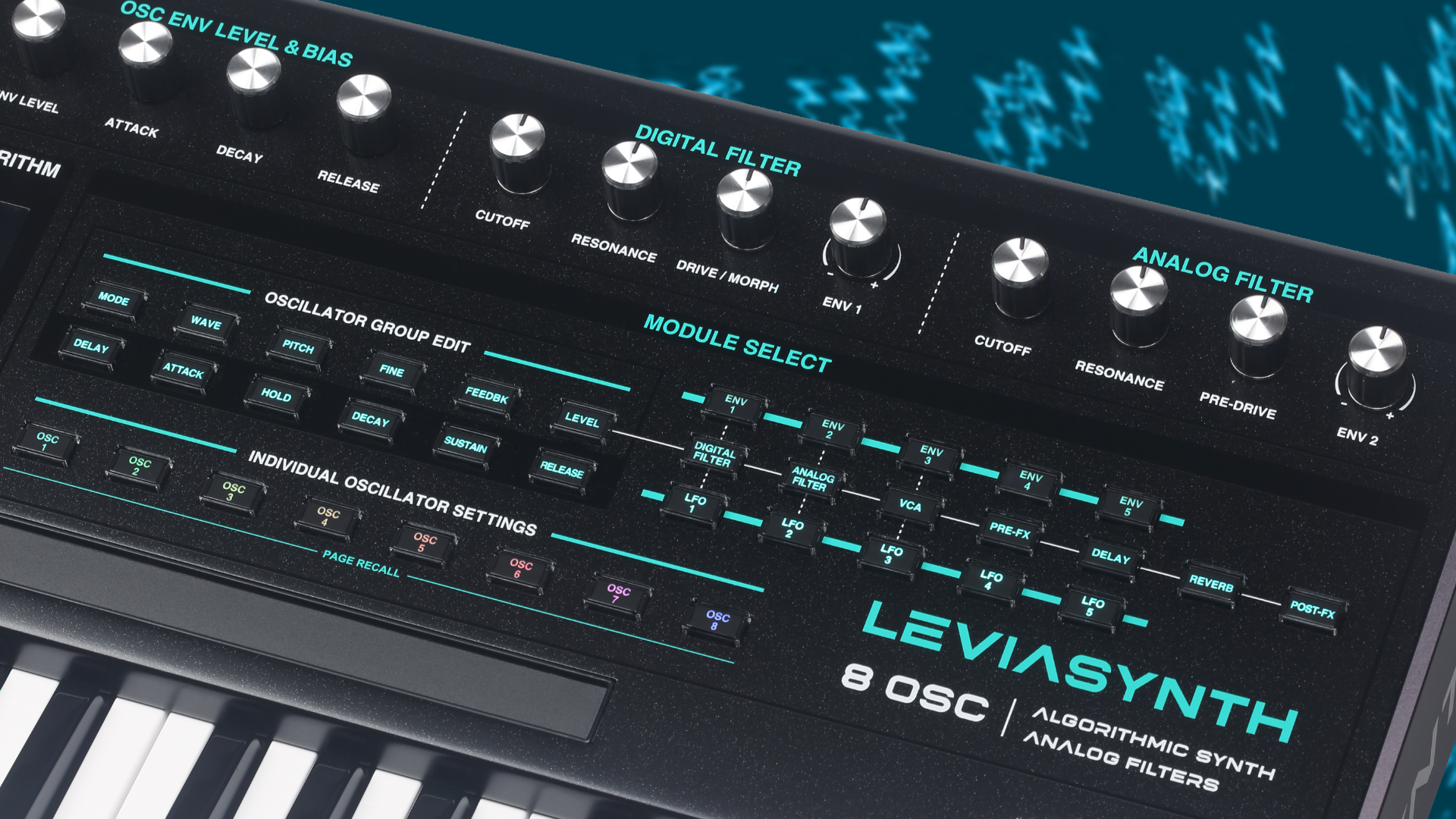
Each of the eight oscillators has its own volume envelope and independent shaping parameters, including feedback.
In addition, each oscillator offers a colorful bouquet of configurations, including phase modulation, FM, pulse-width modulation, HTE sync, and three types of phase distortion.
They are taking a similar approach to Korg with the Opsix, leaving the door open for classic subtractive synth sounds as well as sounds beyond classic FM synthesis.
Analog & Digital Shaping
Filters are essential in a modern FM synthesizer. Here, a hybrid approach is taken: both analog and digital. The analog is a 4-pole 24dB/octave low-pass filter, while the digital section consists of 18 different ones, including Korg MS-20 emulations.
18 types (LP-BP-HP, LP-NO-HP, LP Ldr12, LPLdr24, LP Fat12, LP Fat24, LP Gate, LP MS20, HP MS20, LP 3-Ler, BP 3-Ler, HP 3-Ler, LP Stn12, BP Stn12, HP Stn12, LP 1 Pole, LP 8 Pole, Vowel)
This covers a wide range of filtering, from subtle to aggressive. Both analog and digital filters have separate sections on the front panel with independent controls.
Neat, the digital filters also offer morphing capabilities, allowing you to create filterscapes. Both filters also support pre-drive saturation and self-oscillation.
Alongside the eight operator envelopes, Leviasynth also features five envelopes per voice and five syncable LFOs per voice with classic and advanced shapes (sine, triangle, noise, random, step…).
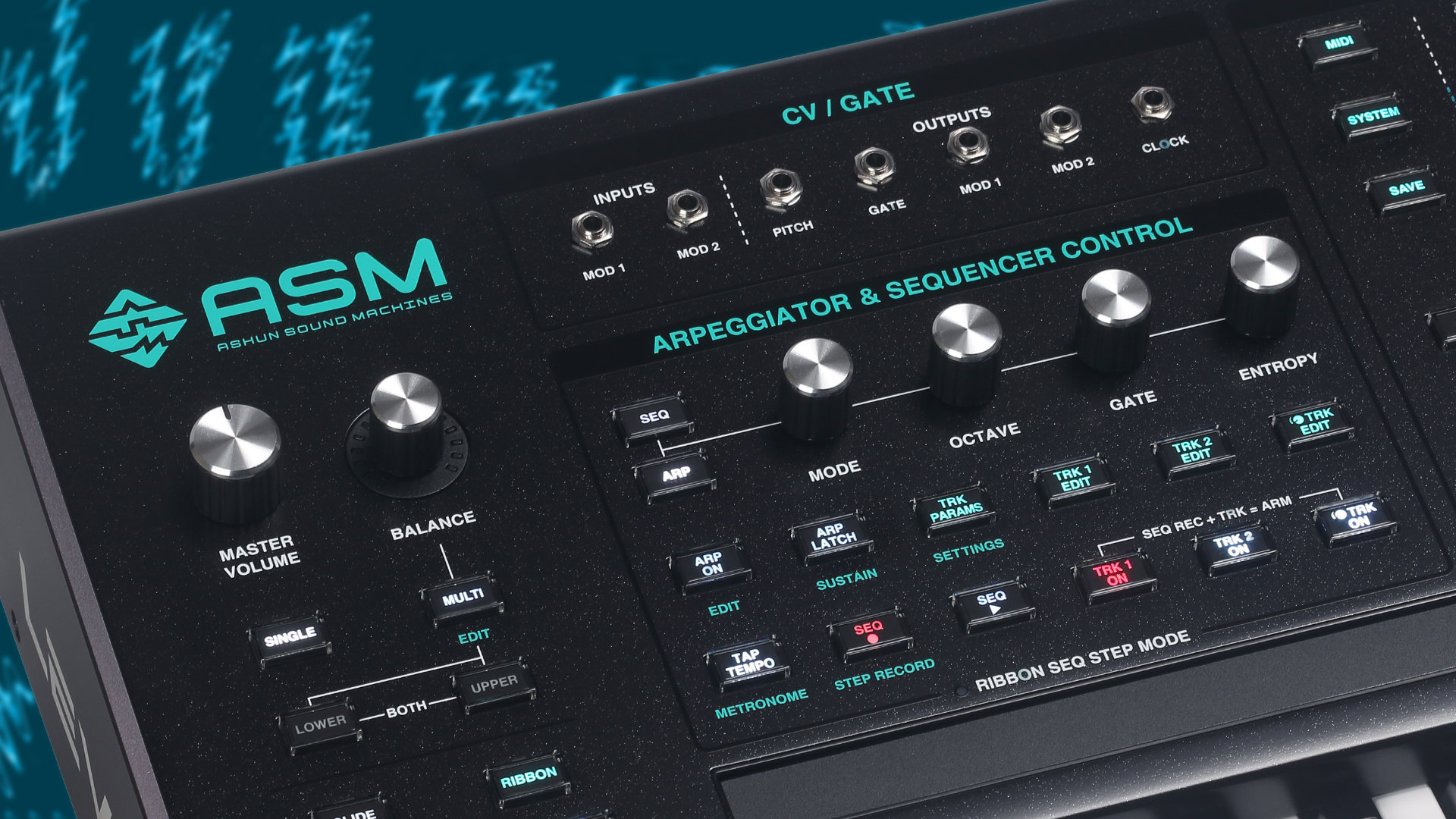
They are all freely routable in the powerful 32-slot modulation matrix, giving access to more modulators, such as velocity, aftertouch, polyphonic, and MPE. Yes, the Leviasynth is fully MPE compatible.
ASM Leviasynth also houses a multi-FX section with two insert effects and two master effects, including five delay types, four reverbs, chorus, flanger, distortion, rotary, compressor, and more.
Hurray! A Sequencer
The Hydrasynth has a super fun, inspiring arpeggiator that I love, but no sequencer. They’ve done things differently here. Leviasynth has a 3-track sequencer onboard that records both layers and macro automation.
Further, you can find the beloved Hydrasynth arpeggiator in an expanded form with a new Entropy function designed for advanced real-time note manipulation. I hope they can also pack this into the Hydra at some point.
Plus, it supports micro-tuning, eight macro controllers, unlimited favorites, and two distinct randomizers.
Leviasynth is made for rich sound design sessions. Patches can be saved into a total of 1024 single-mode locations and 640 multi-mode locations. The factory library ships with 512 single-mode and 256 multi-mode patches, designed by professional sound designers.
The free ASM Patch Manager for Mac and PC enables easy firmware updating and patch management. I also hope it will have a built-in patch editor; that’s something Hydrasynth still lacks after all these years.

Connectivity
The back side is identical. From left to right, it has a headphone socket, stereo connectivity on two 6.3mm jacks, sustain and expression pedal inputs, a 5-pin MIDI thru/out/in interface, USB-B port, a power supply (12V 2A), and a power switch.
ASM Leviasynth First Impression
At first glance, Leviasynth looks like a real algorithmic beast. That’s what colleagues who received test units confirm as well. The sound design possibilities look massive from what I’ve seen in the videos. Whether it’s too much in one device remains to be seen.
Anyone who says it’s a Hydrasynth successor is talking nonsense, in my opinion. They’re very different instruments, each with a unique character.
What Korg launched with the Opsix, ASM refined and took to the next sonic level with the Leviasynth, and added analog filters on top. It’s a super exciting FM, uh, sorry, algorithmic Synthesizer. But whether it’s the best Synthesizer release of the year remains to be seen. The year is only 19 days old.
ASM Leviasynth will be available soon from retailers for $2499/3299€ and the desktop version for $1799/2399€.
More information here: Ashun Sound Machines
Available from my partners

Looks really cool, but a price comparison between the hydra and the leviasynth is a big time oof!
Interesting synth with a slightly interesting price.
Quite expensive, maybe worth it.
But a Chinese manufacturer being much, much cheaper in us$ than the euro.
Watched the leviasynth reviews from bobeats & loopop & sonicstate in series.
*Head Explodes*
At 2499 I rather go with the modx m which I also does FM, virtual analog, has amazing presets and PCM sounds too. Yamaha is underrated IMHO
Not sure the analog filter justifies the price.
This is two Digitones II and some more and with these you also get very capable midi sequencers.
With the two Digitones II you will produce many tracks and need nothing else, but with one Leviasynth you will still need some more equipment and a mixer.
I know it is not always about economics, but I just can’t see the value in this product. Seems like after building a lot of respect with Hydrasynth the investors now want to see some cash.
at this price, they can keep it
$2499 USD, but £2884. What’s going on there?