
NAMM 2026: Stylophone On-The-Fly is a new performance, no-menu-diving sequencer that expands the CPM (DS-2/DF-2) device family.
Over the past two years, Dubreq has enjoyed great success with its CPM (Compact, Portable Modular) series, featuring the DS-2 drone synth and the DF-2 stereo analog filter box.
A new Stylophone sampler called Voice was introduced last week. There’s another new product for NAMM 2026. Dubreq has unveiled the Stylophone On-The-Fly, a new performance sequencer.
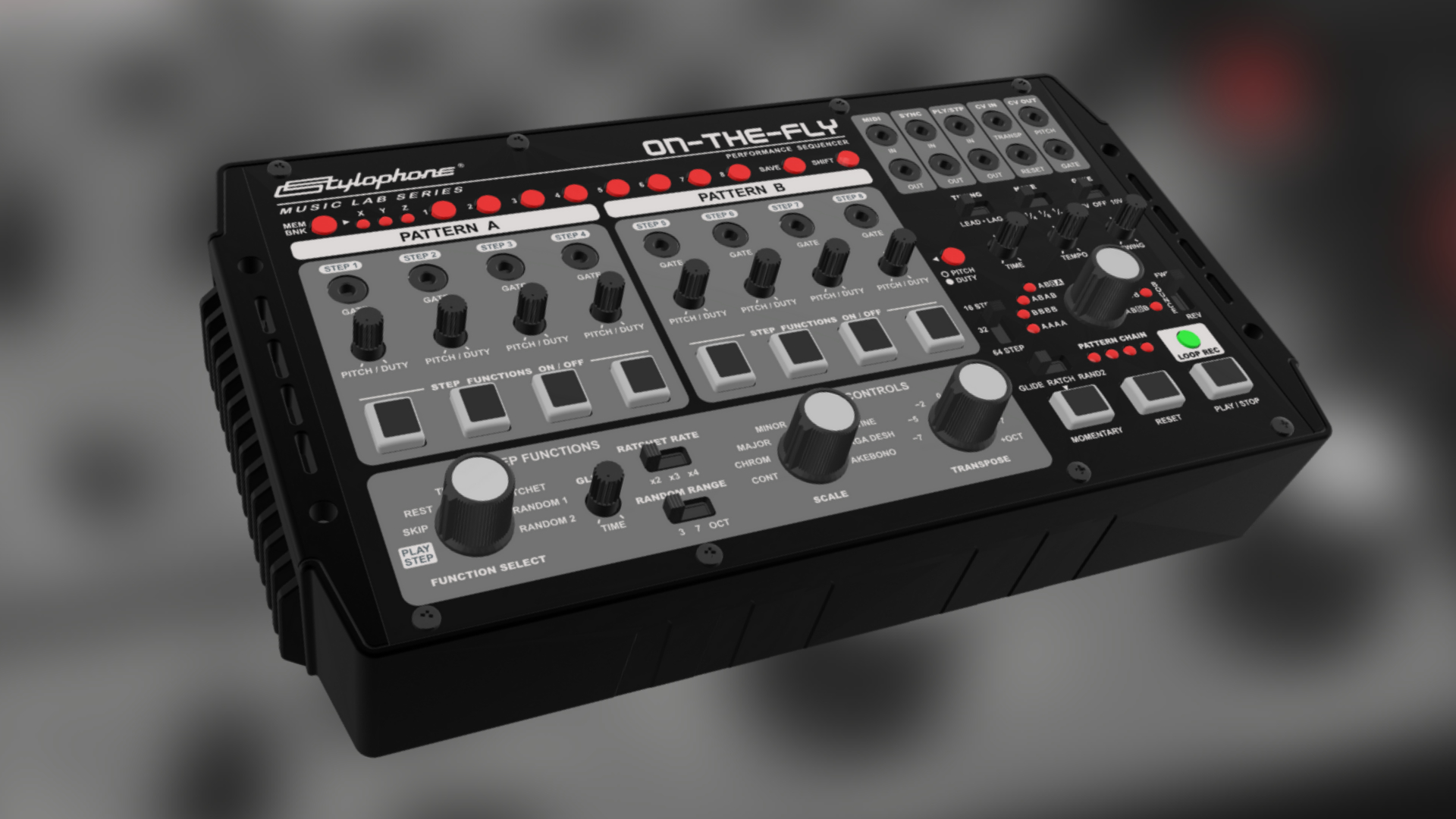
Stylophone On-The-Fly
On-The-Fly is a new hands-on performance sequencer that integrates seamlessly into the current CPM instrument/effects series or into any other MIDI/CV gear.
The concept of the Stylophone On-The-Fly strongly reminds me of the almost legendary Korg SQ-1. Dubreq says it’s very accessible, no menu diving, and it’s programmable and playable. Exactly why the Korg SQ-1 is so loved by many.
Stylophone On-The-Fly has two instantly accessible patterns, each with 4 steps, for a total of 8. Each step has a dedicated control over the pitch/duty. Plus patch points for each step.
A highlight is the unique way it combines both patterns. This is super instant because it’s a switch knob with built-in pattern chaining presets. Depending on the button’s position, you get multiple repetitions of pattern A or B, or a mixture of both.
You can instantly switch between these chainings. The same applies to the directions: forward, backward, and backward bounce.
Four steps or eight steps might not sound like much at first glance. However, with per-step functions, you can achieve significant complexity in just eight steps.

Each step includes a button that lets you assign a step function. These range from simple skip, glide, and reset to ratcheting or controlled randomness per step.
This flexibility allows you to generate complex, highly varied sequences from as few as 4 or 8 steps. Alongside this, you have a built-in quantizer with various built-in scales (chromatic, major, etc.) and a live transposition option.
Longer Patterns, No Problem
Ok, if this 8-step complexity is not enough, there is also an option expand them to 16, 32, or 64 steps. You can go even higher. Looking at the front panel, you also have a built-in pattern looper that lets you capture your loops into up to 1024 steps.
Then, you can find adjustable global sequencer parameters, including time, tempo, and swing. There are also different note, timing, and gate settings available, including switching between 5V and 10V for the gate.
On top of that, you can save patterns into three memory banks (X, Y, Z), each with space for up to 8 sequences.
On the connection side, it offers MIDI in/out on TRS mini jacks, sync in/out, play/stop in/out, a CV input, a reset in, and classic CV/gate connectivity for analog gear like Eurorack synths.
Dubreq promises that it integrates effortlessly into modular, MIDI, and hybrid setups — and scales up easily with more units into a multi-sequencer system.
First Impression
Honestly, I’m not a fan of super-powerful sequencers that are crammed with features and operated via tiny displays. However, the Stylophone On-The-Fly is exactly the kind of sequencer I really like. No menus, hands-on, and designed for jamming.
It looks like a lot of fun at first glance. I’m curious to see what the final price will be.
Stylophone On-The-Fly availability and price TBA.
More information here: Dubreq

It is a shame that this comes in a plastic case. Would be amazing if it were an aluminum chasis. With so much music tech being produced these days, it is really important to consider the environmental impact.
It looks to me like the same case as the other two they released.
Meaning you can take it out the plastic case and put it into Eurorack.
Or even build your own aluminium case.
Whilst aluminium is often perceived as more “premium”, modern recycled engineering plastics are extremely durable and significantly better at absorbing shock than metal, which tends to dent or permanently deform. In practical use, plastics can offer superior protection for sensitive electronics.
Environmentally, the issue is more complex than material choice alone. Recycled plastics generally require far less energy to process than aluminium, which remains highly energy-intensive even when recycled. When durability and reduced failure rates are factored in, a well-designed recycled plastic enclosure can have a lower overall lifecycle impact.
Sustainability is ultimately about longevity and lifecycle efficiency, not material symbolism.
This is absolutely false. Most enclosures for electronic devices are made from ABS. Nylon is also heavily used. This enclosure looks to be ABS.
ABS does not break down. It is recyclable but has a distinct recycling process that is not readily facilitated meaning that most ABS items end up in landfill. Any recycled ABS must be mixed with virgin material in order to become useable.
The production of ABS IS energy intensive. Recycling….if utilised is also very energy intensive.
For such an item, the choice of plastic over aluminium is purely because of cost. This is not an item built to withstand high impact or high weathering tolerance. Your argument is very uninformed.
Do not confuse feelings vs engineering verities.
• “Most enclosures are ABS” is a lazy myth.
Modern enclosures span ABS, PC-ABS, glass-filled nylon, PP, aluminium, magnesium, chosen by RF behaviour, EMI requirements, impact response, thermal isolation, tooling economics, and geometry. There is no default material.
• “ABS does not break down” is a non-argument.
Durability is a design requirement, not an environmental metric. Lifecycle energy, mass efficiency, and service life determine impact — not whether a polymer photodegrades in landfill.
• Recycling critique is selective and dishonest.
ABS loses molecular weight when recycled; aluminium loses alloy fidelity and requires re-alloying. Both rely on virgin input. Presenting this as unique to ABS is either ignorance or bad faith.
• Energy claims are backwards.
Primary aluminium: ~150–200 MJ/kg.
ABS: ~80–95 MJ/kg.
Once casting, machining, scrap, and finishing are included, aluminium is far more energy intensive per finished enclosure.
• “Plastic is chosen purely for cost” is flatly wrong.
Plastics are selected for RF transparency, electrical insulation, vibration damping, impact elasticity, weight reduction, and moulded complexity — areas where aluminium is objectively worse.
• Impact and weathering claim is uninformed.
Stabilised ABS and PC-ABS meet UL, IK, and UV ageing standards. Aluminium dents, creeps, and transmits shock; ABS absorbs and recovers.
This is not a materials argument. It is a string of misapplied facts used to justify a preconceived conclusion. The science does not support it.
thanks for that chatGPT response.
If you think that plastic was chosen for this due to anything other than cost and aesthetic, you are part of the problem.
I agree to much functionality crammed into a small screen and combination button pushes is a hassle. I share your opinion on it being a useful tool!
After not clicking with the last few manual heavy devices I’ve tried I decided that I’ve had enough of studying and will be sticking with fun, intuitive gear from now on. Life’s too short for complicated rigs that require a degree to jam with. So the recent Dubreq drops sound very appealing.
@OOO I have worked in aerospace for 27 years. I do not require LLMs to educate me, nor do I outsource my understanding of materials engineering to internet folklore. If structured bullet points are objectionable, that reflects a comprehension issue, not a technical one. This is a forum for reasoned technical argument, not the arbitration of “vibes.” Good luck to you.
20 years experienced industrial designer here.
If you think plastic is the best choice for this application in both efficiency and environmental impact….you are lazy.
Okay, enough of you two for now! You won’t find an agreement here. Everyone has their own opinion, and that should be heard, but there’s no need to escalate the conflict to an unpleasant level! Move on, have a nice day/night and make more music. Cheers.
Interesting ^^ how many TE/HP will it use when mounted in eurorack ?
probably the same as the others but not sure
Their Drone Synth is 42 HP.
I’d imagine this one uses the same enclosure, but can’t say for sure as they haven’t released the full specs yet.