
The JE-8086 is now available, and Giulioz provides insights into the development of the Roland DSP emulator in a new CCC tech talk, including the Supersaw algorithm.
Just before the end of 2025, the Usual Suspect team released the JE-8086, a DSP emulator for Roland JP-8000/JP-8080. Unlike previous emulations, the developers went right down to the core of the synths.
They didn’t emulate the engines, but rather the DSPs; in this case, the Roland chip TC170C140 (ESP2) made by Motorola.
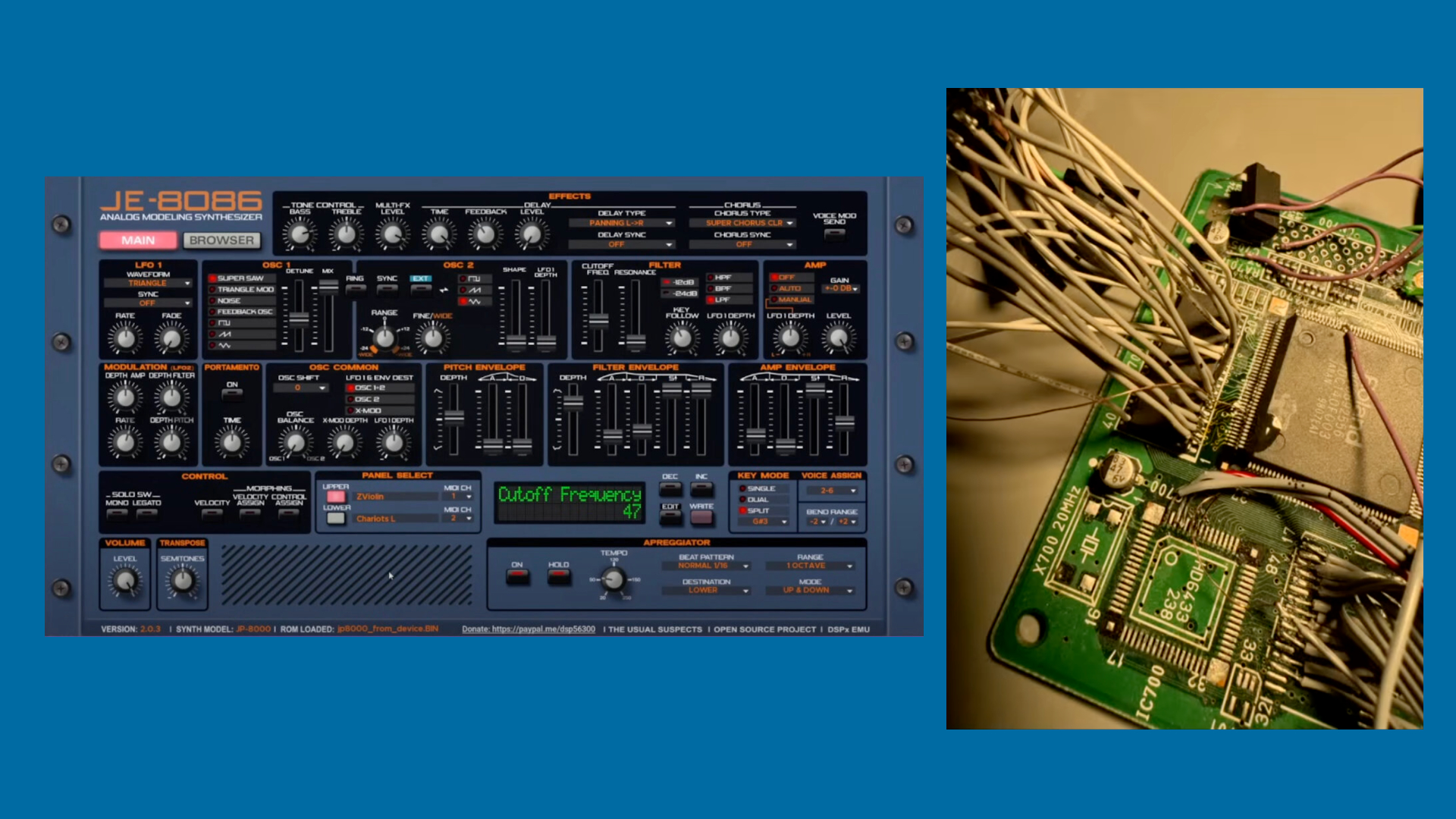
JE-8086: Roland DSP Emulator
One of the developers on this project is Giulioz, who has already reverse-engineered several Roland chips, including Roland TVF (Fujitsu MB87424, 1989), DSP (Toshiba TC23SC260AF-002, 1989), and many more.
A tech talk from the Chaos Computer Club was recently published. In it, Giulioz provided insights into the fascinating development of the latest Roland DSP emulator for the JE-8086. According to him, it was the most extensive project he had ever worked on. There’s a reason for that.
Until now, this information has been a great mystery. Roland has never released any documentation about the chips. Through painstaking work, the developers reverse-engineered the chips using various methods and thus developed the emulator for them.
Many people are praising the JE-8086 emulator; I find it even more remarkable that the developers reverse-engineered this mysterious chip without any documentation.
The Supersaw Algorithm
Additionally, the developers have revealed the long-kept secret of the algorithm that creates the original Supersaw waveform. No developer of any existing JP-8000/JP-8080 emulation has yet captured it as initially intended.
The closest thing so far has been Adam Szabo, who wrote a paper about it and released a very authentic emulation with the Airwave. It’s not perfect for the developers. But the secret is out now, and the technique is surprisingly simple.
Giulioz revealed that the original Roland JP-8000/8080 Supersaw consists of 7 naive saw waves, passed through a high-pass filter without modulation, with no phase tricks or chorus. If you replicate this, the oscillators will alias.
The trick lies in the hardware’s sample rate (JP-8000/8080), which is 88.2 kHz, thus preventing aliasing.
I’m curious to see how many developers will adapt their Supersaw algorithms based on this open-source information.
For anyone who wants to learn how the JE-8086 was developed and how far the developers went, I can only recommend the linked video.
More information here: Guilioz / The Usual Suspects


very Interesting Video!
But the Program Sucks a Lot of Power, from what i have Heard.
It’s installed on my basic M4 and have no CPU issues
M4 is quite New, or Not?
But even basic m4 is powerhouse
I can run many instances of the plugin with no issue, but I get massive and sudden CPU spikes once I open the UI. If I close my DAW and reopen it, I can once again play the same patch with no issue. This is even true of using it by itself in it’s own DAW session, I’m thinking the CPU issues may be a bug or lack of system optimization as I don’t have issues like this with any other plugin including the other Usual Suspects ones and I use a lot of CPU intensive plugins.
thanks!
thats interesting.
maybe Just a Bugfix.
On a Ryzen 5800x (2020) I can run 3 instances on one core. That’s not bad for running through an emulator. You can get those new for $220 on NewEgg right now. I haven’t tested it on my 9700X (34% faster)but would be fine and that’s $300 new.
Not only that but they have a server module so if you have another computer you can run it over the network as a regular plugin in your daw. Granted you’ll want hardwired ethernet, but who else doesn’t something like that.
Just watched this, and it was a cool and fascinating presentation. They invested some serious work, and it’s nice to see some effort to preserve these older VA synths. Not sure why the companies who made them don’t do something similar.
Owned the JP-8080 for 5 or 6 years, but I sold it because other than the supersaw, I preferred the overall sounds of my Virus C, Yamaha AN1x, and Novation KS4 quite a bit more.
still have my First synth the an1x!
it’s ready to play on my quiklok!
love those 90s digital Pads with Lots of movement!
nice for Jungle & drum and Bass.
“I find it even more remarkable that the developers reverse-engineered this mysterious chip without any documentation.” – it’s been a fairly common practice for decades. not as hard as it sounds for those skilled in the art.
There has been a free supersaw based on Szabo’s published paper for many years for VCV Rack. Here’s a link to the manual: https://github.com/kockie69/SquinkyVCV-main/blob/master/docs/saws.md
Great video. Thank you for posting it. I donated to them, it’s well deserved.
Um, just because someone publishes something they’ve discovered, doesn’t make it “open source”! The supersaw could still turn out to be Roland IP. Whether they do anything about that is another matter.
I’m not sure that a simple “7 naive saw waves, passed through a high-pass filter” is under an IP otherwise I will make a 6 naive saw waves variation under a new IP 😉
Scooter should pay Roland a Lot. before the jp8000 they Had 303s and Other Stuff and then mostly jp8000. Rick (Keyboarder with Scooter for 20 years still Had it in His Main stand in an Interview a few years ago. have the First Album with Autographs from Back then. 😃
These guys are absolute geniuses. It still amazes me that with so much time and effort spent on development of this plugin Usual Suspects makes this plugin absolutely free… ❤️
What an excellent insight. Truly great stuff.
Still makes me wonder why Roland didn’t manage to “crack” this code and therefore release its own emulation of JP8000…?
Perhaps Roland doesn’t have necessary highly educated personnel on par with Usual Suspects team, or they just don’t care…
Oh well, it’s too late now anyway, is it… 😂
i admire Eric persing.
but when Roland called and Said they Need New Hoover Sounds, He allegedly Had to Google that.
i am also wondering.
maybe they forgot how they Made it?😀