
Soundforce SFC-Mini V4 is a new Boutique MIDI controller that gives your Minimoog plugins the programming experience of real ones.
Every modern musician has one or more generic MIDI controllers at home. Even if they aren’t particularly inspiring, they do give software instruments some haptic feedback. It’s also possible to bring the whole thing closer to the controlling software.
Soundforce, based in the Netherlands, builds boutique MIDI controllers with layouts designed for specific virtual instruments. These are based on Roland, Oberheim, Sequential, or Moog synths. The latter just got a successor. Soundforce has introduced the SFC-Mini V4, the latest generation of its Minimoog MIDI controller.
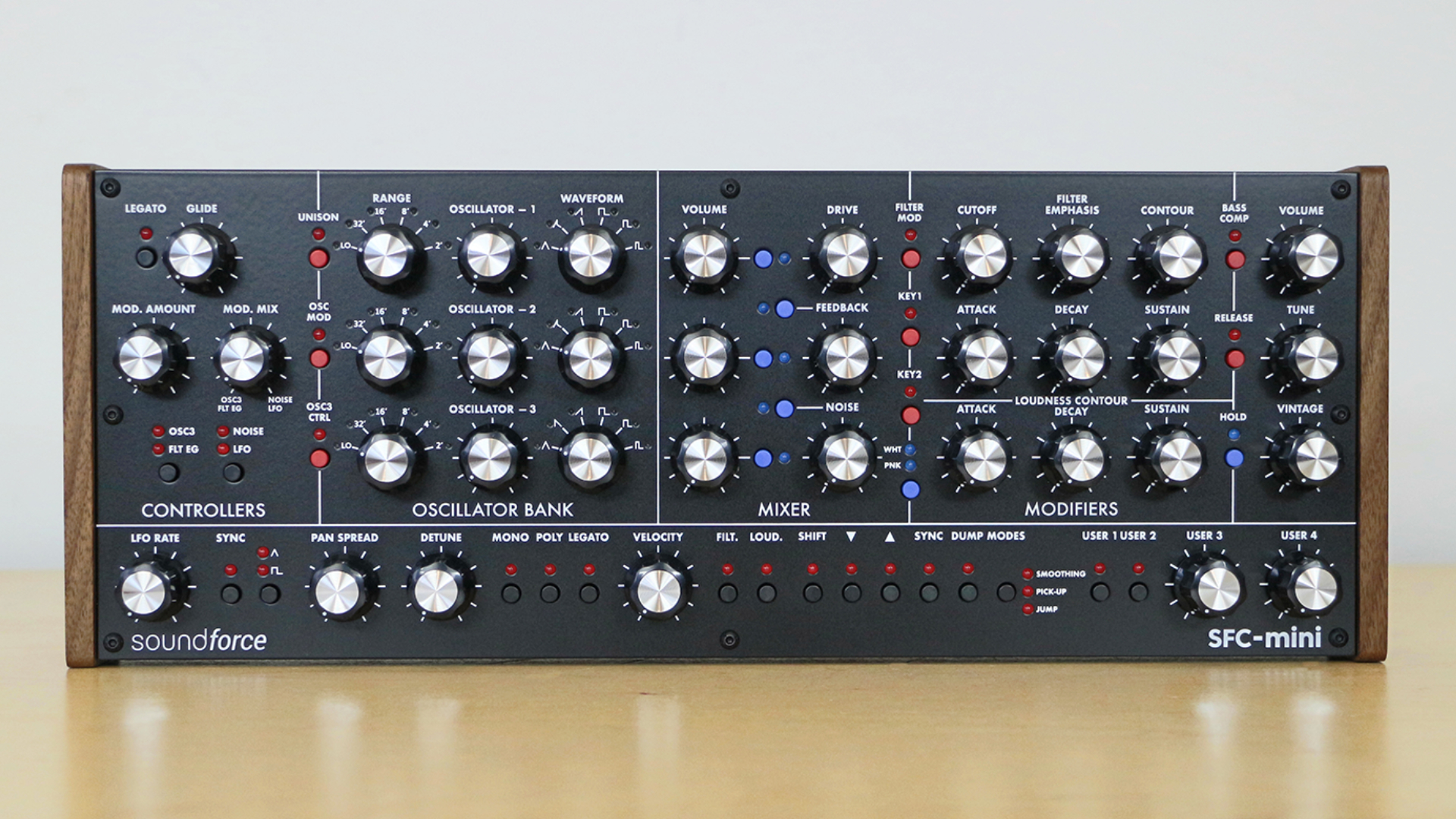
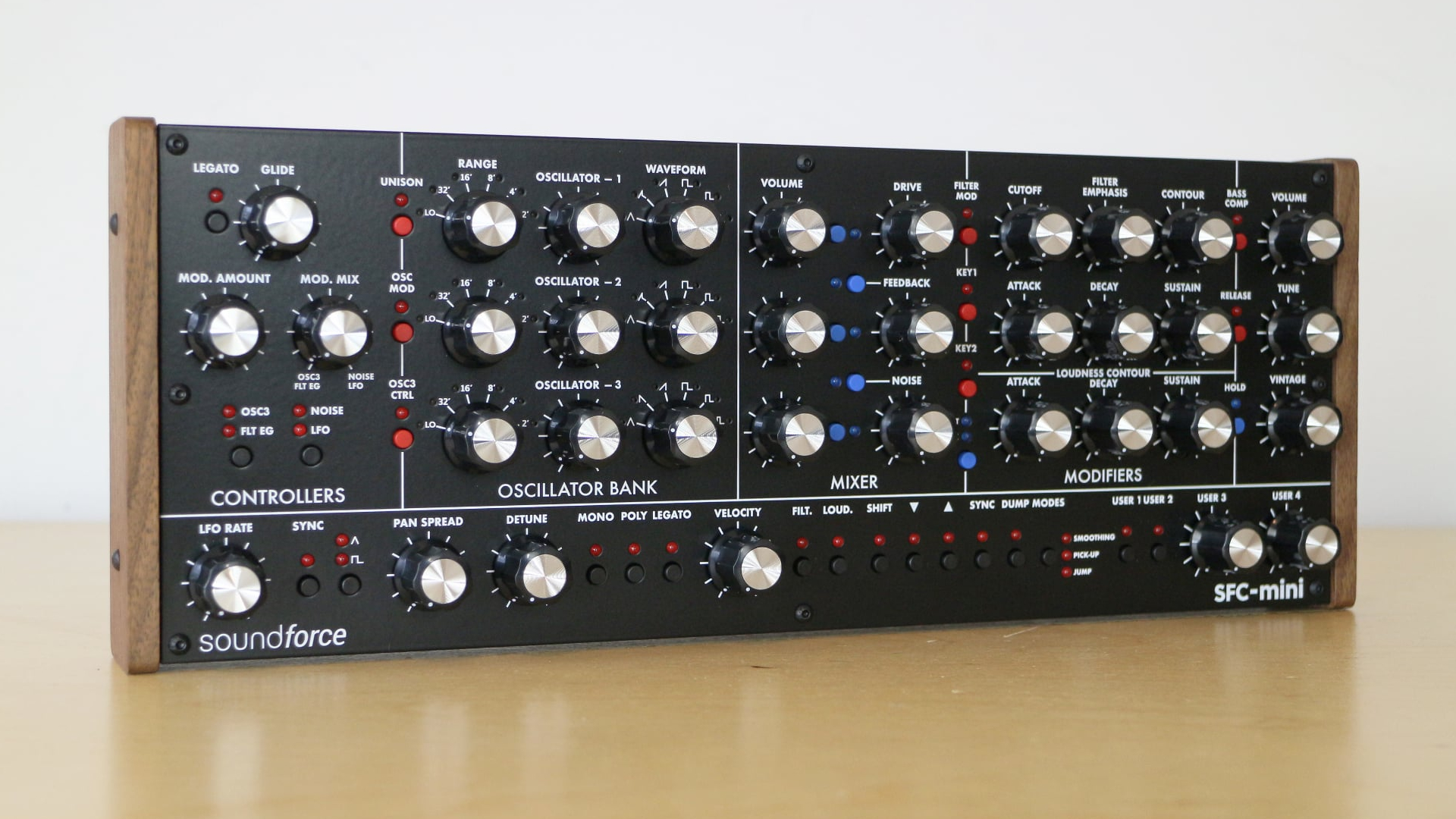
Soundforce SFC-Mini V4
The new SFC-Mini V4 is a new MIDI controller with 65 hands-on controls, including knobs and buttons.
Unlike generic MIDI controllers from Arturia and Novation, which arrange parameters in a more traditional layout, the Soundforce SFC-Mini V4 is inspired by the legendary Minimoog Synthesizer layout. And there’s a reason for that.
The SFC-Mini V4 is designed for Minimoog Synthesizer emulations. They give the Minimoog plugins an analog-inspired workflow plus a haptic experience. It’s important to emphasize that this isn’t just a high-end MIDI controller with a nice feel.
The latest Soundforce controller generation can communicate bidirectionally with plugins, rather than sending MIDI CC data unidirectionally.
This has the advantage that it gives you a more intense “hardware-like” experience because the control reacts to the changes made in the plugin. This is currently only possible with the Arturia Mini V4, but it may be available with other plugins in the future.
Change a preset, load a new instance on another track, or move a parameter with your mouse. In these cases, the controller automatically syncs its LED switches and ingests the pot data in memory.
You can choose among three knob reaction modes when the controller receives input: jump, pickup, and smoothing.
Plugin Support
To ensure seamless integration, Soundforce collaborates with plugin developers and ships the SFC-Mini V4 with dedicated plugin modes.
Currently, it supports the following Minimoog emulations: Arturia Mini V4 (incl. 2-way), Arturia Mini V3/iMini, GForce Minimonsta 2, Cherry Audio Miniverse, Universal Audio Minimoog, Softube Model 72, NI Monark, Synapse Audio The Legend HZ, and Plugiator Minimax.
The Minimoog app from Moog is not included. When asked, the developer stated that it wasn’t explicitly mentioned, but it works perfectly with the controller. More mappings may be added.
Important: Although the SFC-Mini V4 was primarily designed for Minimoog plugins, it is a standard MIDI controller that supports MIDI CC mappings.
On the back, the SFC-Mini V4 features a USB Type-B port for USB-MIDI data and power, and 5-pin DIN MIDI input and output.
First Impression
If you’re familiar with the SFC-Mini V3, the visual upgrade of the V4 is massive. It really does look like a shrunken Minimoog now. The new 2-way communication is also a neat addition.
I’ve always found the idea of building MIDI controllers like this very exciting, and I’m sticking with it. Yes, they are polarizing. But they also have their fans, which I can understand.
If you work extensively with such plugins, either this or the other Soundforce controllers provides not only sound design but also a hardware workflow.
Available from my partners

Literally costs more than a Behringer model D or a Roland se-02, you are smoking something lol
Except for the build quality – I have owned a couple of Nicolas’ controllers and they are full metal, nut-locked metal pots, real wood – it’s a different class. If cost is the only thought, but cost isn’t the only thing that makes hardware viable.
I have the V3 as well as the SFC-OB and SFC-5. I am a sound designer – producing mainly Arturia patches. All three are fantastic, great to use and very well built and an efficient use of space ion my small studio. I cant afford the real synths they represent, so this is an affordable alternative for me. The V4 looks fantastic and after I have bought a couple others I have in mind, I may upgrade to it. On a side note, I also use the Korg MS20ic which works seamlessly with not only the Korg plugin but the Cherry Audio and Arturia plugin.
My mission is to make the best hardware I possibly can for my customers, not to align my prices with a company that has a history of questionable practices and a full in-house factory in the manufacturing beating heart of the world.
This is the best possible response. I’d rather buy a rock solid product from a boutique manufacturer in the Netherlands than support a massive Chinese company with head offices in Dubai.
It will not work well with Synapse The Legend, because this plugin needs TWO knobs per oscillator for tuning (one for semitones, the other for fine tuning) – and this controller does not provide that.
Also, The Legond has a dedicated release knob – absent here.
strange that it has a Legend HZ mode 😉
Yes, there is a plugin mode for the Legend HZ and it tries as much as possible to find a solution for that. You can read the details in the manual: https://soundforce.notion.site/Synapse-The-legend-HZ-2ae8e657f71c80c6862edfd9cf1d1c0a
Many thanks Larry and Rnedp for chiming in! I am so glad you are enjoying your controllers!
You are welcome. To be honest, I am not sure why they are not getting more love from the likes of Arturia users. I have tried to promote them on the Arturia Forum where I contribute regularly but there was little response. But you keep up the good work and I will sell the other kidney to fund my GAS.
Simply the best custom MIDI plugin controllers in the game. The build-quality and tactile experience are second to none. Comparisons with hardware synths are pointless, because these controllers are for people who already decided in favor of software. As Larry said, these are excellent tools for plugin sound designers.
Simply a waist of money, go buy a boog and at least experience the analogue sound. Vsts moogs are just not fun.
To my knowledge, the Boog is monophonic, and you can’t even record it cleanly in a DAW with automation because it lacks MIDI CC for filters, envelopes, etc. Simply a “waist” of money 😉
I want to say: thanks for your opinion that you don’t like VST moogs. You are welcome. But I’m pretty sure there are many music producers who enjoy VST Moogs. I enjoy my Minimoog on my iPad a lot and it’s polyphonic and has MIDI CC 😉
Can a Boog store patches and can they include effects or is your patch organisation based on photos?
Model D is so simple you can store the patch in your head.
Try producing music for a TV commercial or video game with 20 revisions with a Boog (or any other vintage-style hardware synth) then and let us know how it went without presets, midi cc automation, and total recall.
Any updates in store for the Juno or Jupiters?
Nothing on the short term