
With the Essential L1, Donner has created a great-sounding Roland SH-101 clone that, unfortunately, falls short of perfection – here is the review and sound demo.
Many companies recreate vintage analog synths. However, Behringer was the first to do so at unbeatable prices. For the past three years, another Asian brand has been shaking up the low-budget, entry-level market that Behringer had dominated.
The Chinese company Donner made a surprising entry into the Synthesizer and electronic music instrument market in 2022. At that time, they launched the B1, a low-budget TB-303-inspired desktop synth for around 100€.

Donner Essential L1 Review
Donner’s second synth offering is the Essential L1, which is also based on an iconic Roland Synthesizer from the 80s, the SH-101. It has officially started shipping since July 2025.
This review unit was part of the first batch and was kindly provided by Donner. Thank you very much for making this review possible.
Unboxing
The Essential L1 Synthesizer is available in two configurations: either as a desktop unit or bundled with the matching KB-32M MIDI keyboard. If you purchase the bundle, it will still be delivered in two separate, unexciting yet straightforward brown and blue boxes.

The first box contains the Synthesizer and a 9V power supply with suitable adapters for EU, UK, and the USA. The second includes the MIDI controller with a USB-C cable. They also include a small manual with basic information.
Clone With A Modern Twist
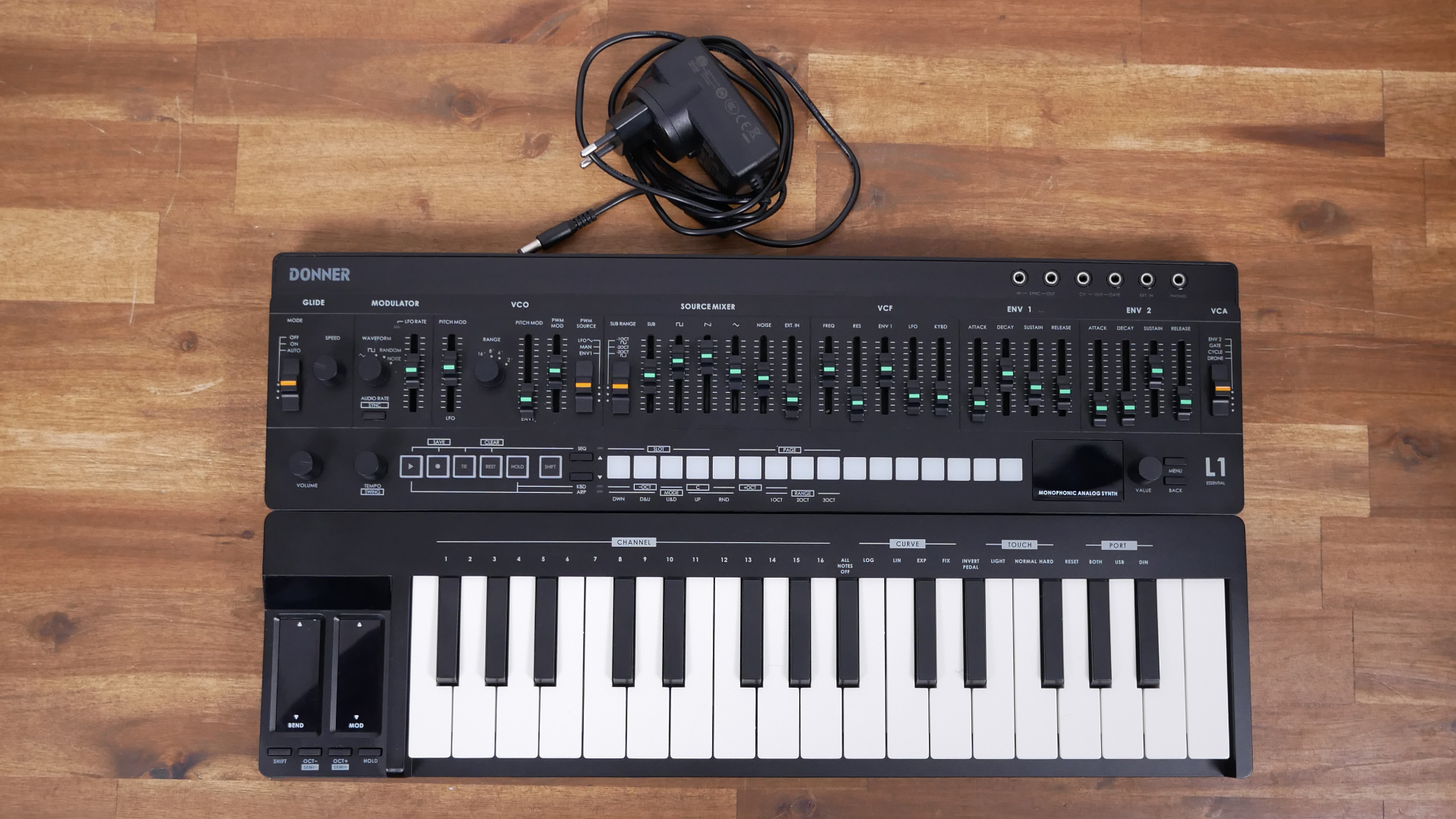
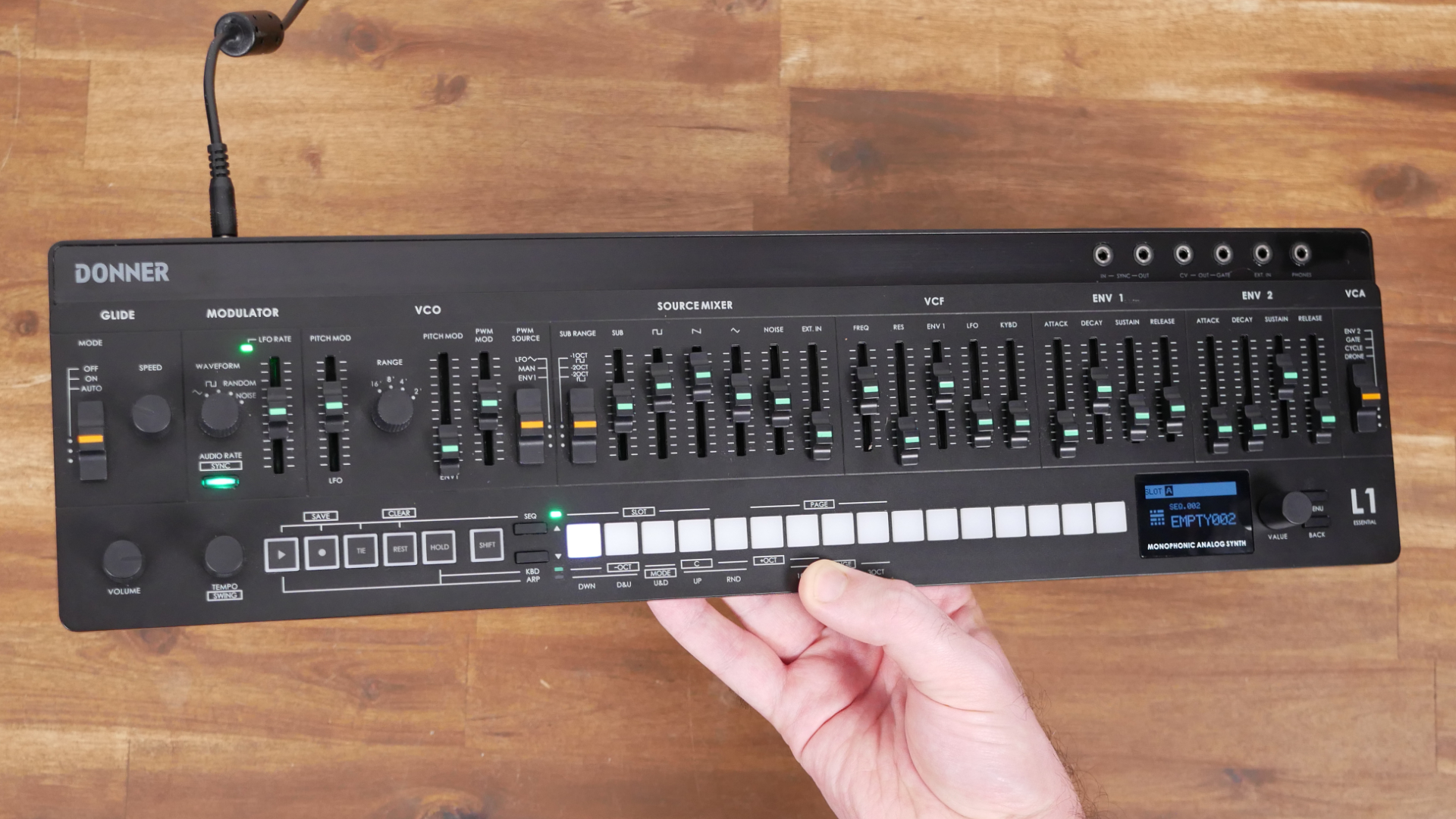
The Essential L1 is a Roland SH-101 clone. Its fader-dominated appearance is very SH-101-like, even though it doesn’t simply copy it. Unlike Behringer, Donner opted for an interesting and fresh concept that gives it a modern twist.
Synthesizer and keyboard are two separate components here that operate independently. A magnetic coupling system enables you to connect them, transforming the Essential L1 into a keyboard synth. This neat system transmits MIDI data to the synth and, in turn, powers the keyboard.
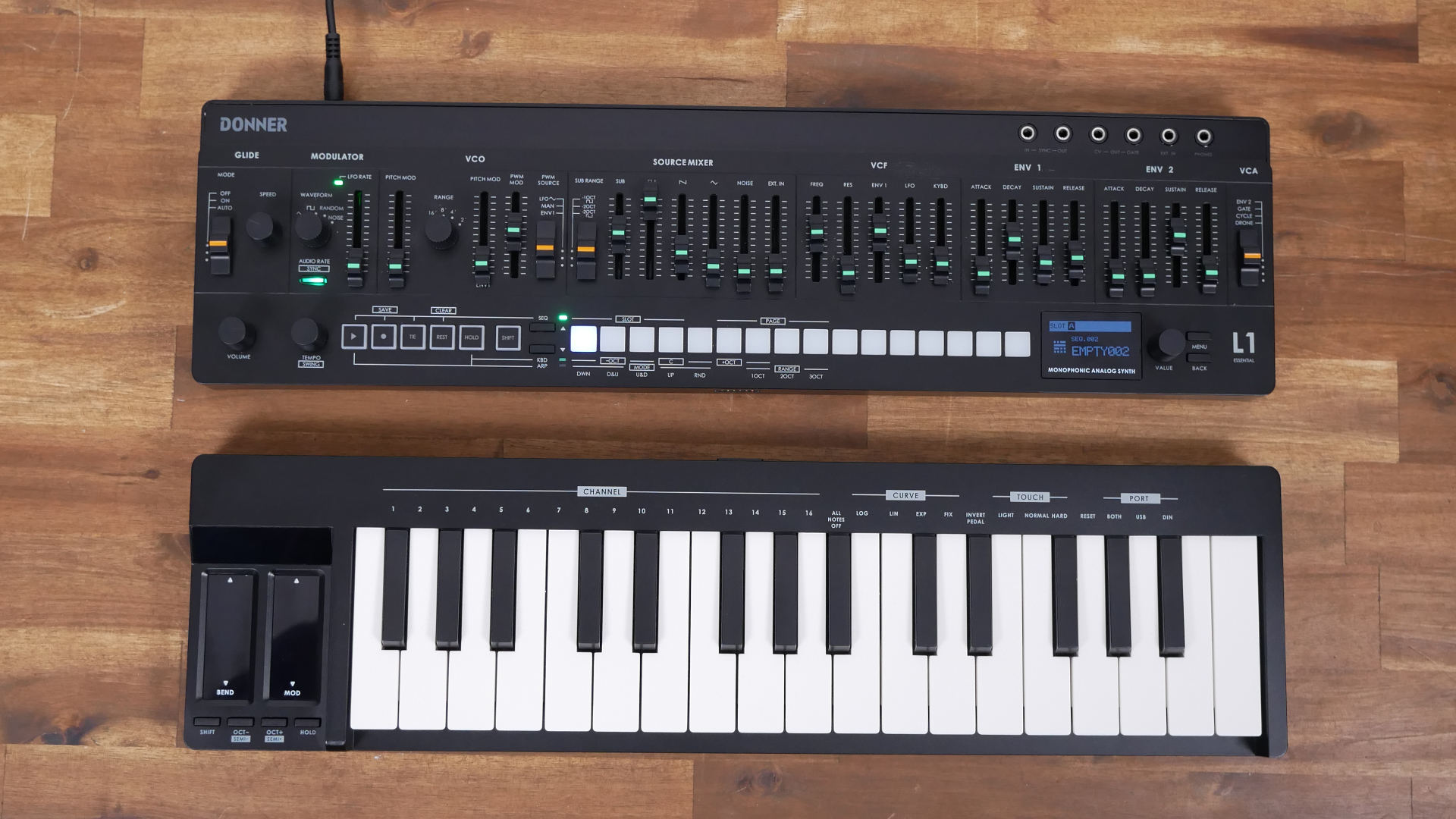
In testing, this worked flawlessly. It always takes 2-3 seconds for the system to recognize the two components. A clever idea that allows Donner to offer the Essential L1 as both a more affordable desktop synth and with a matching keyboard.
Although the system is fresh and exciting, it also has a drawback. For it to work, the synth must be lying on a flat surface. You can’t use it to build a keytar or play it while standing. The magnet doesn’t hold.
Nevertheless, it’s a welcome mini originality that they tried to bring into the clone.
Build Quality
For an asking price of around $300/€300, depending on the offer and coupon, you get a solid-made device. Its all-plastic housing doesn’t have a high-quality finish, but for the price, it’s absolutely fine. Obviously, you can’t expect a high-end product for a cost of $300/300€.
Two aspects of the finish stood out negatively to me. The faders feel somewhat cheap, and the knobs/encoders are stiff in places, especially those on the VCO and LFO range.
The Essential L1 is a device designed for the studio, in my opinion. I wouldn’t necessarily trust it for a long tour, as it feels a bit too fragile for this purpose unless you have a good, specially made case that protects it well.
Connectivity
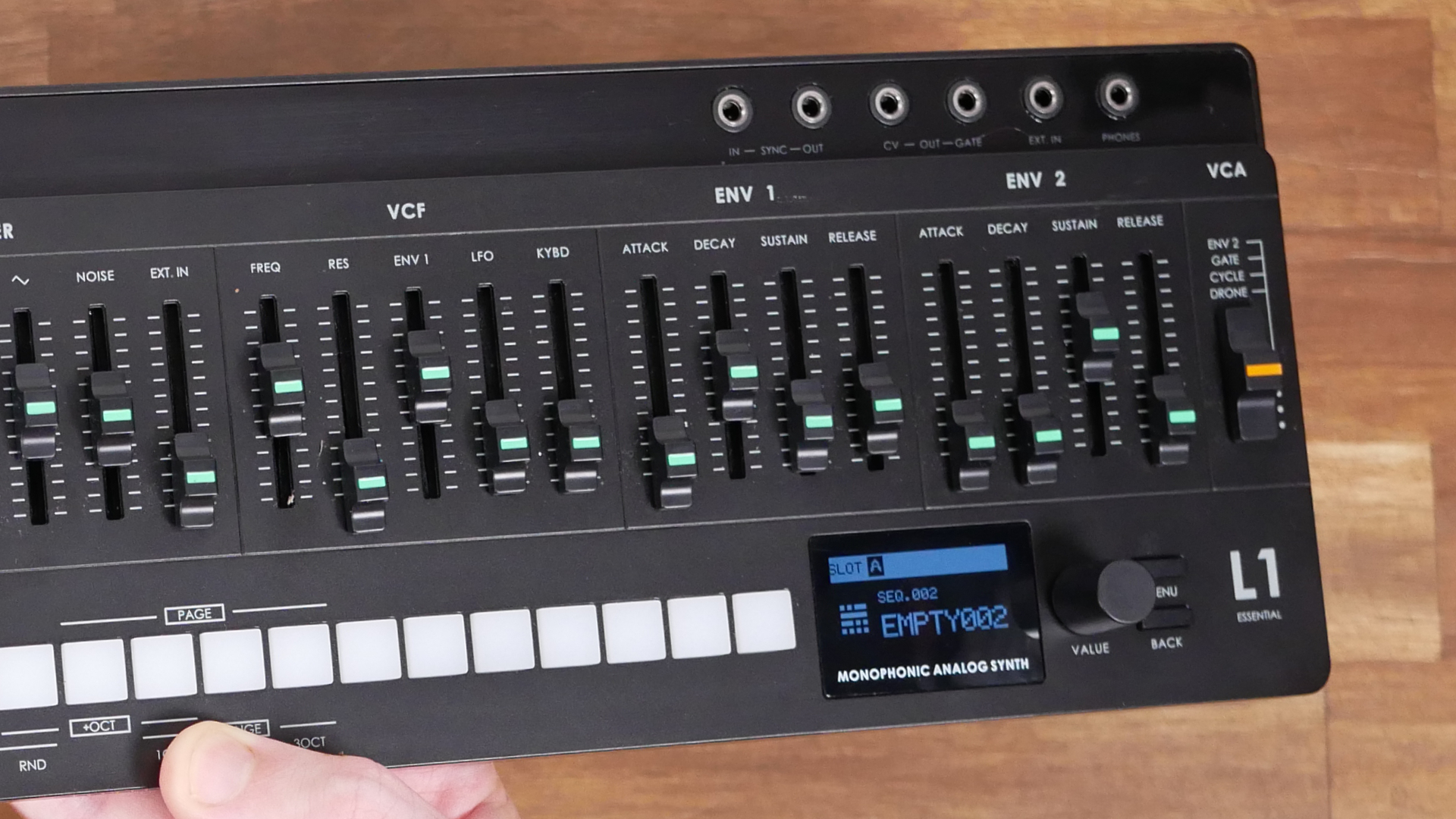
This happens somewhat less frequently, but we will check out the connections of two devices. The Essential L1 features ports on the top and back panel, similar to the Essential B1 TB-303 clone.
On the top panel, you have sync in and out, CV, and gate output, an external input, and a stereo headphone socket.
Then, on the backside, you have again an external input, but on a 6.3mm jack, a main 6.3mm mono main out, a hold input, MIDI in and out on TRS 3.5mm connectors, a USB-C port for MIDI and firmware updates, a DC power in, and an ON/OFF switch.

It has a solid range of connections, but it’s a shame they opted for MIDI TRS here. I reckon there would have been room for 5-pin connectors in the housing. Also worth mentioning is that the device can’t be powered via USB-C.
The KB-32M, on its back, is more spartanly equipped, also with a TRS mini MIDI output port, a USB-C socket, and a hold input. There is also the socket for the magnetic coupling system in the middle of the backside.

It’s great that it has a dedicated MIDI output, which makes it very useful even when used as a MIDI controller.
Analog Recreation
The Essential L1 is a 100% analog Synthesizer based on the same circuitry as the Roland SH-101. According to Donner, it uses chips that were also used in the original: the 3340 VCO, 3109 VCF, and 662 OTA—all chips that are now being authentically reproduced.
In terms of signal path, it’s a classic SH-101. It offers a mixable oscillator with three waveforms: pulse width, saw, and newly added triangle, with a range between 16′ and 2′.
Like on the original, you can create pulse-width modulation, using various modulators and modulate the pitch with the LFO. Although the L1 doesn’t feature the optional FM tweaks of the Behringer MS-1, it does offer other unique features.
A notable addition to the Donner Essential L1 is a second fader that routes the pitch modulation to the first envelope. This opens up new drum sound design possibilities that are not possible with either the original or the Behringer MS-1. I covered this in detail in my linked video.
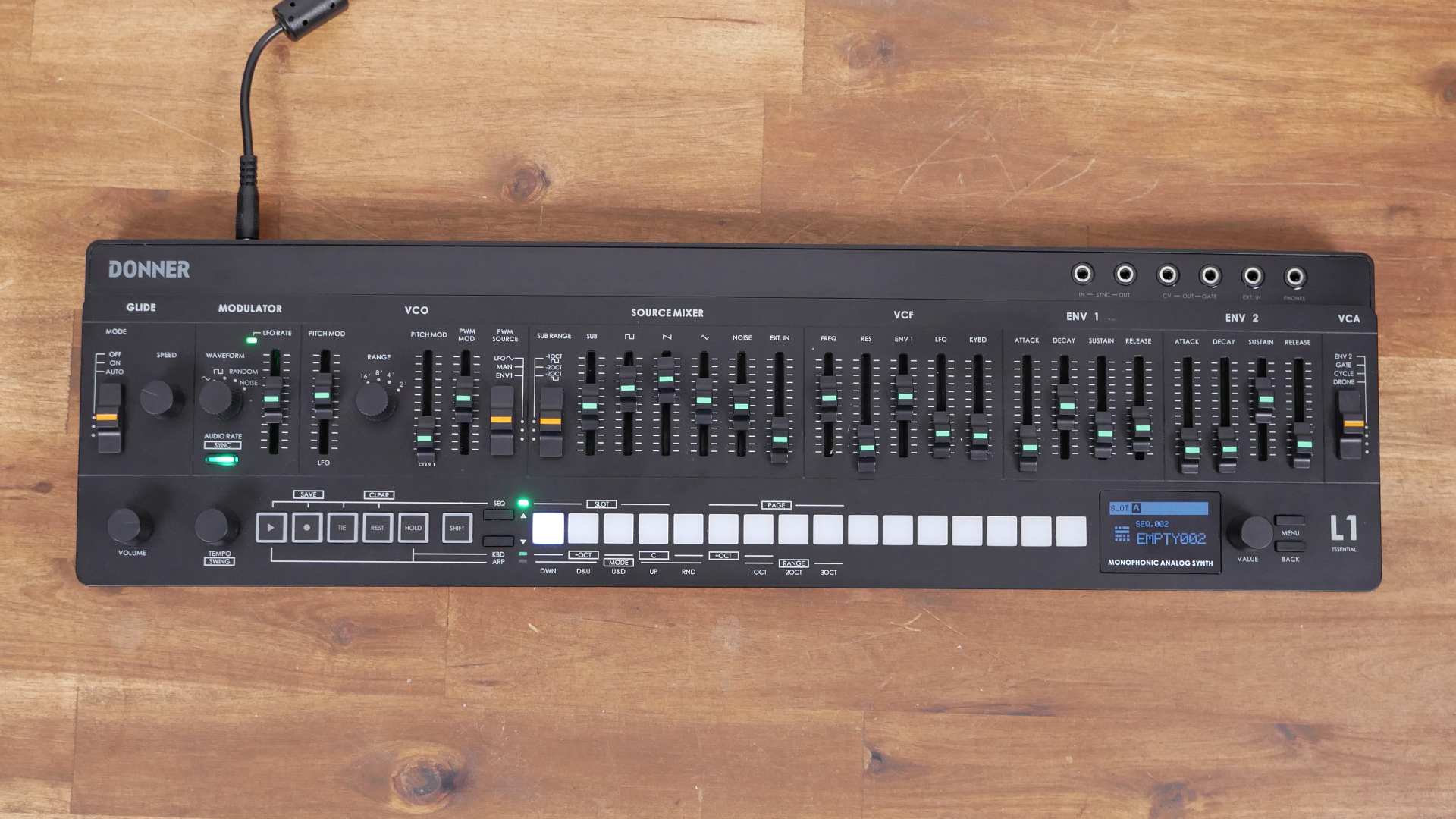
In the next step, you can add more bottom end by mixing in a sub-oscillator with a selectable -1 octave square, -2 octave square, or -2 octave pulse. There is also a noise generator, however, that casts a shadow on the previously authentic analog hardware.
Unfortunately, it sounds completely off from the original. This has been proven by my colleague Loopop and Starsky Carr in their own videos, which feature original Roland SH-101s themselves.
Why Donner? It was going so well on track, and then it suddenly took a wrong turn. This is not the only one in this review.

Analog Filter & Souped Up Modulation
It also features an external input, allowing you to integrate other sources into the analog signal path that passes through the filter. Oddly enough, it’s relatively quiet.
Even at the maximum amount, the external signal isn’t very loud. I had to crank up the volume of my synths a lot to get satisfying results.
The filter is based on the 3109 VCF chip and has controls for the cutoff and resonance, as well as instant routable modulators, including envelope 1, LFO, and keyboard tracking. It does precisely what we expect from an SH-101: piercing yet smooth filtering.
On the modulation side, the Donner Essential L1 offers a second ADSR envelope for greater flexibility. This allows you to control the filter and amplifier independently, instead of using the same one. They are snappy like the one on the original.

The LFO offers identical waveforms plus noise, and also features an audio-rate range, which is particularly suitable for wilder, noisier sounds.
In a dedicated menu, you can also modify the behavior of the envelopes and LFO. You can merge the envelopes so that you have the original setup again. This is a clear indication that the modulation is digitally implemented, not analog.
Then, you can enable retrigger and velocity control for each one independently. Also, the LFO has a retrigger option. These are nice additions that weren’t included in the original.
At the end of the signal chain is the VCA. In addition to the familiar VCA modes (ENV2, gate, and cycling (LFO)), Donner has also included a welcome drone mode that keeps the VCA constantly open.
Besides drone sounds, this can also be used to turn the Essential L1 into a filter FX box. Also onboard is glide, which features two selectable modes: On and Auto, with dedicated speed control.
A Major Issue
Apart from the noise generator, the Donner Essential L1 is a great and authentic-sounding Roland SH-101 clone. With the extra envelope pitch mod and a second envelope, the developers expanded its sonic range further with minimal changes to the circuit.
Okay, take your credit card, click on my affiliate link, and buy it before it’s sold out. Stop not yet! In all this praise, there is a major drawback and a significant problem that should be mentioned.
The L1 features a display that provides access to envelope and LFO information, as well as memory locations for sequencer patterns. No, you cannot save sounds.
The problem here is that the display is introducing low-level noise into the analog signal path, indicating that it isn’t appropriately shielded. If you reduce the brightness in the settings menu, it also significantly reduces the humming noise.
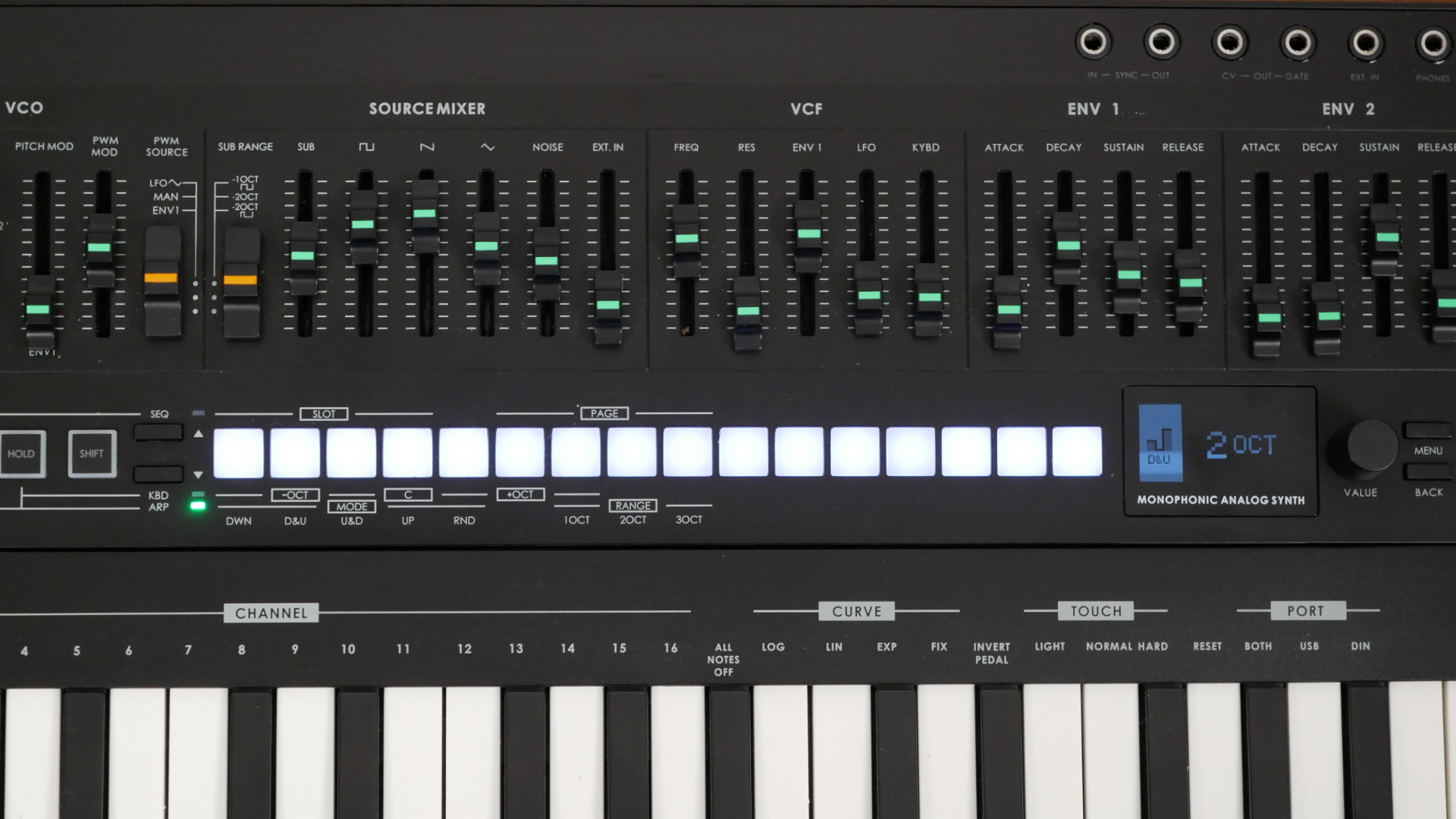
That’s not all. The sequencer LED lights also produce noises. Whether it’s a combination or a single component that connects both, making this noisy issue, is unknown. I have a unit from the first batch. I have no information on whether this was fixed in later batches.
If you use the L1 solo without an extra, it functions as intended. You’ll hear a faint background hiss, but it’s barely noticeable during regular playing.
It’s a different story when you spice up the sound with an overdrive or distortion pedal—a common practice with the Roland SH-101, for example, to achieve more characterful sounds. These effects amplify the low noise into an audible problem, which is no longer pleasant.
An alternative is the headphone socket on the front panel, which is surprisingly noise-free. Since I use and prefer the main output, also due to the signal impedance differences, it’s important to me to have a cleaner main output.
I hope they can fix it in later versions; otherwise, the synth will always have this shadow hanging over it.
Arpeggios & Sequencing
The display and modulation are not the only digital elements in the Essential L1. The arpeggiator and sequencer are located in the last third of the interface, which can be played hands-on using the eight function buttons and 16 step buttons.
Arpeggios can span between 1 and 3 octaves and be played in various directions: down, down, up, down, up, randomly. All of this can be changed on the fly using the buttons. It has a handy hold function, but it’s not possible to modify the arpeggiator pattern using the buttons.

The sequencer is just a button press away. It’s very inspired by the popular Roland SH-101 sequencer. The one in the L1 has 64 steps with programmable ties and rests.
Additionally, the menu system enables individual patterns to be saved and combined into longer sequences, also referred to as songs.
A nice touch is that the sequencer can transmit clock/gate signals as well as pitch, allowing the L1 to be incorporated into modular setups.
Modern, more advanced functions, such as probability, ratcheting, or a simple random pattern mode, are not available. There is also no option to mute individual steps on the fly. Since my video review, several quirks and bugs have been fixed, so it now works more smoothly, including the sync.
KB-32M
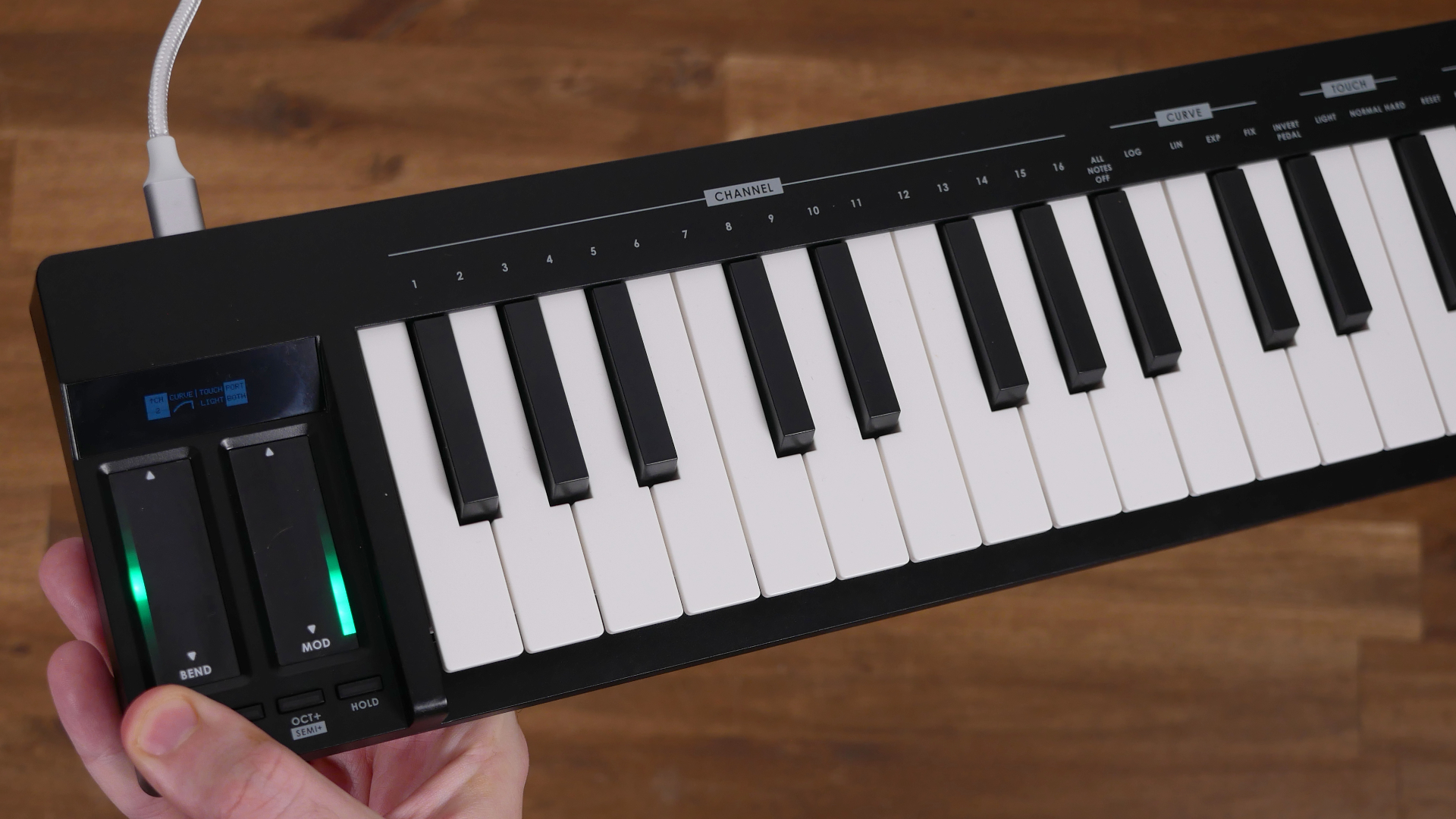
Alongside the Synthesizer, Donner also developed the matching KB-32M MIDI controller, which magnetically attaches to the Essential L1. It is optionally available. It features 32 mini-keys that are great to play with, and they support velocity.
Yes, velocity can also be used with the L1 Synthesizer. However, velocity must first be activated in the envelope settings.
The built-in touch and backlit mod wheel, located next to the pitch control, is unusual for the L1. It doesn’t respond to any data, and you can’t map any parameters to it, which is a missed expansion opportunity.
Further, you can change the octaves and semitones, and set the MIDI channels, MIDI curve, and more. The keyboard also features a mini display that provides feedback on various key parameters.
A nice, portable MIDI keyboard with good quality. However, since it doesn’t provide the Essential L1 with any significant additional functionality, you can opt for the desktop version, save some money, and continue using Keystep or an alternative.
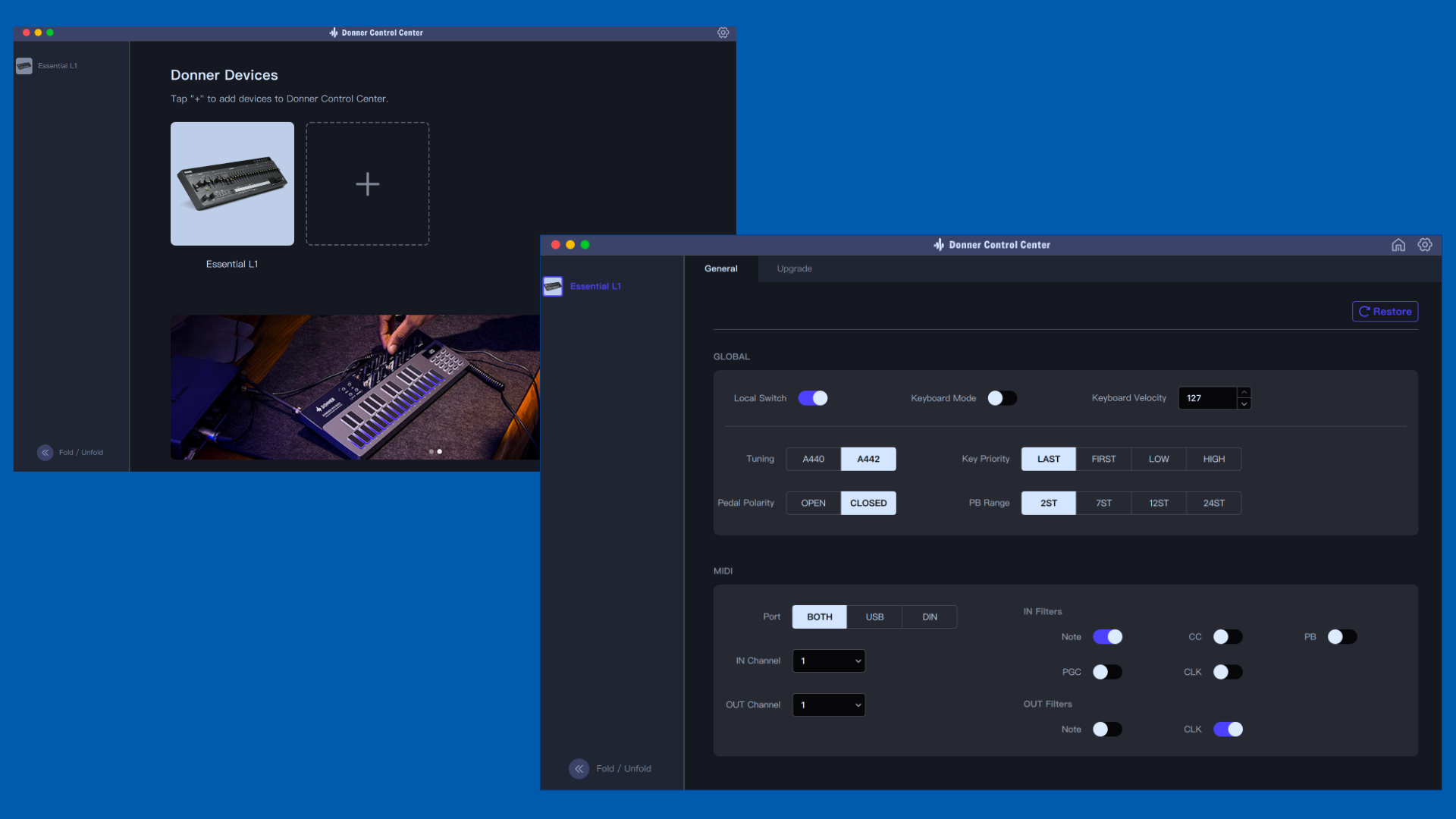
And the Donner Control Center software handles firmware updates and more advanced global settings.
Donner Essential L1 Review Summary
In summary, the Donner Essential L1 is a great-sounding, fun Roland SH-101 clone with some excellent modern extras. Its unique design, including a desktop option, sets it apart from its main low-budget competitor, the Behringer MS-1.
From a technical standpoint, the pitch modulation envelope, the extra envelope, and the drone mode are welcome additions, making the device more versatile.
However, the noise issue overshadows these positive points. The inaccurate noise generator timbre and low-level noise bleeding are flaws that significantly impact the final score. It just missed out on perfection.
Everyone makes mistakes, but I think these could have been identified and fixed very quickly during beta testing. But was there any testing at all?
For the asking price of around $300/€300, you get a solid analog synth based on the Roland SH-101, albeit with a few weaknesses. Between Donner and Behringer, I’d choose the Behringer MS-1 because it’s more polished, offers FM options, and is slightly cheaper.
However, for those who prefer not to use Behringer gear, this is an affordable alternative.
Pro
- concept: detachable keyboard + desktop synth
- analog sound
- second envelope + audio-rate LFO
- sequencer
- drone mode
Neutral
- build quality: it’s fine for the price, but not at a high quality level
- no added functionality to the mod-wheel
- not the cheapest Roland SH-101 clone
Contra
- low-level noise in the signal path from the display
- noise generator (not authentic)
- VCO and LFO range knobs
Donner Essential L1 is available now: desktop module for 349,99€ and keyboard KB-32M 149,99€. The price varies due to constant discounts or coupon codes. It can therefore fall well below 300€.
More information here: Donner
Available from my partners
The noise is a deal breaker for me.
I far prefer the look and feel/design of the Behri clone personally.
Cheap Chinese low quality waist of time, save up for better.
Returned mine immediately upon receiving it for $300+. The build quality is shockingly, poor and plastic. The keyboard is one of the worst keyboards I have ever used. The faders, knobs and dials are absolutely impossible to tell where they are sent due to the choice in coloration. I’m honestly surprised the review paints in such a positive light.
With three negative and 3 negative-voiced neutral points, I don’t think the synth is in such a postive light. Plus, I recommend the Behringer MS-1 over this. Also about the qualtiy I wrote that I wouldn’t take it on tour because it’s too fragile. Same that the noise is major issue.
I’m not sure you read the entire review.
Perhaps the point that they are making is that despite the number of negative points that are raised in the article, the headline says that it falls short of perfection, thereby implying that it is close to perfection.
As I review it as a Roland SH-101 clone and not as a “new” synth what it isn’t because of its vintage model. Here the sound is the most crucial point, the headline implies to this fact. The analog engine is almost perfect but the noise generator and the noise bleed didn’t give it the award.