
The Roland TR-1000 Rhythm Creator marries the analog and digital TR era, plus sampling and more, in a new, modern, and hybrid drum machine.
On September 25, Roland began releasing teasers for a new product under the motto “Tomorrow Returns.” Unfortunately, the secrecy failed, and the product leaked through every possible hole. Whether planned or not is unknown.
Today, however, the secrecy is over. Okay, most people already know, but for everyone else, Roland today unveiled the TR-1000. This new rhythm creator/drum machine marries the company’s analog and digital eras, along with numerous extras.

Roland TR-1000
It’s not one of those dreams that’s abruptly overtaken by the AIRA ghosts. You read it right. Roland is back in the analog drum machine business.
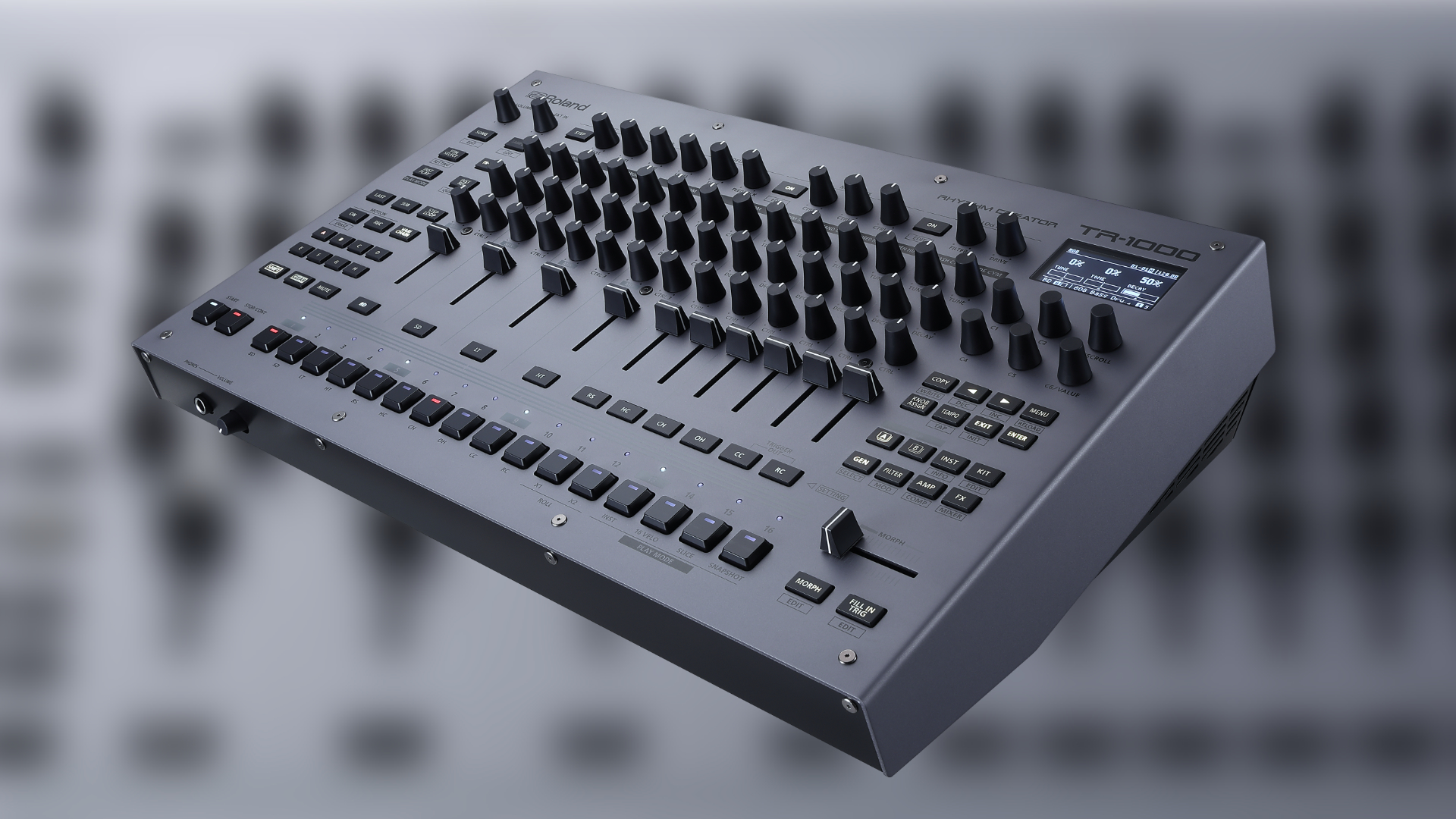
The new TR-1000 is a hybrid drum machine that can be described as a TR Supergroup. Roland prefers to describe the TR-1000 as a Rhythm Creator, as it’s not just a drum machine but also a platform for sculpting drums.
The design itself shows that Roland has placed great importance on this product. Instead of plastic, it features an aluminum gray panel and steel chassis, weighing in at 5.5kg.
In comparison, the TR-8S weighs only 2.1 kg, making it more comparable to the original TR-808, which weighs 5 kg. The panel has plenty of knobs, sliders, and buttons that give hands-on control over the engine, as it should feel like an instrument and not like a computer, says product manager Peter Brown
Talking about the engine. Roland’s new flagship drum machine features an impressive hybrid engine, the most powerful Roland has ever incorporated into a product of this kind.

Hybrid Sound Design Engine
As the title suggests, the TR-1000 is a marriage of the analog and digital TR worlds. On the one hand, there’s the analog part, which consists of 16 voices.
Ten are dedicated to the legendary Roland TR-808, while the six others are based on the analog voices of the TR-909. Yes, only six, because the 909 cymbals and hi-hats were samples.
According to Roland, they have not only reissued the 808/909 circuits in analog, but they have also further developed them by adding parameters, expanding ranges, and improving dynamic ranges. For example, you can tune the kick drum of the 808.
Then, it features a digital part, including ACB (75), FM (7), PCM (340), and sample (2121) tones. These also contain modeled TR-808 and TR-909 sounds, but with a unique circuit-bent flavor – not always the same thing.
With all digital synth engines and their extensive parameters, you can create your own drum/percussive sounds, as you are familiar with the TR-8S/TR-6S.
There is one more engine. Roland also embedded a built-in sampler into the TR-1000, allowing for real-time sampling from the external stereo input. You can sample into the device via the external input, and resample the engine with special modes.
Additionally, it features non-destructive sample slicing, allowing up to 16 slices, each with its own parameters for pitch and time stretch. Yes, a time-stretch mode is available for loops and one-shots.
Alternatively, you can import your own samples in the formats WAV, AIFF, MP3, and via the software editor in FLAC and M4A into the 64GB internal memory. 46 GB are available for user content, and the other 18GB are packed with a collection of 2000 samples.
And one sample can have a length of up to 16 minutes (16-bit) at a sample rate of 48 kHz. Indeed, a 16-minute-long background drone is not a problem here.

Layering Sounds
Each sound generator comes with its own multimode filter, envelope + amplifier, compressor, modulation (LFO with three destinations), and FX section. The latter encompasses a wide range of algorithms, including both analog and digital ones.
On the track level, you get various filters, reverbs, delays, compressor types, and more, while the master FX offers 14 distinct effects. As a bonus, this also includes a stereo analog filter and analog overdrive for adding warmth and depth to your tracks.
The engine is hybrid and can be used as such. The TR-1000 features 10 tracks, with four of them being layer tracks, allowing you to layer two sound generators. That is, analog with digital, or two digital ones with a mixing knob on the hardware. This provides you with numerous ways to craft your unique drum and percussive sounds.
On the remaining six tracks, you have an engine for each track, complete with all the necessary elements behind it. All your sounds can be saved into 2048 user drum kits (128 kits x 16 projects).
Next-Level TR Sequencing
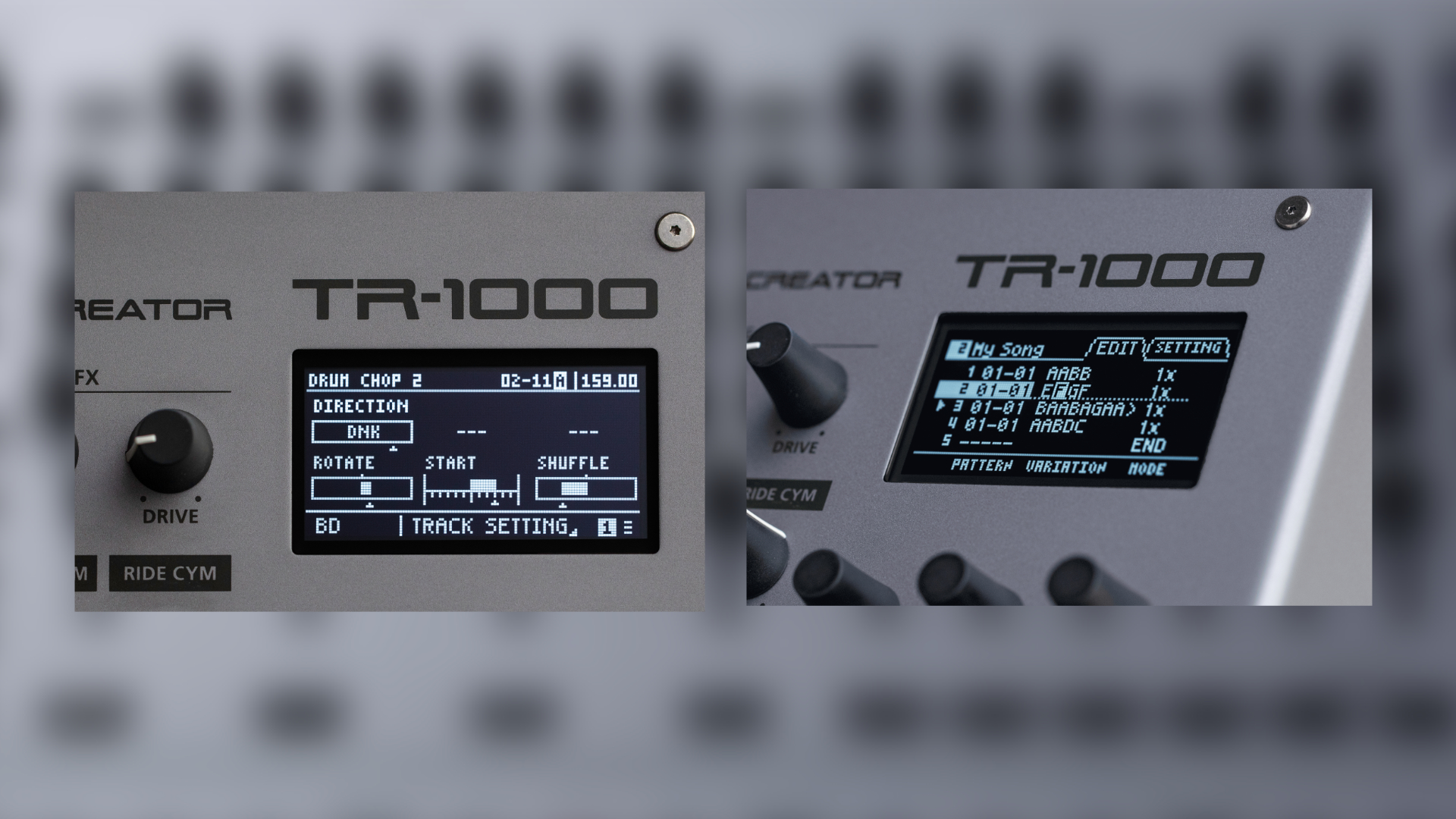
Sequencing is a crucial component of any TR drum machine, and TR-1000 masters it like a glove. It features a TR sequencer for each track with real-time recording with 16 steps, eight variations (A-H), and four fill-in patterns per main pattern. Plus, there is an exclusive part for the trigger out.
A highlight of the newly developed TR sequencer is the implementation of micro-timing on the step and track levels. This lets you push individual tracks forward or backward so they all fit perfectly into the groove—something never before possible with a Roland TR drum machine.
Furthermore, each track has its own length, playback direction (classic ones or random modes), rotation, and shuffle parameter. Plus, it has a song mode and you can record the panel controls, including the analog ones, into the sequencer, allowing you to create patterns with an evolving sound character.
The sequencer can be programmed with 16 RGB backlit buttons with a 16-level velocity option. Also notable is that the panel controls are not just one-parameter knobs, but fully assignable macro controllers with multiple destinations.
There is also a performance-oriented fader with morphing that is fully customizable. You can use it to morph multiple parameters from one state to another, perfect for build-ups and transitions.
Connectivity
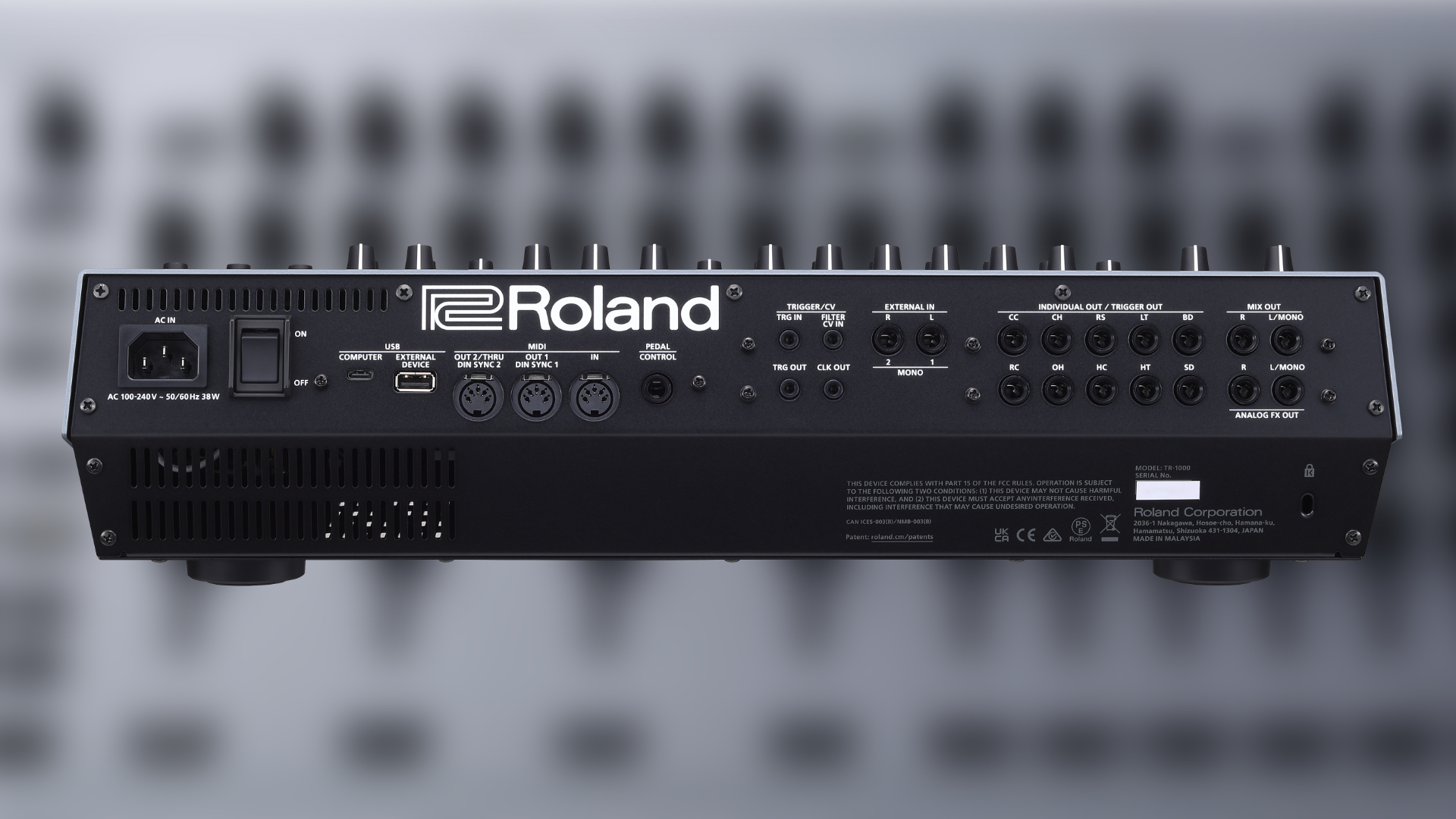
The back of the TR-1000 features a vast array of inputs and outputs. I think everyone will find what they’re looking for here. It starts with a built-in universal power supply with a dedicated power ON/OFF switch. No annoying power brick is required; a simple AC plug is sufficient to power the device.
A USB-C port is onboard for MIDI and audio duties, including communication with the Roland TR-1000 editor software, and a USB-A (computer) port for external devices. Then, you have a full 5-pin MIDI interface with two MIDI outputs supporting DIN SYNC, and a MIDI Input. There is also a pedal control socket.
For DAWless music producers, it also features a trigger in/out, a filter CV input, and a clock output. A stereo external input (2x mono) is available for sampling your hardware gear into the unit. Next, you have individual outputs for each track, which can be either audio or trigger outputs. Finally, we have a mix out and an analog FX output.

The TR-1000 also includes a software editor. It serves as a sound manager that allows you to import samples into the device. It’s also an editor for the sound engines, giving a full overview of each track, mixer, and effects.
The TR-1000 launches the legendary TR heritage into the future with a bold mission: to inspire a culture hungry for the next wave of rhythmic experimentation. Musicians and producers can conceive, create, and perform with a range of premium drum sounds, powered by analog, digital, and sampling engines with advanced tone-shaping and layered track architecture.
Roland TR-1000 First Impression
Roland finally listened to the people and did what many people wanted: analog drum machines. Thank you! I think the idea of blending the two worlds and offering them in a flagship “supergroup” TR is a great match. It reminds me a lot of an Elektron Analog Rytm, but from Roland.
You have to like the gray look, but it looks very high-quality and classy. The only thing I wish was that the OLED display were a bit larger. That’s something that bothers me about many Roland products. Nonetheless, the TR-1000 is a powerful instrument with a remarkable range of tweakability.
With this price, Roland is certainly targeting a more high-budget customer base. This will undoubtedly put many off, but hey, we know the affordable alternatives. If you want both original analog and digital Roland sounds in an impressive package for the studio and live, I think this monster is hard to beat.
Roland TR-1000 is available now for $2699,99
More information here: Roland
Available at my partners

…but they can’t make a modern analog Jupiter.
maybe they will let see
They don’t see the business case for making a modern analog Jupiter 8. Analog is a fetish; people irrationally seek out analog instruments when the cold reality is that they could make basically the same music with a collection of good soft synths, for a tiny fraction of the cost. If you want the Jupiter sound, but a Roland System 8. It is a fantastic instrument that emulates some of the best classic Roland synths.
analog Synths are more fun.😅
Is it irrational to claim that a Stradivarius is simply more pleasing to the ear, fingers, and touch than a cheap student violin?
I don’t think so… in my opinion.
Inspiration, feeling, touch, responsiveness: that’s what music is all about !
If you’re happy with VSTs, good for you.
For me, VSTs are just mixing tools.
These days, I ALWAYS start a composition by playing around with analog or acoustic gear, because of the feeling these devices give me. Digital is far behind… and VSTs, far far far behind.
But i’m ok with you, you can actuelly do what analog does with free VSTs and a computer, no-one will tell the difference in a finish product, but what’s the point?
Produce an infinite number of pieces of music for as little as possible ? (go AI for this shit…)
Or live a transcendent experience that will grow you and your audience to a new and ever-expanding level of consciousness through the power of music AND feelings ?
Love this always-the-same discussion. Being cellist, orchestra player and pianist, my compositions are made 100% with AU plugins only and they sound great, full of emotions and empathy. I sold all my hardware and now with the better audio interface of the M-Chips-series I even do not need a 1000€ interface. Just digital plus headphones. Amazing times. 🙂 Use what you need to make music, but do not judge about others working styles (in both directions), no?
I don’t pass judgment, except on AI. I hate AI for music, there’s nothing more “anti-human” than that for me… but I admit that calling people irrational irritated me a little, I grant you, I have almost 30 years of experience, with analog equipment at first, then 100% digital later for practical reasons, possibilities and budget. Then one day, I returned to analog almost by chance, and I immediately noticed the difference, and it clearly does not lie in the sound itself, but in the “feel” and the “latency” too, so in the responsiveness to touch. In short, a huge difference, but one that is easily forgotten in the face of the increased possibilities, the compactness and the often lower price of digital. But going back to analog for guitar gear is super obvious, it’s obvious. I also felt the same sensations with an analog synth that I had abandoned for a “more powerful” digital synth. But likewise, the day I went back to it, I couldn’t live without it, and since then, I’ve learned my lesson, and that’s all we want, but it’s not irrational!
Digital isn’t bad at all, as I said. On a finished product, no one will tell the difference, but if the player is able to feel the difference, then the pleasure and feeling while playing will perhaps also be better… and so the result, perhaps, too.
First step Into a larger World (ob1) 😎
we will See.
wondering If Uli has given Up on the Task.😁
WHO Has the Money?
Jeff Mills and Hans Zimmer 😎
And I.
nice!
have fun😎🤘
egyptian Lover Made nice Videos.
Good endeavour but I think they re a little late to the party and the price point is not appealing at all.
they did it smart. took their time. created a box with all modern features but implemented in a better way than the competitors. Solid experienced engineering putting Roland back on top.
true…
check the mpcs..
OK, not really comparable but much better bang for the Buck. will Stick to my Lil basstard tr6s. so underrated.😃
Teh price.. lol
It’s super-powerful for sure, but not one new idea in the whole box.
the morphing pads is a new idea for the MPC world
seems nice, but more Like a small Gimmick Like the d beams Back in the day.
price is getting people here. granted, price is part of the conversation but that aside, this is incredible. sophisticated features that are easy to execute. it’s more than the sum of it’s parts.
great features as is and it looks like Roland are heavily invested in expanding on it in future. I like how Roland have developed a product for the music. For the musician. Getting sick of other manufacturers producing compromised boxes due to other products ini their catalogue. Elektron for example. Clearly omitting features in order to push you towards buying multiple Elektron boxes.
Price is steep, but so many hardware instruments are. I believe I paid € 2100 for good ol’ Tempest over 10 years ago? Also € 2500 for the S2400 plus DSP. I think the TR-1000 justifies it’s price and they will sell really well, but of course not to everyone. I just hope that Roland makes tons of money from it to motivate updates and new features.