
Phonicbloom Siluria is a new multi-timbral polyphonic Synthesizer and multi-FX processor that is playable with a touch interface.
Last year, Phonicbloom, the developers of the Gecho Loopsynth, announced the Siluria. The first batch of this experimental touch system has been shipped. It will soon be possible to pre-order units from the next batch.
Those who already own the Siluria will be pleased with the new firmware 1.1, which introduces new features and is now available.
Firmware 1.1 introduces the ability to load arbitrary WAV files (mono/stereo) from the microSD card, expanding the synth’s range. Once loaded, you can loop like on tape, change the tape speed (-4x / +4x), and the direction.
The new update also gives you the option to change scales on the fly.
A nice update that transforms Siluria into a sound design tape sampler player device.

Article from September 14, 2024
A Synthesizer here, a Synthesizer there. The market is growing with new devices every week, including classic desktops/keyboards and unusual ones, aka experimental synths. These stand out with new concepts, wilder engines, or new designs.
The Irish company Phonicbloom is one of the latter. They have created the tiny Loopstyler groovebox or the Wing Drum electronic tongue drum Synthesizer. The developers are currently working on Siluria, a new digital touch Synthesizer.

Phonicbloom Siluria
Siluria is a new digital polyphonic, multi-timbral Synthesizer. It is powered by a dual-core RISC-V processor ticking at 1GHz, with 512MB of memory. For the audio part, it uses a Hi-Fi audio codec running at a 48,000Hz sampling rate.
That’s right, Siluria is a polyphonic multi-timbral drone synth. According to Phonicbloom, you can explore several sound engines. However, the details of these are currently unknown. The same applies to info about filters, modulation, etc.
It is known that it will host a multi-FX section. Thanks to the audio input, external signals can also be processed, making Siluria an FX device.
External input is just one of the three audio input options. Besides this, it also features a built-in FM radio, and the ability to load .wav files through the microSD card. These sound sources are available as sound sources for the FX processors or as modulation sources.
FM radio frequencies or samples as a modulator sounds very exciting, and I guess you can create wild stuff with this.

Eye-Catching Interface
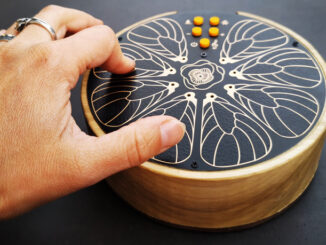
Phonicbloom Siluria’s interface is particularly eye-catching here and could be straight from the Dune movies. It consists of two areas: a capacitive keyboard and eight smooth analog knobs.
The keyboard offers 12 touch-sensitive plates with velocity and polyphonic aftertouch support. The plates can influence the pitch or effects applied to the individual voices, promising the developers.
Then, the scales are also editable, with the base note following the main frequency in a quantized or precise manner. Siluria’s interface registers each touch and visualizes it with warm white LED lights.
On the other interface side, it hosts analog potentiometers that give precise, high-resolution control over the parameters of the synth engine.
But you are not dependent on the touch interface. It is also fully controllable via MIDI. Plus, you can use the synth interface as a polyphonic aftertouch MIDI controller.
Connectivity
A look at the back, where you can find the I/O section. It includes six 3.5mm Jack connectors: audio in and out, MIDI in and out, a separate output from the FM Radio (unprocessed signal), and an external antenna connector.
There is a built-in half-wavelength antenna, but you can add a longer one if the existing one is not long enough. Also onboard is a USB-C port for power and data transfer. You can power it from any standard 5V source, power banks, computers’ USB ports, or various adapters.
Lastly, you can’t see it in the picture,s but there is also an OLED display on the side panel for navigating through the settings (FM radio tuning, etc.).
Here are some sound demos. Phonicbloom has hit the jackpot with the first one. The video has over 100k views in the first three weeks. It looks like there is a lot of interest in a drone synth.
First Impression
I listened to the first sound demos, and I have to say: I want to hear more sounds of this machine. Siluria sounds fascinating, rich, and unique. There is a lot of wild drone stuff, but also elements that remind me of physical modeling.
This is an exciting new experimental Synthesizer that I hope to learn more about in the future, especially what the engine has to offer.
Phonicbloom Siluria is available now for pre-order for 599€. Shipping starts in 1-3 months.
More information here: Phonicbloom


Looks interesting. I’m not able to find one pic of the connectors which seems odd. I’m very interested nonetheless.
I like this, although it seems to have few controls.
Interesting, I’ll have a closer look.
Please let me know where I am able to purchase the Siluria
Thank you