
Arturia Astrolab 37 is the most portable member of the young stage keyboard family, offering the same power but at a significantly lower price.
In April 2024, Arturia introduced the AstroLab 61, its first-ever stage keyboard. This was also a first step into a new product category for Arturia. Even though the product was not initially designed for the knob tweaking synth market, most of the criticism came from this community upon its release.
In the middle of this year, Arturia expanded its lineup with an 88-key version featuring hammer-action keys and an upgraded processor. They also underlined once again the target market for this instrument.

Now the lineup is completed with the most interesting version, especially for synth players: the Arturia AstroLab 37. More portable, just as much synthesis under the hood, but for 699€.
Arturia AstroLab 37
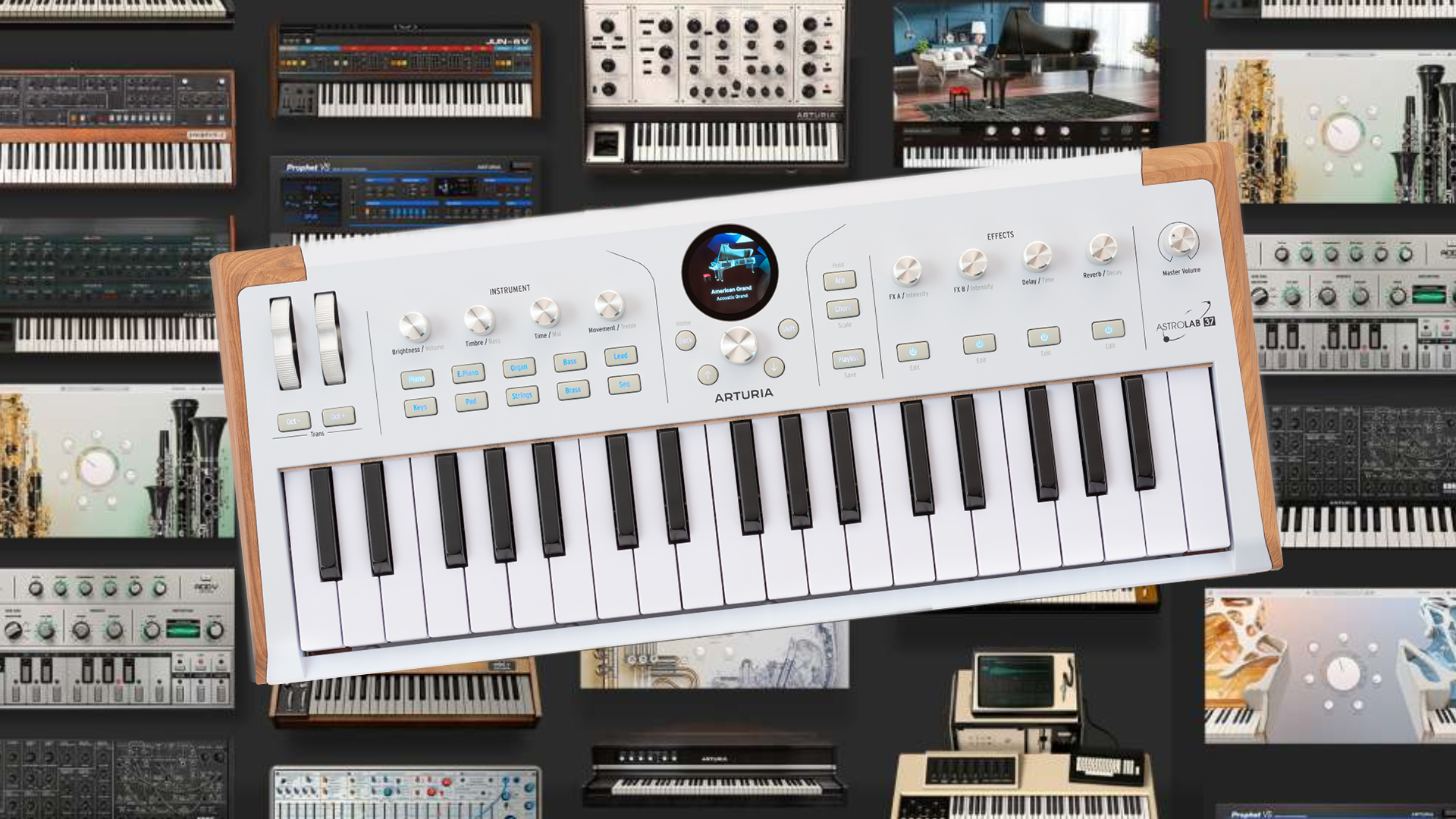
Like its bigger brothers, AL61 and AL88, the AstroLab 37 is a synthesis-packed stage keyboard. The big difference, however, is that it is significantly more portable with its 37 slim keys featuring velocity and aftertouch.
This new alternative form factor makes the AstroLab keyboard more flexible and versatile. It can be conveniently placed over a keyboard, taken to a jam session, or even used on the couch.
It seamlessly brings your beloved DAW sounds to a standalone, portable hardware instrument. Smaller doesn’t mean fewer possibilities.
Synthesis Powerhouse
Arturia has incorporated the same dual-layer engine in the AstroLab 37 as in its larger siblings. According to developers, the AstroLab 37 is powered by the same CPU as the 61 version.
Again, the Analog Lab Pro software is the heart of the engine, which, in turn, draws on the constantly expanding V Collection virtual instruments.
Out of the box, the AstroLab 37 features 44 instruments and 1800+ presets (V Collection 11 Pro) spanning analog classics, modern hybrids, pianos, and performance essentials. Everything is standalone and works even without a computer or app.
This includes sounds from instruments such as the Mini V, CS-80V, JUP-8000V, Acid V, Prophet V, and many more.

You also get access to the sound palette of the Pigments and MiniFreak V multi-engine Synthesizer plugins. Mellotron V, however, is still excluded. You can also turn the AstroLab 37 into a powerful Vocoder synth via the external input.
V Collection users can take it a step further by designing their own sounds from scratch for the Arturia AstroLab 37. Craft your sound in a V Collection plugin on your computer, assign your favorite macros, save it, and export it to the AstroLab 37 hardware.
Now, you can take it on stage or in your next live jam without carrying a laptop with you. And the V Collection 11 is currently on sale at half off. What a coincidence!
Thanks to its vast array of instruments, the AstroLab covers an enormous world of synthesis: analog modeling, 90s-style virtual analog, 8-bit, classic FM, granular, additive, wavetable, vector, west coast, sample playback, and more.
On top of that, you can configure each preset with up to 17 different insert FX plus fixed reverb and delay slots to create expressive play and dynamic live sets.
Macro Operation
The user interface of the larger AstroLabs received significant criticism for offering only macro parameters rather than complete control over the instruments. Even though it has been slightly resized, the concept remains the same. Sorry
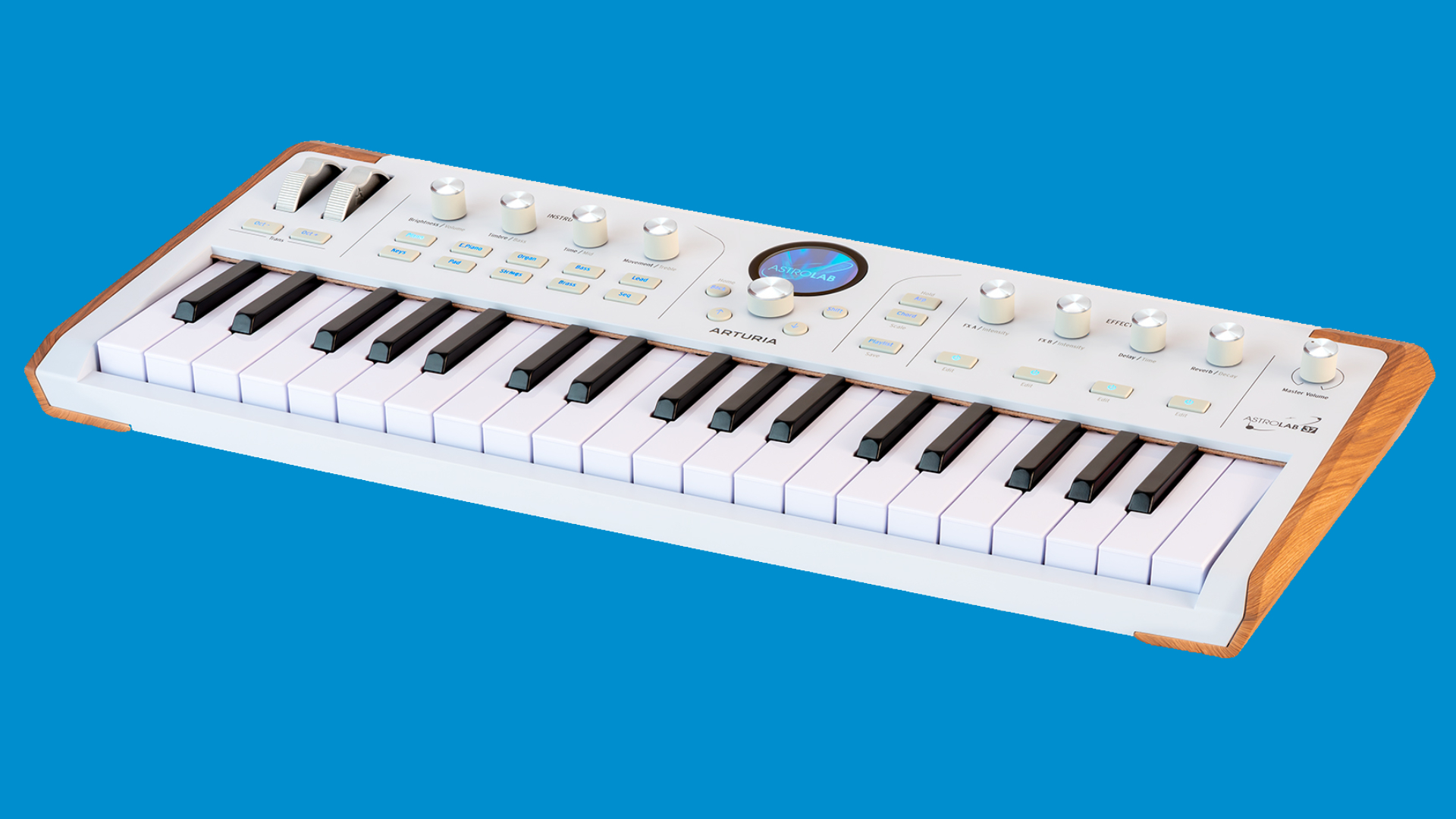
There are again eight macro parameters, 4 for instruments and 4 for effects. Ten shortcuts allow direct access to the respective instruments. This worked flawlessly on the AstroLab 61 in the test.
The macro controls are again fully customizable within the Analog Lab Pro software. So you can precisely define which parameters you want to use as a macro.
One thing I’ve wanted since the AstroLab 61 is a small, sophisticated MIDI controller that displays all the instrument parameters and updates automatically when switching instruments. With this, you could turn it into a full Synthesizer. Hope this will become a reality.

The prominent rotary screen knob has been removed on the AstroLab. I’m assuming it’s due to cost and design choice. Instead, there’s an OLED screen with a large encoder and a few buttons for navigating through the menu system.
One thing does the AstroLab 37 better than its brothers. It’s the centralized interface, thanks to its portable, compact form factor. With the others, the left side is very empty.
Performance
Just like on the larger versions, you can easily layer or split two sounds directly on the hardware. Because the hardware is based on the CPU of the 61, the polyphony is limited to eight voices per part for synths and 48 for pianos/organs.
By combining two synths, you can achieve a dual-timbral hybrid Synthesizer with up to 16 voices.
Alongside this, it also features the same multimode arpeggiator, built-in chord generator & scale modes. Not onboard is the MIDI looper from the 61 and 88 versions.

AstroLab 37 also features the same playlist mode in which you can organize and build your live sets directly on the keyboard. Alternatively, you can create them in the Analog Lab Pro software or a dedicated iOS/Android app.
Connectivity
On the back, the AstroLab 37 is almost indifferent to its larger siblings. It has stereo connectivity on two balanced 6.3mm mono outputs (L+R), a single Mic & TRS input for vocoder (stereo on 61/88) with gain control, and a headphone socket.
Further, you have a 5-pin MIDI in/out interface, a USB-C port for computer connection, a USB-A host port, a power supply input, and a single sustain pedal. The 61/88 versions offer an expression pedal and two AUX inputs on top.
Lastly, it comes with Bluetooth audio for playing along with backing tracks and Wi-Fi support for wireless communication between the iOS/Android companion app and the hardware.
First Impression
AstroLab will remain a stage keyboard concept that will surely polarize opinions, especially in the synth world. Nevertheless, the AstroLab 37 is probably the device that will appeal most to Synthesizer and electronic musicians.
It features the same feature-packed synthesis engine as the flagship models, but in a more compact, lighter form factor at a significantly lower price point. For 699€, you get a portable instrument with an impressive pool of inspiring, ready-to-use sounds for jams and productions.
Yes, with limited hardware editing capabilities, but the ability to design your own sounds with the V Collection plugins. And honestly, I don’t know of any “Synthesizer” in this price range with that massive sound spectrum.
Arturia Astrolab 37 is available now for $699/699€.
More information here: Arturia
Available from my partners


When dark version and im in
Keyless module version might be nice. Basically a pigments/V collection in a box.
Yeah the module idea is better to me than 37 slim keys.
I was just playing around with Pigments last week and thinking it would be nice to export some of the tones for playing live. Sure, could go the laptop route, but that doesn’t appeal nearly as much.
Instant buy. All the synth goodness of the 1960s, 1970s and 1980s available at you finger tips. What is not to like? I was dreaming my whole life about such a machine.
Are these the same minikeys w/AT as the MiniFreak, KeyStepPro and Keystep37?
these are slim keys with velocity and aftertouch like the MiniFreak
I would have a Groovebox from Arturia. A 5 part multi-trimbral synth with Astrolab sounds with a built in a Keystep Pro sequencer.
About Astrolab 37. I really don’t understand why PART1 and PART2 buttons are not on Astrolab 37 : there is room for both buttons : if a computer is requiered to manage the synth basic PARTs parameters, then I prefer use a computer + Analoglab|Pigments + Keystep 37, rather than Astrolab.
the part buttons are very probably done via the menu