
Moog Messenger is a programmable monophonic analog Synthesizer with dynamic wavefolding and modern filtering: now with editor
At Superbooth 2025, Moog showcased the Messenger, a new monophonic, programmable analog Synthesizer with wavefolding and advanced sequencing capabilities.
There is some good news. First, the price of the Messenger has dropped significantly over the last two weeks to its current best price of 659€, and second, there is now an official software editor.
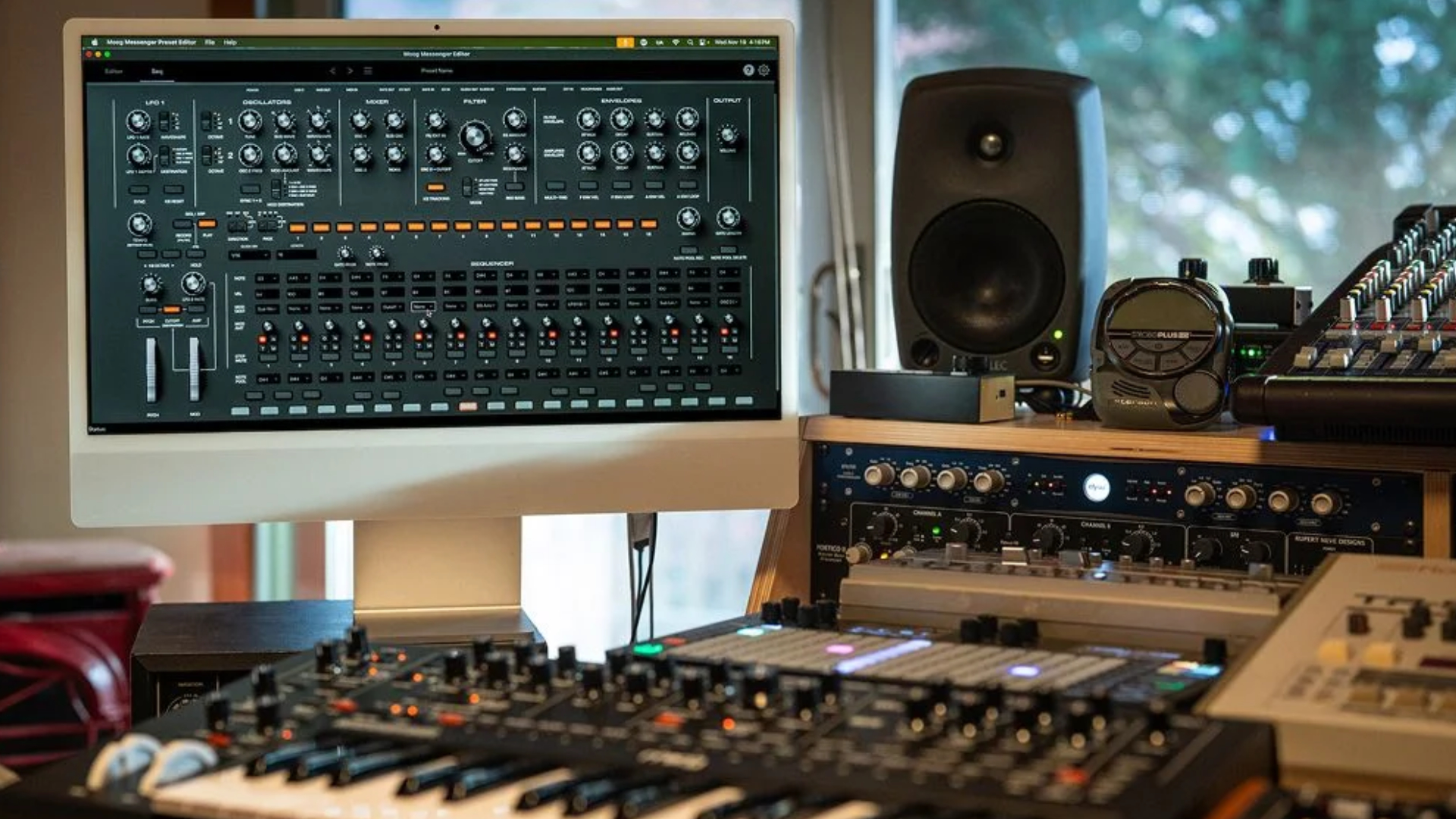
Messenger Editor
The new preset editor lets you program the Messenger remotely from your computer. The software synchronizes seamlessly with the hardware via USB, allowing you to switch between the two at any time.
The new software is helpful in many ways. On one side, it allows you to delve deeper into patch design, making it easier to see all active modulations, etc. Especially for parameters that are found in the hardware’s configuration menu.
Programming sounds is one thing, programming the sequencer is another. You can now program Messenger’s sequencer via the editor’s neat graphical interface.
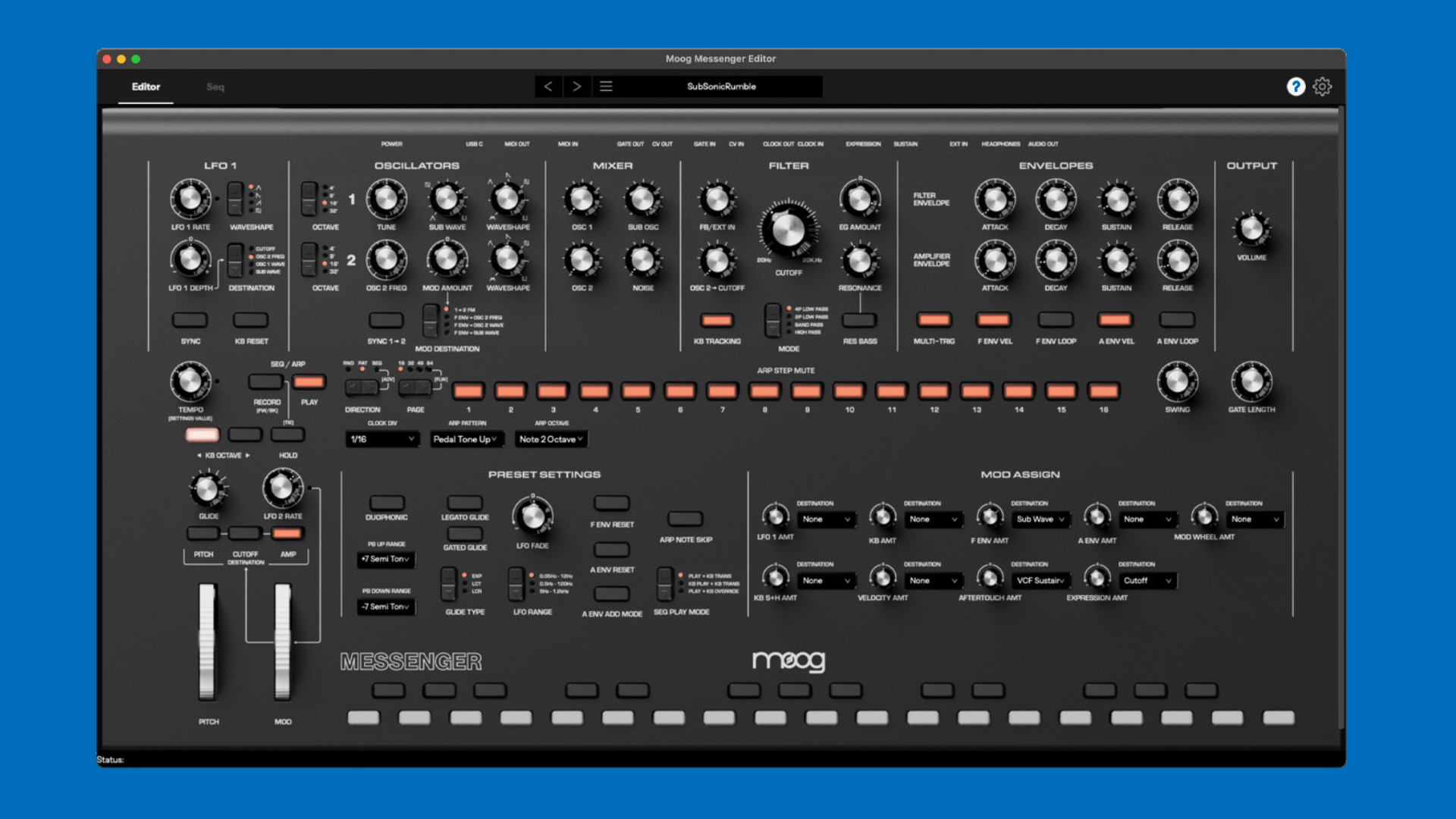
So you can precisely dial in the sequencer like note data, velocity, modulation, or even per-step probability.
The new Moog Messenger editor is also a librarian for your sounds. You can use the new preset browser to manage the sounds on the hardware or load them onto your unit. You can easily create categories and tags, making sound search and organization a breeze.
Plus, there are simple import and export functions for entire sound banks or individual sounds. It also makes it way easier to build entire preset libraries that will especially please sound designers. An excellent addition for the Moog Messenger!
Alongside the new sound librarian and editor, Moog also released firmware 1.0.13, featuring duophonic mode and assignable mod wheel control.
The new editor is available now as a standalone app for macOS and Windows. In December 2025, they will also release a VST/AU plugin version that fully integrates it into your DAW.
Moog Messenger is now on sale in Europe for a limited time at 659€.
Available from my partners.
Thomann

Update from September 18, 2025
Deal time. Moog Messenger is available now in a limited-time sale in the US for $699 instead of $899.
Update from May 8, 2025
Room must be made for new things. This was also why Moog Music discontinued the Subsequent 25 last March after five years on the market. One less programmable mono synth with memory in the portfolio. Who will succeed him? Moog itself will provide the answer in Berlin this week.
At Superbooth 2025, Moog has introduced Messenger, a new programmable analog mono synth for the masses and the first official under the inMusic embrella.

Moog Messenger
Messenger is a new compact yet powerful monophonic analog Synthesizer. According to Moog, Messenger represents a significant evolution in their Synthesizer lineage, blending the company’s rich heritage with new sonic possibilities and enhanced playability.
First, Messenger is not another Sub-Phatty or Subsequent 25-like instrument; it’s a new, standalone, modern Synthesizer with features never before seen in a programmable Moog synth at this price point.
It builds upon the DNA of Moog’s beloved mono synths, such as Model D, Voyager, Grandmother, and others, featuring newly developed circuits within a familiar format.
At its core are two continuously variable-shape voltage-controlled oscillators (saw, PW, PWM…) with an octave range between 4 and 32. New, unique hybrid wavefolders are a highlight of the Messenger synth. They unfold the harmonics in the oscillators and take the classic Moog sound in new directions.
In addition to the wave folding, you can apply pulse width, sync, and frequency modulation (FM) for richer harmonic textures and dynamic overtones. Plus, a mixable sub-oscillator with a continuously variable wave shape further adds deep low-end.
The three oscillators (two primary and one sub) then feed into a mixer where they can be perfectly blended. This also includes an additional noise generator. From there, it goes into the filter with a twist.

Modern Filtering & Modulation
When you think of Moog, you associate it with the legendary 24dB Ladder filter. The Moog Messenger also has a Ladder filter, but a reimagined one. It uses a new pole-mixing design, offering 4-pole lowpass, 2-pole lowpass, bandpass, and highpass responses.
The engineers have also addressed the weakness of the classic Ladder filter. Messenger has a resonance bass compensation (RES BASS) switch that preserves low-end power at high resonance settings. Don’t worry; the classic response is also available, a feature that was not taken into account in the Moog Muse.
Modulation also has modern adaptations. Two loopable ADSR envelopes with velocity responsiveness and multi-trigger capabilities are present.
Then, it hosts two LFOs: one variable shape with sync and reset, and one triangle wave tied to the modulation wheel. They provide extensive modulation options. However, random or special modulators are missing.
Effects are also lacking. The Moog Messenger does not have delay, reverb, or distortion. It’s a shame, though, that these would have rounded out the synth nicely.

Hands-On Evolving Sequencing
Messenger features 32 semi-weighted full-size keys with velocity and aftertouch, designed for performance and studio use. Besides the keyboard, it also integrates a creative arpeggiator and sequencer. The arpeggiator has multiple pattern modes and rhythmic programming like in the Muse polysynth.
The sequencer is a creative highlight. It can hold up to 64 steps and offers modern functionality, such as probability-based generative behavior and parameter recording. This allows for classical and evolving sequences where parameters are constantly in motion.
For the Messenger, Moog opted for a one-knob per function interface/layout without a display mounted on a robust metal panel. Each engine feature has a dedicated knob and buttons are used to navigate through the internal menu, e.g., to program the sequencer. These buttons are also used to access the 256 preset slots of the synth.

Connectivity
You can find six analog CV patch points on the back side for seamless integration into any setup, an external audio input to the filter, and expression and sustain pedal inputs. Further, it includes MIDI In/Out via 5-pin DIN sockets and USB-C.
“With Messenger, we aim to honor Moog’s rich heritage while embracing the future of analog synthesis,” said Joe Richardson, Moog Music President and inMusic EVP, Chief Commercial Officer. “This instrument is crafted for musicians and producers seeking a portable, powerful monosynth that delivers the iconic Moog sound, enhanced with modern features and intuitive controls.”
First Impression
On Wednesday, I had the opportunity to test and get a first look at the new Moog Messenger. The instrument is very streamlined and offers a wealth of great features. Some of them aren’t exactly what you’d expect from a super classic Moog mono synth: wavefolders on every oscillator, new developed multimode ladder filter with resonance boost, extended modulation capabilities, and more.
It’s a solid overall package at first look that reminds me of the Korg Monologue or even the Novation Bass Station 2, so the Moog Station. I’m curious to see how people react to it. The sound was great in the demos I recorded. We’ll have to see how wide the sound range will be, especially with the mod options and sequencer.
Moog Messenger is available at selected retailers worldwide starting June 2, 2025, for $899 USD.
More information here: Moog Music


Stunning that anyone would release a mono synth in this market, even Moog. It shows the utter contempt for the price sensitivity and price/value proposition people expect these days.
I thought the same thing. Bursting with innovation, now that inMusic owns them, aren’t they? Oh wait… there’s a reason they got bought in the first place, because really, how long can you milk your founder’s only hit (fight me…).
Alternatives: Dreadbox Typhon + 500 Cheeseburgers at McD for more satisfaction.
Food and Other stuff is very expensive now. so Its great to have a Moog under 1000€.
It’s also great to forget brand names and look at what they do. I personally think it’s a bit much for what it does. But then again, I’m not a gear collector or someone who listens to one single instrument all day, but a musician, so I’m probably not the target group of this whole out of control saturated market. I know, it’s a hot take, that people buy synths to make music and perform, I know 😉
Yes, completely out of touch with the state of synth technology and the times
Yes. Only digital polysynths make sense in these difficult times. Why buy one analog voice when you can feed your family of four with 23 pristine digital voices, instead.
Bravo! 👏🏻👏🏻👏🏻👏🏻👏🏻👏🏻👏🏻👏🏻👏🏻👏🏻
NOTA: Mis aplausos eran para el comentario escrito por Joseph A. O’Donnell.
Absolutely!
The Novation Bass Station II beats this hands down, and then there’s AFX mode on top of that. See you later, inMoogsic..
it seems inmusic has run out of old schematics to work with so if your going to support the use of unethical labor than just buy behringer (if you actually do buy used). this is an outright scam at this point. charging 900 when the grandmother charged only $100 bucks more, and was at least somewhat produced ethically.
grandmother Costs 1300€
This would crush as a $500 machine – a no fx monosynth is going to struggle at its current price in this market Moog logo or not
Agree. Also, if it’s really not adding anything to the millions of existing synths on the market. I still think Typhoon with it’s ridiculously good sounding effects from Sinevibes is the only analogue monosynth anyone really needs, given its form factor, features, price (and dreadbox employees seem like really nice and funny chaps).
I somehow don’t see the appeal of spending that much money on what becomes a museum piece in 90% of cases and I’m not really sure, how Dr. Moog would think about the lack of innovation of his heritage, tbh.
Curious if this is a post-tariff-applied price. Surely they would factor that in, given the likely negative reaction from folks who are already upset with THIS listed price, only to see it climb past $1500 with tariffs.
Man i dunno, this looks like a pretty decent Sub37/Subsequent replacement and alternative to the Novation Bass Station 2. Theres just enough little bits and tweaks that it looks interesting to me.
Maybe it’ll end up being too expensive, I dunno, if so i just won’t get one. Done!
I don’t see much ‘modern’ in this $1000 piece of plastic, to be perfectly honest. It looks like a glorified Bass Station II – without the affordable price tag or the sonic possibilities of a Bass Station II.
And please don’t get me started on inMusic’s shoddy customer support…
I bet it sounds better than a BSII. I have the latter, and a Sub25. What I find so crazy is the BSII, by comparison is much weaker at … bass! The Sub25 can shake the walls the way the BSII cannot.
In any case, having one set of knobs to cover both oscillators is a horrible UI decision.
So the Messenger’s sound is likely better. Build quality — we’ll see. My BSII feels like a hollow chunk of plastic.
Moog instruments have a higher price for a higher quality of sound, its totally justified. I like the fact that it has better features than the Moog Subsequent 25. It has new circuit designs in the oscillators and filter. The modulation matrix is easy as turning the parameter knob you want to control. I think the best way to record solos, bass and melody is on a mono synth.
The Most Boring Synth of 2025.
So, I suppose it’s not selling well.
Nothing is selling right now. There’s a lot of belt tightening going on across the US as the job market crumbles and people aren’t buying as many tech toys.
Subsequent 37…..9.98kgs
Messenger………4.95kgs
Yes, I know! the prices aren’t the same, but the weight is double.
Why is that?
Open your modern “moog, sequential etc” and you will see that under the hood they are the same electronics like behringer. The last real Moog was voyager everything that came after is a “ behringer “ in a shiny box.
Your assumption seems based on a misunderstanding of electronics—specifically surface mount technology (SMT). This is a common mistake. SMT is not limited to low quality, it can be used for both low and high-quality implementations. Through-hole technology has no real advantage. It only makes designs larger, increases electromagnetic interference, runs hotter and is more expensive. SMT is better in every practical way and it can be manufactured to either low or high quality standards.
I think he is referring to the repairability of Thru-hole vs surface mount (SMT). Thru-hole = MUCH easier to find (Panasonic, Nichicon, Vishay, ON Semi, etc) repair or/and replace. SMT = doable but trickier (tiny parts, more heat-sensitive, need hot air, tweezers, microscope, etc). Also getting parts is more difficult if those are ICs, proprietary stuff, etc and get discontinued fast (caps and resistors are easily found thou).
That said I would get a Messenger… if they get to $699 again. Actually, nothing Moog is on sale right now.
they were on sale in the US, now there are in Europe on sale
The Sequential Take 5 and TEO-5 have SHARC chips under the hood. Behringer is still struggling along with their copies of SSM and Curtis analog chips. They’re in different league, technically.
Behringer Has many Quality issues.
my blue Marvin Stopped working after the OS Update.
also Pots and faders are much better in Moog, sequential and Other products.
Sure, you also pay a Lot for the legacy of the Brands.
Messenger and Fourm are pretty attractive for the price.
and i guess also Uli has something to do with it.
Duophony is a huge addition!