
Native Instruments Erosia is a new multi-layer cinematic virtual instrument for Kontakt 8 Player that is powered by hybrid synthesis.
Today it looks like it’s a heavy sample-based instrument day. Following UVI’s new Prisma Producer Lab, there is something new from Berlin.
Native Instruments has today unveiled Erosia, a new, powerful cinematic virtual instrument for Kontakt 8, in collaboration with Jeremiah Savage.

Native Instruments Erosia
Music producers who extensively use Kontakt and, in particular, Native Instruments libraries are familiar with Jeremiah Savage.
This is because the sound designer and music producer is the creator behind the beloved Kontakt instruments Kinetic Metal and Kinetic Toys.
Native Instruments Erosia is his latest project, a cinematic virtual instrument for Kontakt 8 that once again explores the world of physical textures. This time, however, deeper and more sonically versatile.
Erosia turns the raw friction, scraping, bowing, and cracking of overlooked objects into living cinematic textures.
Jeremiah Savage used contact microphones on these objects and captured 6.56 GB of new sample content, which was then packed into a new instrument. The engine, specially created for the library, uses both sample and synthesis power from Kontakt 8.
Explore a palette of bowed bicycle spokes, dry ice, abandoned buildings, rusted hinges, cracked pianos, and more; each stretched to reveal a hidden resonance.
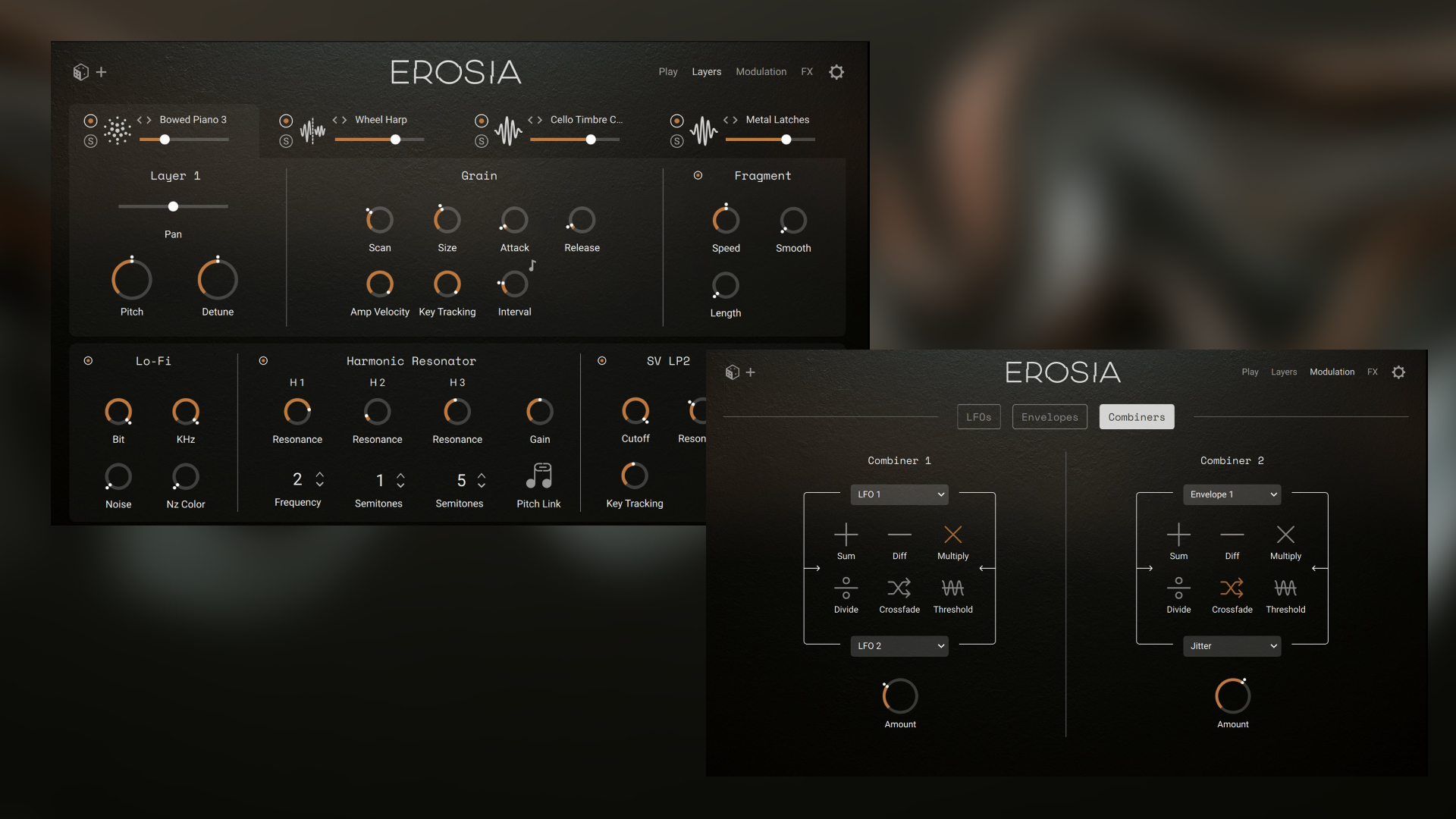
Multi-Synthesis Engine
At the heart of Erosia are three powerful engines: Grain (granular synthesis), Wavetable, and Sampler. Each sound source can be played back by an engine that can be customized with various parameters. Not as deep as a full-fledged Synthesizer, but quite flexible.
For example, the grain textures let you create grain fractures and animated textures by using parameters such as scan, size, attack, release, and more. The wavetable engine adds evolving harmonic color, while the sampler preserves realism.
Music producers can layer up to four sources, each with a distinct sound source. Then, you can shape these with various parameters, add modulation via built-in LFOs, envelopes, and sequencers—a wide range of options to animate and evolve sounds.
Alongside the modulation, it also features four creative macro controls on the first page of the user interface, making sound manipulation easier on the fly.
Further, it hosts a comprehensive multi-FX page with a suite of reverbs, delays, saturation, and more. They are also tweakable with the modulation engine.

Sounds
To get it started, it ships with over 200 expressive snapshots designed for cinematic scoring.
Native Instruments Erosia is capable of creating morphing and modulating soundcapes from materials under strain, from ice crackling across cymbals to glass vases straining under tension.
First Impression
Since I’m a big fan of physical modeling sounds, the Erosia is a Kontakt instrument that really appeals to me. I really like the acoustic, metallic sounds of it.
It is also nice to see that Kontakt libraries now offer more multi-synthesis options such as granular and wavetable,
Native Instruments Erosia is available now for 149€. It runs in the free Kontakt 8 Player and the Kontakt 8 plugins with version 8.6.0 or higher installed.
More information here: Native Instruments

Be the first to comment