
Cherry Audio Mercury-8 is a new, authentic Roland Jupiter-8 emulation that completes the Mercury plugin collection. Here is a review.
The original vintage Roland Jupiter series consisted of four prominent synthesizers: the Jupiter-4, Jupiter-6, and Jupiter-8, plus the MKS-80, aka Super Jupiter rack unit. There are several emulations out there from various developers. For example, Cherry Audio took the opposite approach.
Instead of beginning with the popular flagship, they released soft versions of the JP-4 and JP-6 called Mercury 4 and 6. Now, with a delay, Cherry Audio also released their own take on the Jupiter-8 called Mercury-8, thus completing the Mercury plugin series.

The Cherry developers kindly sent me a copy in advance for review. Since I neither have an original in the studio nor the money to buy one, I won’t go into detail about how close it is to the Jupiter-8.
Cherry Audio Mercury-8
Mercury-8 is an authentic emulation of the Roland Jupiter-8 polyphonic analog Synthesizer from 1981. But wait!
It’s not just a 100% 1:1 emulation of the original feature set. Cherry Audio has equipped the Mercury-8 to be more like a never-existed Jupiter-32 on steroids.
The user interface is exceptionally close to the original, making it very authentic for programming sounds within this original workflow—modulation on both sides, and sound generation and filters in the middle.

Mercury-8 features a dual-layer architecture with 16 polyphonic voices per layer, including split and stacked modes—8 voices in total, up from 2 on the original.
This gives you a 16-voice Jupiter-8 emulation per layer, freely programmable and later combinable with the other layer. The layers are visually separated by two colors: red for the upper area and green for the lower area.
Mercury-8 Voice or a Jupiter-32
The synthesis offers no major surprises and provides the exact ingredients of a classic Jupiter-8: two multiwave VCOs with the legendary cross-mod and sync functions, a source mixer, a fixed highpass filter, a -12 dB/-24 dB lowpass filter, a VCA, and two envelopes.
Another indispensable feature of a JP-8 emulation is unison, which makes brutal sounds possible.
New additions include an analog drift parameter for altering the character of the emulation and a freely assignable 4-slot modulation matrix per layer. This supercharges the original modulation capabilities..
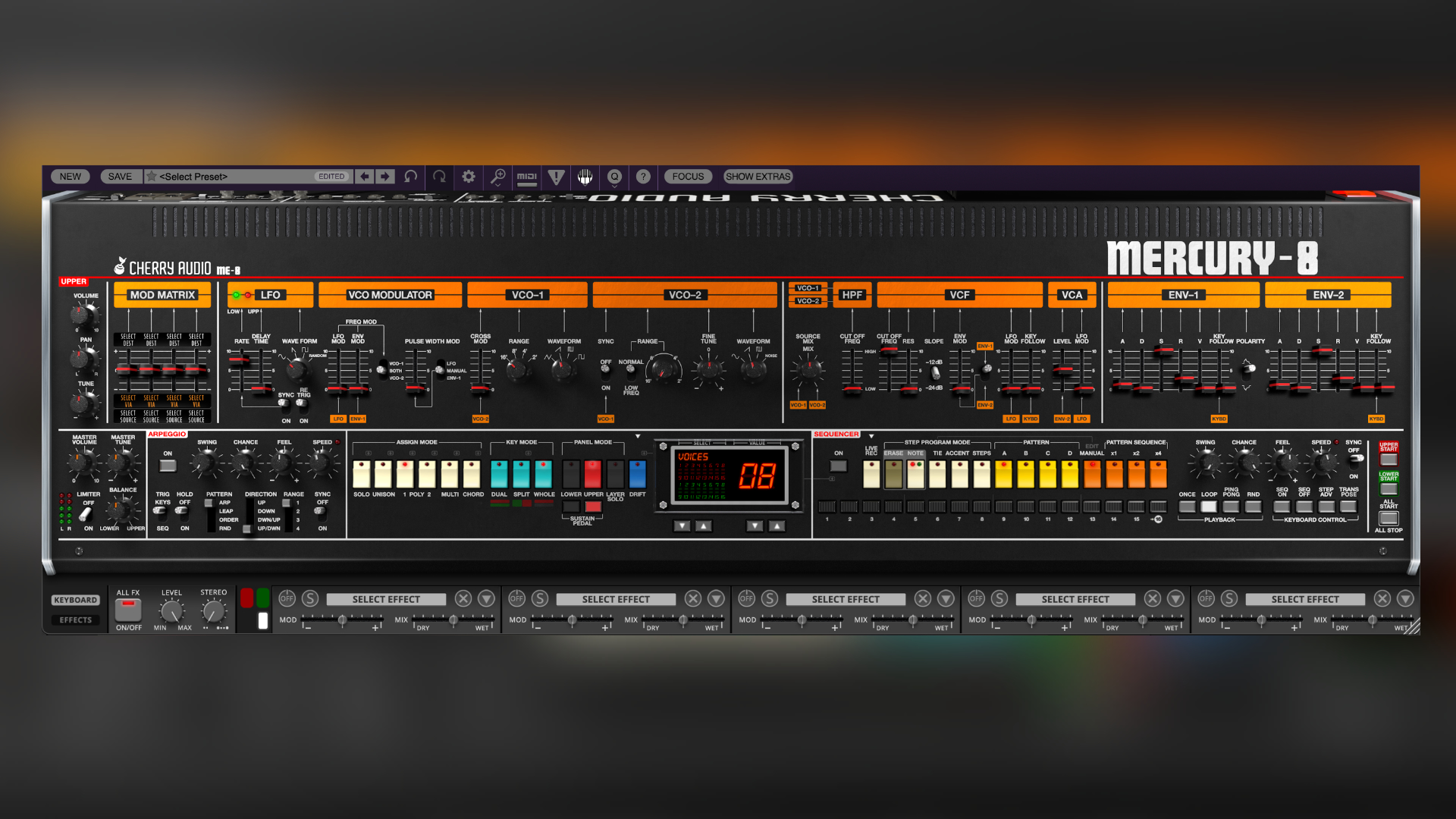
Here, you can use envelopes, LFOs, random, noise, or even the sequencer and polyphonic aftertouch as modulation sources. This makes patches possible that weren’t possible with the 1981 original.
Don’t forget: this is per layer, so you have another modulation matrix on the second floor. Musicians who like things complex will love this option.
Mercury-8 also features the original modulation bender on the bottom left, where you can instantly bend and modulate the VCOs and VCFs.
Colorful Multi-FX
Unlike the Juno series, the Jupiter-8 had no built-in effects, not even the well-known Juno Chorus. The Mercury-8 voice also lacks them, but the Synthesizer does have a foldable dedicated two-layer multi-effects unit.
This allows you to process the classic Jupiter-8 tones into new sonic territories. Each layer (lower, upper) has its own multi-FX processor with four slots plus a global one also with four selectable FX modules.
You can select from 20 different effects modules, including many well-known algorithms that are already available in other Cherry Audio plugins, such as a digital delay, flanger & chorus, and galactic reverb.
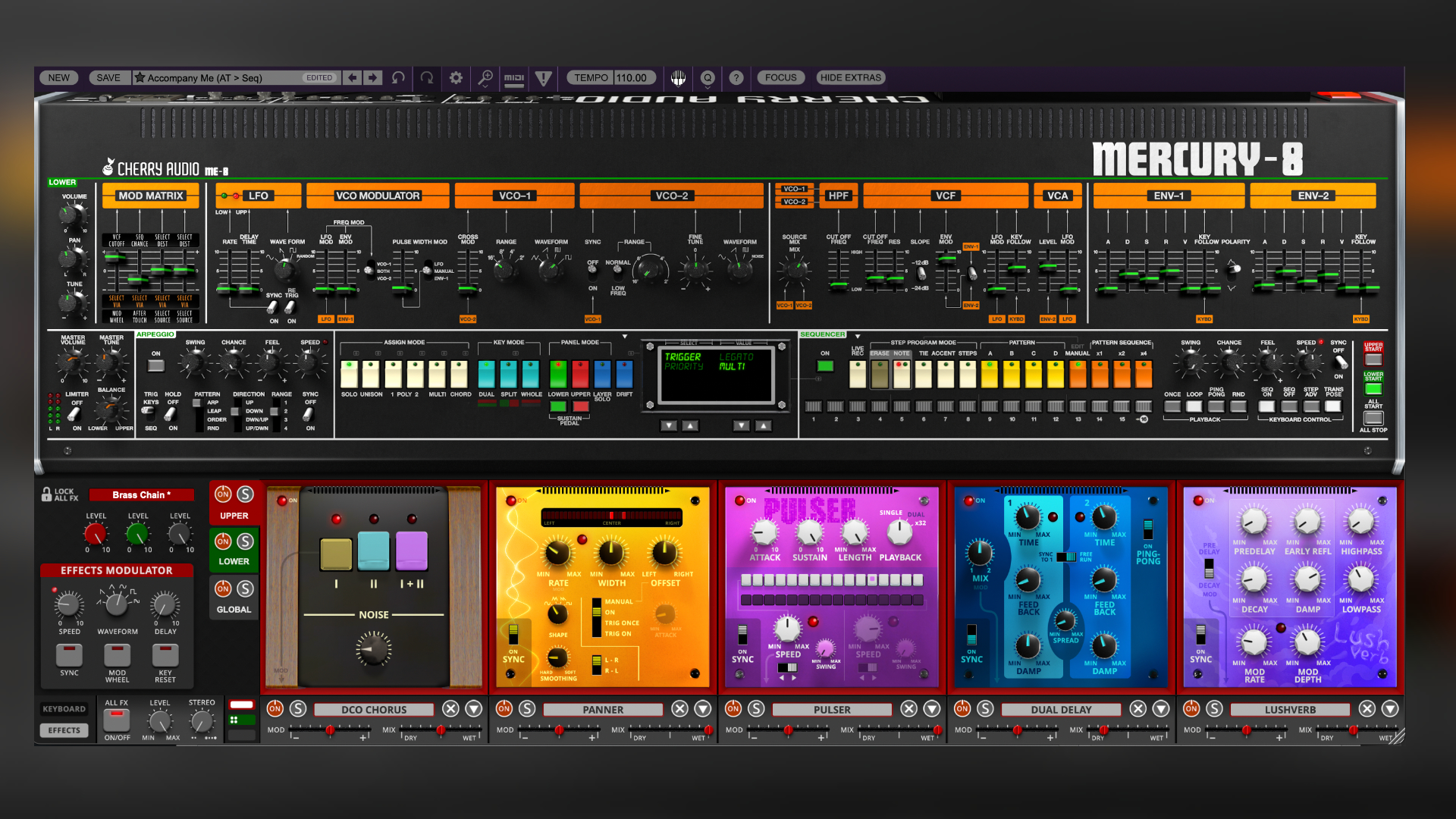
Yes, many are reused from other plugins. However, there are also new, lovely additions.
First, you have a new DCO Chorus, a chorus that is modeled after the legendary Roland Juno chorus. It offers the must-have three modes and an adjustable noise level.
An effect that can be used to create beautiful, wide, and warm vintage sounds. Even though it wasn’t included in the original, the two go together very well. Then, you have a new panner module that lets you create interesting sounds in the stereofield.
The third and last new FX is a pulser effect, essentially a gate FX with 32 steps, allowing rhythmic effects.
All in all, these are convincing in both sound and functionality. They can all be fine-tuned, mixed, and even modulated. Each layer has a multi-wave LFO for modulating a parameter. Another one would be nice, too.
A like also goes to the option to save effects chains. Often overlooked, but can be very helpful in sound design sessions.
Rhythmical Pleasure
Each layer includes an arpeggiator and sequencer to provide movement to your sounds. The arpeggiators are familiar from other CA plugins.
Alongside classic features like patterns, directions, and range control, there are also chance and feel settings to add variety and evolving movement to the results.
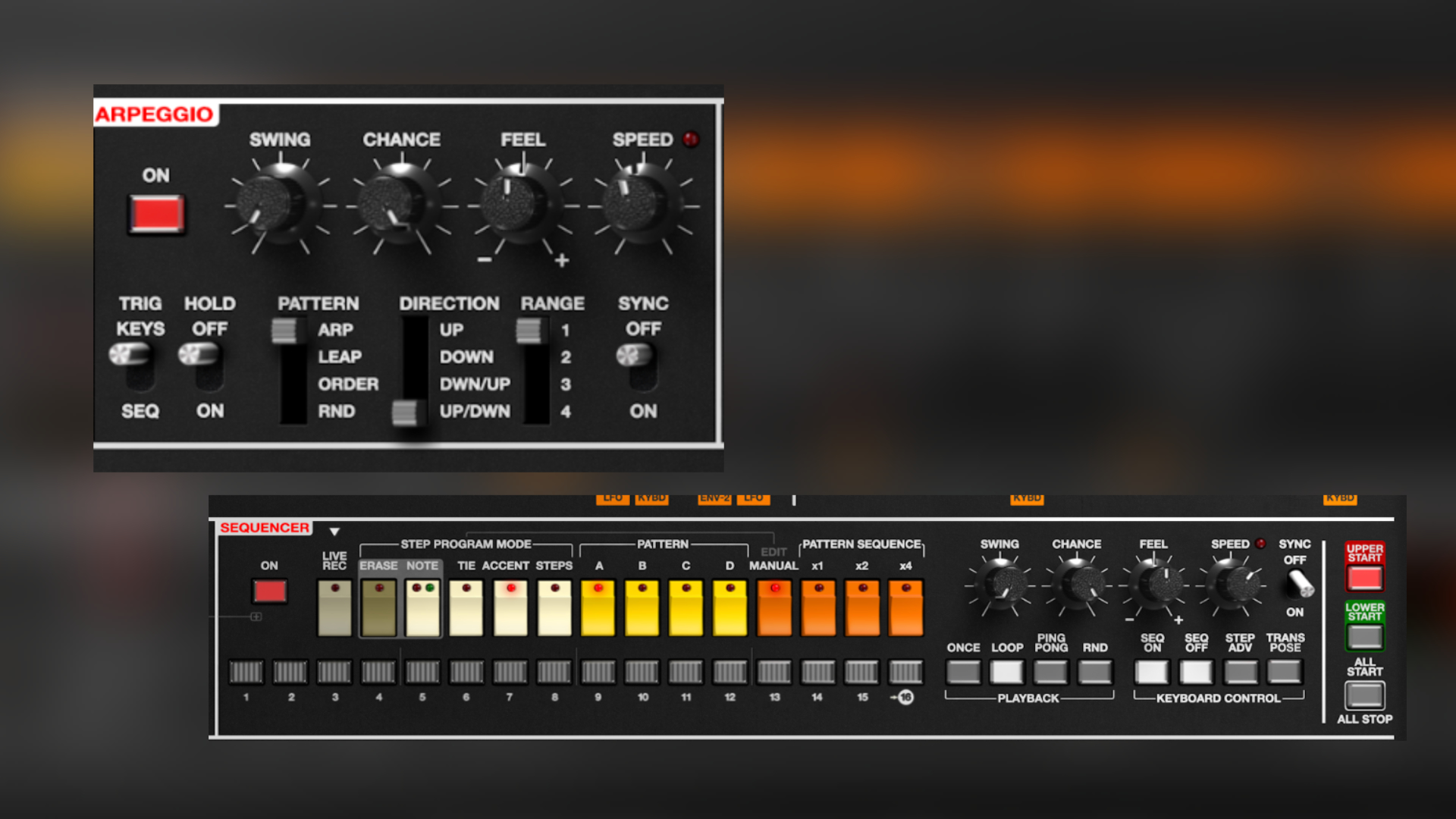
The same applies to the sequencer. It is also best known from other Cherry Audio plugins, like the Trident MkIII. This includes various playback directions, real-time recording with accent, ties per step, and various arranging options with A-D patterns.
Don’t miss the button on the absolute right side of the UI. It enables transposing sequences on the fly – a convenient feature.
Also neat is the ability to start each sequencer at the same time or with a delay. Sync is also available, but ratcheting or probability, however, is still missing, which is a shame.
Jupiter-8 Editor?!
The important portamento feature is included, as is a limiter. The latter is essential because CA plugins tend to overdrive pretty fast.
Most musicians buy the Cherry Audio Mercury-8 plugin because they don’t have the original hardware. This is understandable given current secondhand prices. If you’re one of the lucky ones, you can also use the M8 as an editor.
Mercury-8 supports data exchange with MIDI-modified hardware. You can import and export original Jupiter-8 patch bank SysEx data. If I’m not mistaken, this is a feature that you can’t find even in the official Roland Jupiter-8 emulation.
Sound Design
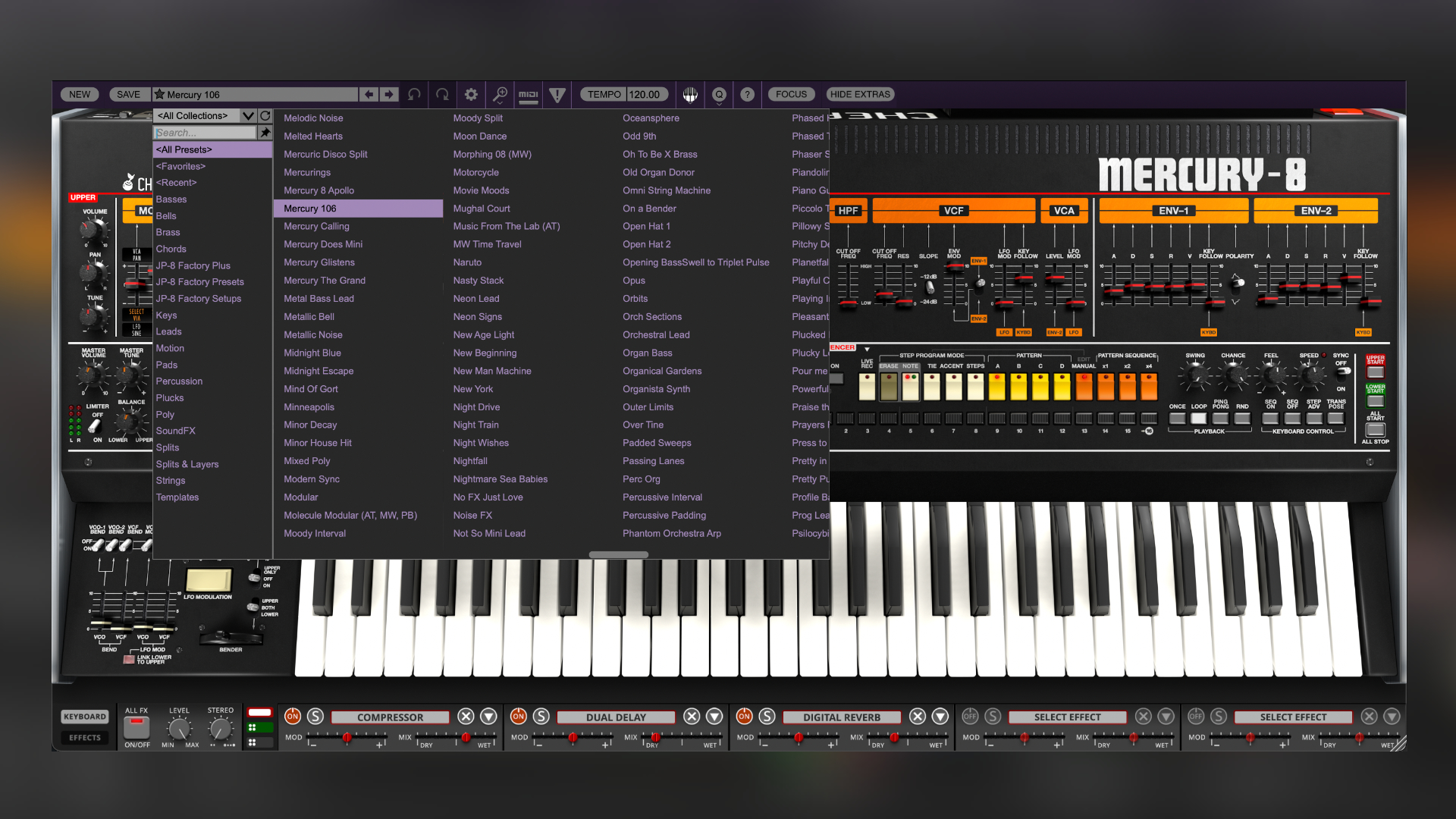
Cherry Audio delivers the plugin with over 600 newly professionally designed sounds. As a bonus, it also includes the original hardware preset banks. This makes it easy to compare the hardware with the emulation. But only if you own one, damn.
Those who prefer to build their own sounds can delve into the dual-layer engine’s vast sound design options. The range is enormous.
You can certainly recreate the popular Jupiter sounds, from crisp basses and juicy pads to beautiful dominant sync or unison leads and all sorts of dirty cross-modulated sounds.
Even though most people love the bread-and-butter sounds, I prefer to delve into the cross-mod madness. Thanks to the expanded engine with more modulators, effects, etc, you can achieve sounds not possible with the hardware.
An epic, fluffy pad on the lower layer and a crazy cross-mod patch on the upper. But both with 16 voices. Another option would be to manipulate the patch per layer with different effects, giving you very complex sounds easily.
Do these patches sound like those on a real Jupiter-8? I can neither confirm nor deny that. Personally, I find them charming, and they have many Jupiter tones I know from demos. One thing is sure: you can build these sounds using the original’s workflow.
Cherry Audio Mercury-8 review
All in all, Cherry Audio has delivered an excellent conclusion to their Mercury plugin series with the new Mercury-8. In a direct comparison between Mercury-4 and 6, this plugin is on a higher sonic level. I hope the others will receive an update in the future.
I like that the feature set isn’t simply emulated 1:1, but rather the whole thing is supercharged with new shaping options, which are also possible in hardware nowadays.
Whether the Cherry Audio Mercury-8 is the perfect emulation of the original Roland Jupiter-8, I can’t confirm or deny. I don’t want to throw glitter in your eyes, and ultimately, it’s not true. I’ve never played the original long enough to give you a definitive verdict.
That is something the Roland Jupiter-8 owners have to decide. Nevertheless, it must be said that emulations from 2025 are at a very high level. You really have to delve into the absolute details to find points to criticize. That was different back then.
The only thing one can criticize is the UI. They tried too hard to be too faithful to the original. The UI is extensive, yet the parameters are tiny and difficult to see perfectly on a large screen. Yes, there is the focus function, but it is suboptimal, as one would ideally want to use a complete UI.
Anyone who wants to design sounds on an interface/concept like Roland’s vintage flagship synths and achieve similar results won’t go wrong here.
Cherry Audio Mercury-8 Availability
Cherry Audio Mercury-8 is available now for $69 USD. It runs as a VST, VST3, AU, and AAX plugin on macOS (native Apple Silicon + Intel) and Windows. They also released the new Synth Stack 6, including all 2025 releases.
The Grid Preset Pack with 100 additional presets by renowned producer Michael Oakley is exclusively available from Cherry Audio for $9.99.
Mercury-8 is also available as part of Cherry Audio’s new Synth Stack 6 collection, which bundles 36 of their acclaimed plugins for $599. There are upgrades and crossgrades available for existing users.
More information here: Cherry Audio
Available from my partners

I like to see hardware vs software comparisons like Starsky Carr’s excellent videos. Caveats aside, that’s the only way to see if they’ve achieved what they set out to.
Sure is pretty though.
yes also enjoy them but I don’t have the option to do these
:Dual Layer” reminds me of the D16 – Lush-101 and the Roland – Gaia’s.
the original also was dual timbral
Same old, same old… Don’t we have enough of analog emulations already?!
Why can’t Cherry Audio release something original, fresh and groundbreaking aka Arturia Pigments..?
They have. Check out their Harmonia( harmonic series synth), Sines (sine wave synth) and Dreamsynth (hybrid).