
The latest Cherry Audio plugin is an authentic emulation of the Crumar DS-2 polyphonic analog Synthesizer from 1978 for macOS and Windows: review + sound demo
When people talk about DCO synths, they often immediately think of the Roland Juno or other similar synths. But it wasn’t one of the first. That was the Italian Crumar DS-2 Synthesizer from 1978.
In its somewhat unique bi-timbral analog engine, the developers used DCO to generate stable oscillator tuning. Now, you can explore this special synth in your DAW. Cherry Audio has teamed up with Crumar for a second time. This time, emulating the DS-2.

Disclaimer: Since I’ve never held or played a Crumar DS-2, I can’t say precisely how authentic the Cherry Audio plugin is. Hainbach, who has a broken DS-2 in his studio and made a great video about it, could help here.
Review Summary
Pro
- authentic Crumar DS-2 sound design workflow
- distinct sound character
- modern and useful addition
- full polyphony
- polyphonic aftertouch
Neutral
- authenticity
- in 4x oversampling mode high CPU consumption (better performance in 1x -2x)
Contra
- many presets rely too much on the FX
- FX modulation parameter is not freely mappable
Cherry Audio Crumar DS-2 Review
The DS-2 is probably not the Synthesizer you had on your Bingo emulation map. This might also be because Crumar isn’t the most famous synth brand. However, it has a long history.
The DS-2 was Crumar’s first commercially available full-fledged Synthesizer, released by the Italian developers in 1978. The synth stood out for its somewhat special feature set and signal path, as well as the usage of DCOs.
A technology that was considered innovative at that time. 48 years later, we have a DS-2 emulation with Crumar’s agreement in our macOS and Windows DAWs.
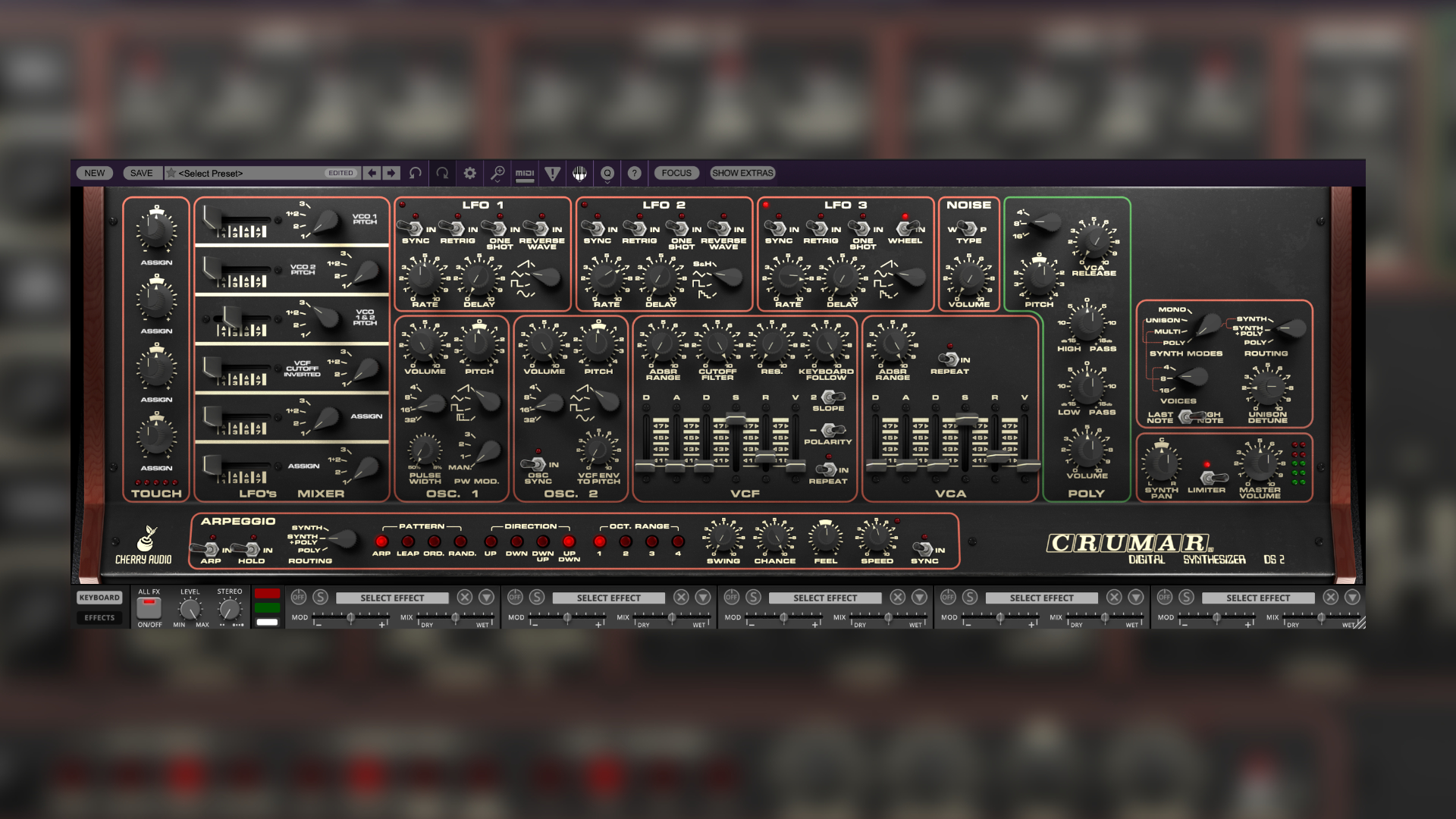
On the table is an authentic emulation that digitally replicates all the features of the original, plus exclusive extra cherries available only in this plugin.
Dual Layer Architecture
The signal path, like the original, is twofold: a synth section and a poly section, but with major changes. In the original, the synth section was a monophonic Synthesizer, while the poly section was a 44-voice polyphonic string synthesizer.
In Cherry Audio’s version, the synth section is now fully polyphonic, with up to 16 voices in unison and multi-voice modes, offering panning and tuning options. The poly section also got an upgrade and is now full polyphonic (not octave-divide) with 32-note polyphony.
The multi-voice mode is a powerful feature in this synth. When expanded, you can give each voice its own unique character by tweaking a selection of parameters, which then change with every press.
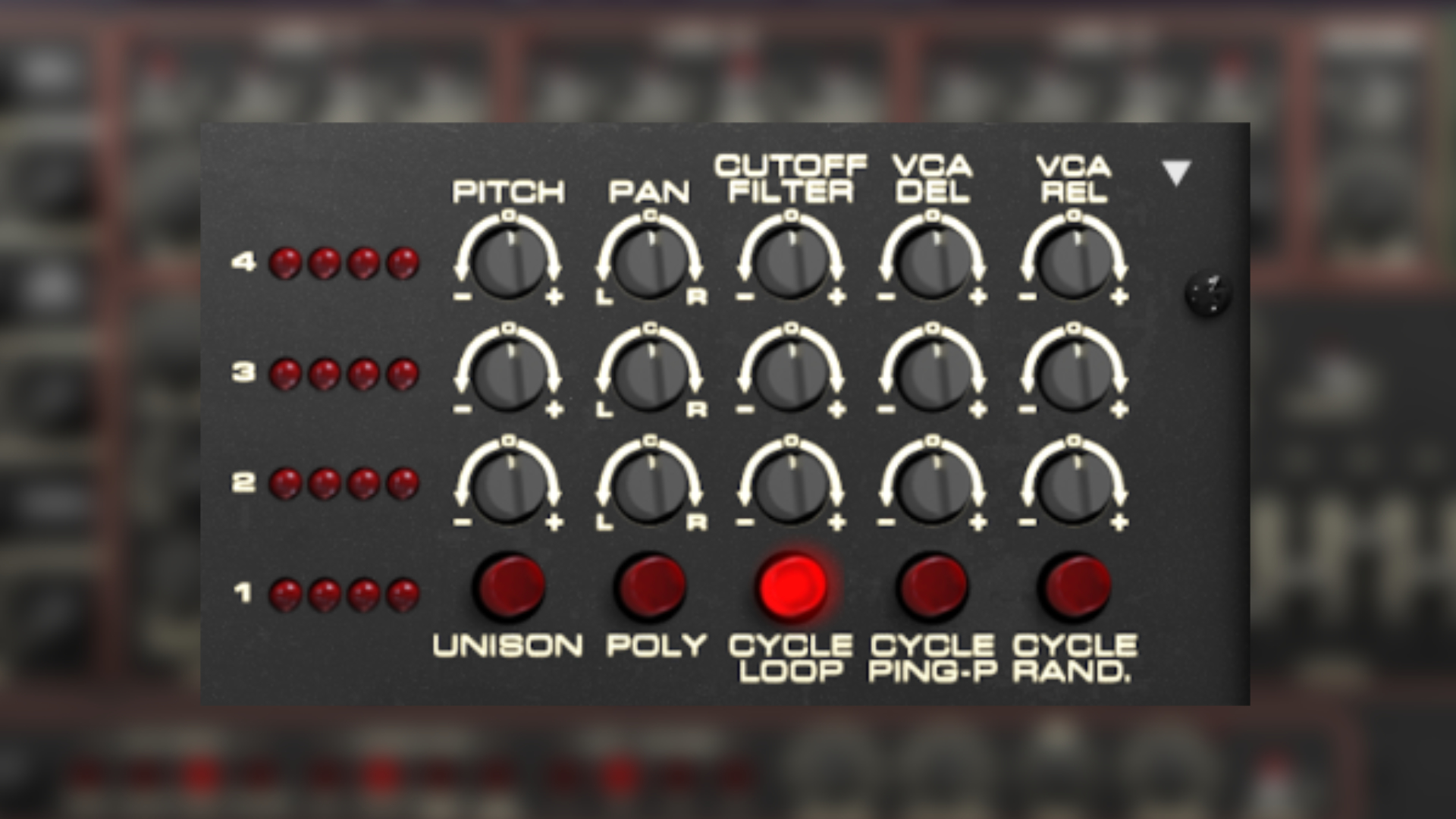
With 4 voices, you can adjust each voice individually in pitch, pan, cutoff, and more. If you switch to 8 or 16 voices, you can still change only the four voices, but the changes are applied to the rest.
Alongside classic unison and poly configuration, you also have three voice cycling modes: loop, ping-pong, and random.
In Cycling mode, you can make the voices dance and give every voice a different mood with each individual or chord keystroke. You can make this extreme or more subtle to imitate the quirky, unstable character of vintage synths.
This can be easily integrated into sound design, allowing you to create patches that constantly change with each key press.
As written, the signal path has two cores that can be used simultaneously in a layer or split setup or individually by turning off the other core via the routing switch. Let’s start with the “synth” part.
The Synth
The largest part is the synth section, highlighted in red/orange. It’s surprisingly classic and simple. Two multi-wave oscillators with pulse-width modulation on oscillator 1 and sync oscillator 2, a noise generator, a lowpass filter, two envelopes, and three LFOs.
New in the Cherry emulation is a stair-stepped sine waveform in the second oscillator, great for classic FM tones. Listening to the oscillators, it’s noticeable that the DS-2 doesn’t have the perfect, crystal-clear oscillators.
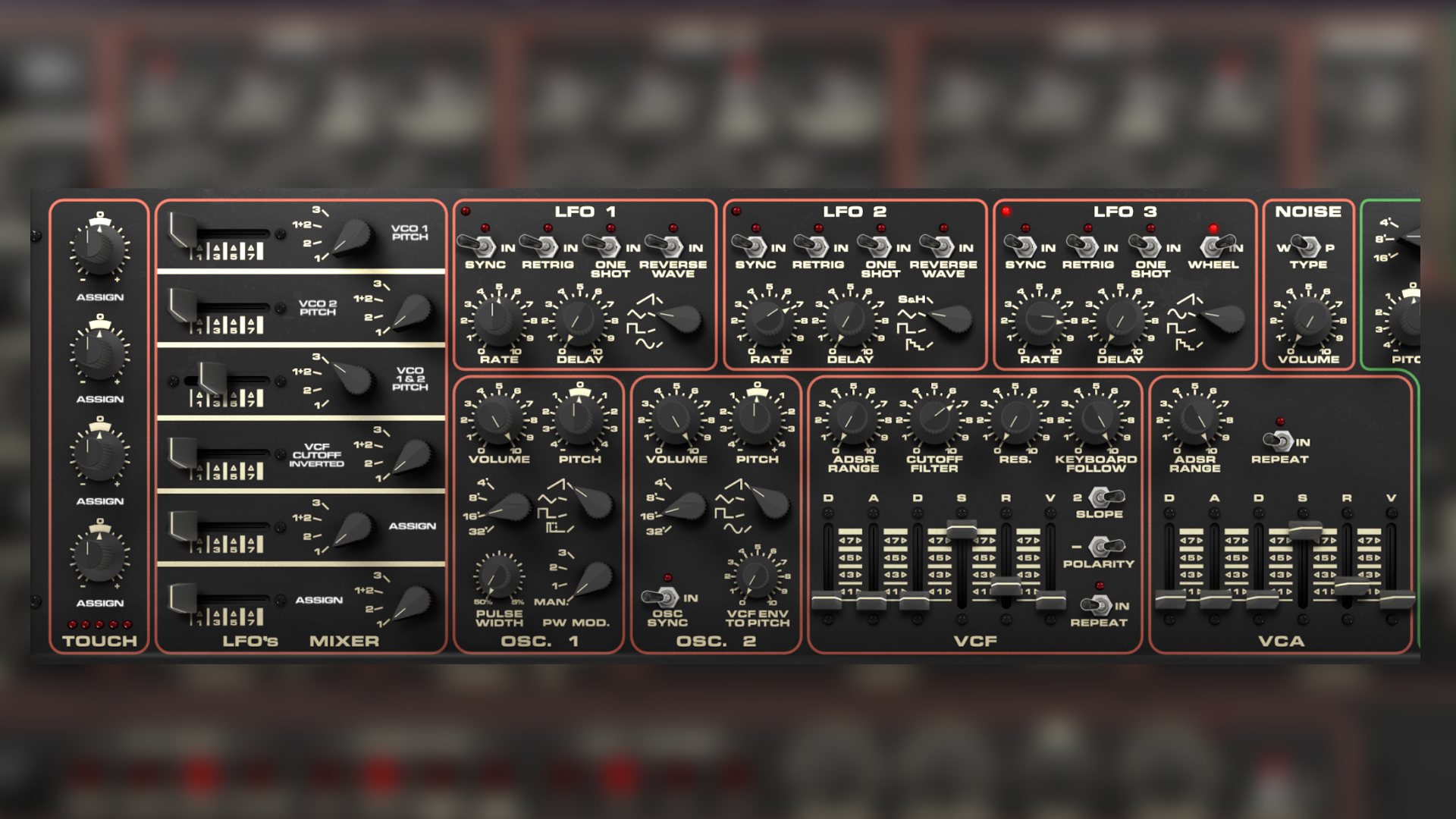
They deliver somewhat graduated, almost step-like waveforms with intriguing overtones. Whether this lovely imperfection was also present in the original, I can’t confirm since I can’t compare them.
The filter offers only a low-pass option. They added a second slope, so you have 12 and 24dB. At max resonance, it sounds very musical to my ears and has even a slight format character.
It behaves differently with low resonance: Here, it acts like a classic low-pass filter with little inherent charm.
Modulation
Two ADSR envelopes are onboard, like the original. Delay stage, velocity, and looping functionality per envelope are new for the plugin, making them more flexible and modern.
In addition to the DADSR envelopes, the user has three LFOs available. Yes, the third is a new addition to the plugin, and with the loopable envelopes, you create patches with up to five LFOs.

Each has a slightly different set of waveforms and offers modern, essential features such as sync, retrigger, one-shot, and a new reverse wave option.
The core of the modulation engine is a slider LFO matrix/mixer that lets you dial in parameter modulation to parameters in a very hands-on way. This is no longer hard-wired like on the model but now has six assignable destinations with 33 options each.
For those needing complex waveforms, LFO 1 and LFO 2 can be combined here as well. I really like the slider option because it lets you create modulations quickly without a lengthy setup.
At first, I thought: maybe too classic, but with the LFO mixing option and loopable and retriggerable features, you can create very beautiful and organic movements in the sound. A random option would have been nice. Plus, there are four slots for polyphonic aftertouch modulation.
The Poly
Moving on to the poly section. It can be a little confusing because both parts of the plugin are polyphonic. The poly part here is a string section that used “divide-down” oscillators in the original.
Simple setup with octave control, pitch, non-resonant highpass and lowpass filters, a release envelope routed to the VCA, and a volume control. It’s hard to go wrong here.
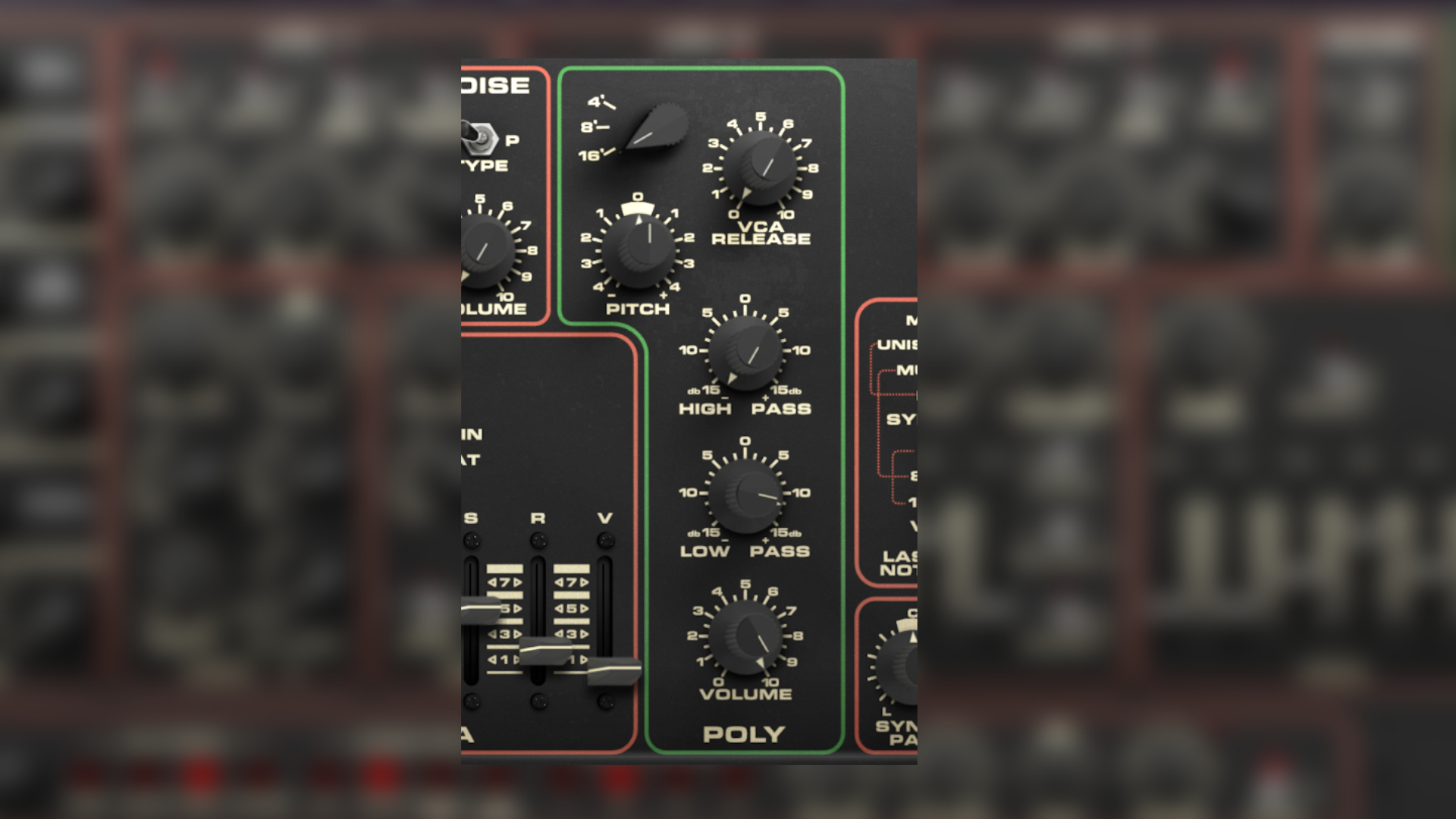
For those missing the warmth in the sound, this section beautifully envelops the synth with a lush, warm retro layer of textures.
Alternatively, you can play the strings solo without the synth part and can still filter, modulate, and refine it to the same extent. Plus, the split-and-layer option gives you the flexibility to use the cozy, warm part wherever you want.
Arpeggiator & Multi-FX
An arpeggiator sits beneath the two synth layers that can be routed to either one layer (synth or poly) or both at the same time. It has the classic features, including various playback directions, hold, a 1-4 octave range, speed control, and swing.
Lovely extras include a selection of arp patterns, a probability function (aka chance), and speed, which bring an organic, more unpredictable vibe to the arpeggios.
Creating custom patterns is not possible, but perhaps we will see this in a future CA plugin. Omitting a sequencer was the right decision as it doesn’t fit with it.
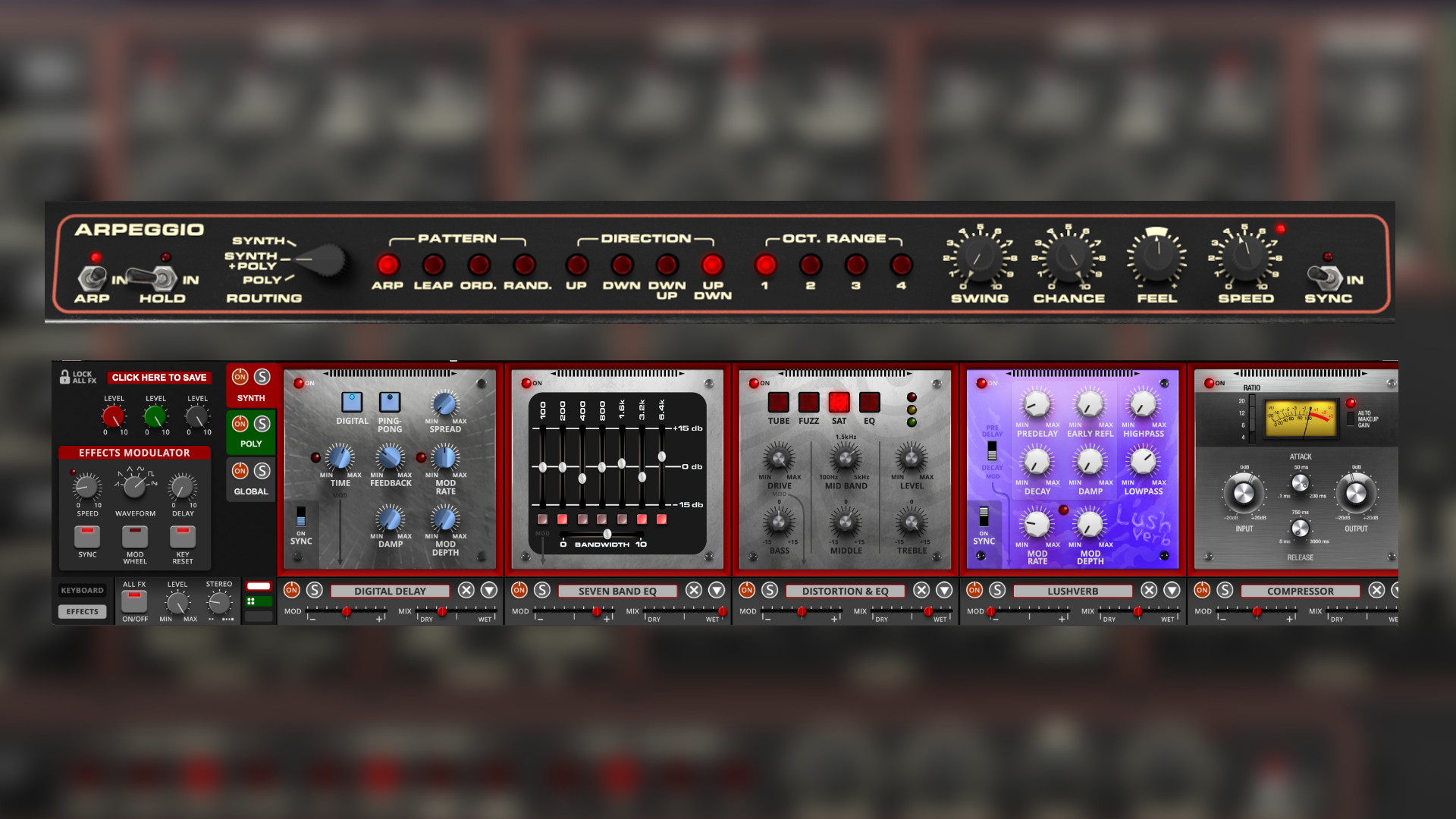
At the bottom of the synth is a multi-FX processor section with three independent channels: synth, poly, and global. Each one is independent, has five freely assignable FX slots, and one assignable LFO.
On the FX menu, there are 20 different effect modules, including many Cherry Audio algorithm classics, such as digital delay, flanger & chorus, and glactic reverb. It also ships with the recently introduced effects, such as the DCO chorus, panner, and more.
There’s not much to say about them. This part repeats itself with every new CA release. They are convincing in both sound and functionality. I like that you can modulate parameters with a dedicated LFO per channel and save effects chains.
However, modulation is still limited to a single fixed parameter per FX. I have criticized this in other releases as well. The same mapping freedom as in the regular modulation would be great here.
Sound Design
Compared to recent CA releases (SH-MAX, Mercury-8…), the Crumar DS-2 is significantly simpler in design. One must be careful not to let this simplicity fool you.
If you fully exploit the modulation with all its possibilities and work with splitting/layering, etc., you can achieve very sophisticated patches. Especially when you design hybrid patches playable on two keyboard sides.
From classic, powerful basses, assertive leads, and lush pads to experimental sounds, the DS-2 covers a wide sound spectrum. In terms of its basic sound, I would describe it as somewhat rough, grainy, edgy, and unique.
I can’t say for sure whether the original had these characteristics as well. In my demo, I removed the FX in many places to give you a closer look at the core sound, and for another reason as well.

A huge arsenal of FX is at your disposal. Using these, however, somewhat diminishes the Crumar’s true grainy character. In my testing phase, I preferred the Crumar without or with minimal FX. Otherwise, the FX are too dominant, and the synth becomes interchangeable with other synths.
This is also noticeable again in the factory presets. Cherry Audio ships the plugin with an impressive set of over 300+ factory presets in 14 categories.
The factory synth offers a vast overview of what’s possible. Basses, leads, pads, FX, rhythmics, etc. Unfortunately, many patches are too cluttered with effects for my taste. The motto seems to be “more effects are always better.”
Personally, I prefer less, especially with emulations, so you can actually hear the modeled sound. In this case, the high level of FX diminishes the synth’s retro charm. It’s great that there’s a global FX off option, so you can listen to the patches without it. Less spectacular, but more authentic.
Don’t forget to grab the “Deep Space Preset Pack” from James Dyson if you need even more ready-to-play patches.
Cherry Audio Crumar DS-2 Review Conclusion
Just when you think you’ve seen almost everything in synth emulation land, Cherry Audio comes along with the Crumar DS-2. This release shows that only a fraction of vintage synths have been emulated so far.
Arturia, GForce, Softube, TAL, Synape Audio, and Cherry Audio have enough material to keep them and us busy for years to come. It’s commendable and very welcome that Cherry Audio also creates emulations of synths that are weirder, odd and less famous.
They demonstrate this once again with the soft recreation of the Crumar DS-2. A synth we haven’t on our emulation bingo map.
Cherry Audio delivers another great-sounding, characterful Synthesizer that reflects both the original features and the sound design workflow, plus major refinements over the original Italian hardware from 1978.
Since I don’t have a Crumar DS-2 in front of me, nor do I own one, I can’t comment on its integral authenticity. Only people who actually own one can say that.
All I can say is this: I listened to some sound demos beforehand to get a first impression. Then, I played the synth and its sound without an active FX wall. For me, I had DS-2-esque moments and vibes. How close they are, I’ll refrain from commenting.
A must-have? No, but nice to have. Especially for those who like Italian retro synths and their unique, often quirky characteristics.
Availability
Cherry Audio Crumar DS-2 is available now for $59. It runs as a VST, VST3, AU, and AAX plugin on macOS (native Apple Silicon + Intel) and Windows. Tip: at AudioDeluxe, you can get 10% OFF with the code SPRING10 + get a free plugin on top.
You can purchase it via their Build Your Own Bundle until April 13th, 2026, starting at $99 instead of $119 for three plugins. The Deep Space Preset Pack with 100 extra presets is available for purchase separately for $9,99.
More information here: Cherry Audio
Available from my partner


Same old, same old…
CA is just recycling the same sound engine, slapping new UI and releasing it as “new” plugin… 😹
This simply isn’t true. I own a handful of Cherry Audio synths and they each have their own character and nuances.
I probably have close to a dozen CA synths with the PS-20 being my oldest favorite. Are you telling me they all sound similar? Please enlighten!