
INA GRM Tools Atelier, the spiritual successor to GRM Tools, is a modular environment for colorful sound manipulations.
In today’s world, there are countless high-quality plugins and tools for advanced sound design. Some offer more superficial functionality, while others delve deeper and manipulate frequencies down to the last detail.
A legendary tool used by many recording studios worldwide, as well as avant-garde contemporary musicians, is GRM Tools from INA. It’s the French Institut national de l’audiovisual, established in 1958 by Pierre Schaeffer.

Following the preview at Superbooth 2025, INA has today released GRM Tools Atelier, the spiritual successor of the GRM Tools software bundle.
INA GRM Atelier
Behind the GRM Atelier release is a well-known figure in the music tech world. Matthias Puech is a developer who, among other things, developed the code for the 4MS modules Ensemble Oscillator and Tapographic Delay.
INA GRM Atelier is a modular sound playground that follows the significant steps of the original GRM Tools plugin collection. Unlike the original, Atelier is a complete sound design laboratory that is an instrument and a colorful effects processor in one package.
You can use it as a standalone app with computer DAW-less charm or as a plugin with all modules. Talking of modules. Atelier has eight simple yet powerful modules for sound generation and processing.
It’s like a modular synth where you can freely patch modules together. Let’s take a look at the modules.

Play, Generate, & Shape
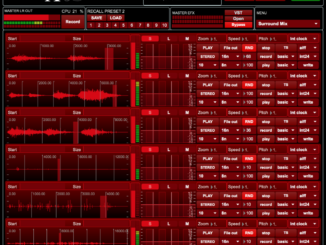
GRM Play is an inspiring sampler that works like a virtual tape recorder, with creative features such as input sampling, resampling, multiple playheads, versatile playback regions, and more. It also has a unique envelope that is applied while reading the sample region, with fade and slant controls.
Depending on how you use the play-sampler functions, behavior can vary greatly. For example, you can create granular effects without having a granular function. If you prefer working with synthesis, the next module is for you.
GRM Gen is a bank of complex generators inspired by traditional modular synths that continuously sound until stopped. It doesn’t require MIDI notes or triggering events.
It has various waveforms (sine, triangle, rectangle, noise, etc.) and a built-in envelope follower for ducking behaviors and more. This module serves as the source counterpart to the sampler, which allows synthesis to discover.
GRM Band is the spectral chisel, or more simply, a powerful linear-phase FFT-based spectral sculpting tool for your signals with up to 16 independent and spatializable bands.
It carves into frequencies like in clay. Feed it audio and start isolating spectral regions, put forth or gently reduce tonal elements, or totally change the frequency profile of your material. I hope you are still here because we have five more modules.

Pitching, Delaying & Gaining In New Ways
GRM Pitch is not another classic pitch shifter. It uses a bank of eight pitch shifters and granular delays, arranged on a convenient 2D surface. But instead of just doing the regular duties. It deconstructs the concept, exposing it piece by piece and offering users a unique pitch processor.
Thanks to the open design of the Pitch Shifter engine, you can go far beyond what a pitch shifter can do.
GRM Time is a novel delay that offers an engine designed for pushing your explorations into uncharted territories. It takes audio as input, stores it in a buffer, and replays it a while later. But the fun only begins here.
You can use the buffer and shape it with 32 freely-tunable taps, variable transport speed, continuous granular playback, and per-tap band-pass filters. Matthias Puech and his team promise that it can reach sound transformations yet unheard of for a delay processor.
Then GRM Gain takes the concept of a gain control to another direction. Alongside classic amplitude controls, it can also affect the tonal and temporal characteristics of an incoming signal.
For example, it includes a small delay that simulates the speed of sound in air, a subtle room-like reverberation, and more. With this module, you can add depth, movement, and presence.

Comb Filtering At Its Best
GRM Comb is the final sound processing module in the new INA GRM Tools Atelier environment, and, as the name suggests, it’s a processor that bundles the world of comb filters. And yes, again on steroids.
Comb filters are used in many areas. For example, to create physical modeling sounds or effects, such as waveguides or delays. This module offers everything you know about comb filters, along with neat additions, turning it into a physical modeling instrument.
You can use it as an end-of-chain effect processor to give audio signals a distinct organic flavor, or as an integrated part of your crafted Synthesizer, turning it into a physical modeling/waveguide synth.
The GRM Viz module visualizes the whole mangling extravaganza. It’s a complete toolset, including VU-meters, a spectrum analyzer/spectrogram, a correlation meter, and an oscilloscope.
Patch & Modulate Them
GRM Tools Atelier is a modular sound environment in which everything is real-time, interactive, and modulatable. It follows Pierre Schaeffer’s founding principles of composing by directly interacting with the musical material
Modules can be combined as desired and allow the user to use them in a variety of ways: as a synth, FX processor or a wild mix
To make this as powerful and fun to use as possible, the INA GRM team has developed a novel polyadic modulation engine with a straightforward drag-and-drop operation system.

At launch, it offers three types of modulators (random, controlled, and programmable) that can be patched to the modules’ parameter slots.
Unlike analog modulators (Eurorack…), a single source can produce an infite variety of independent modulations when connected to several destinations. This creates an enormous depth of movement that can be infused in the parameters.
Furthermore, Atelier is not limited to mono or stereo setups. It features unbounded multichannel processing and brings it to the composition stage.
That’s just the beginning of a new powerful sound design enviroment. INA plans to update GRM Atelier in the future with more features, and modules in point updates. They estimate this will be about 1.5—2 years worth of upgrades.
First Impression
Many years ago, I started working with GRM Tools. Back then, I made a video jam about the plugins. GRM Tools Atelier is a massive advancement in both the quality of the processor and the visual workflow. Where the original looked like cryptical, clinical software, these new plugins are real eye-catchers.
I am looking forward to experimenting with the new version in the coming weeks and months and will follow how it evolves.
INA GRM Tools Atelier is available now for an introductory price of 199€ (until November 14th, 2025), and goes up to 249€ in mid-November. It runs as a standalone app and VST3, AU, and AAX plugin on macOS only for now.
It’s a lifetime purchase: no subscription, and no recurring fees. When v2.0 is released, they will propose discounted upgrade paths for existing v1.x user. While the initial release is macOS only, we are already working on a Windows port that will be available in early 2026.
More information here: INA GRM
Being able to insert ‘blank’ time into a looping envelope (8:00 mins in the video) is a neat trick that the Moog One has.
ina grm trying to hit that instagram/youtube/volca/elektron/op1 crowd with the Andrew Huang video.