
Stylophone ON-THE-FLY, announced at NAMM 2026, is a new performance, no-menu-diving sequencer that expands the CPM (DS-2/DF-2) device family.
NAMM 2026 wasn’t exactly a big Synthesizer celebration—largely because an event was taking place in Berlin. Even so, there was some news—one highlight being the Stylophone ON-THE-FLY sequencer.
Dubreq, the company behind Stylophone, spent 10 months developing this new sequencer. It has now been officially released.

Stylophone On-The-Fly
Stylophone ON-THE-FLY is a new performance sequencer that can be used as a desktop unit or as a Eurorack module. The original, highly immediate concept—which I explained in the NAMM article (below)—remains in the final product.
ON-THE-FLY includes two 4-step patterns (A and B) that you can configure on the hardware, freely or with quantization using built-in scales like chromatic, major, and more.
Then you can add per-step effects like skip, rest, tie, glide, ratchet, and random – all the usual things. You can play them momentarily or record them so they stay within sequences.
What sets the ON-THE-FLY apart from many other sequencers on the market is the way it brings these 2×4 patterns together. Instead of playing back steps 1–8 in the traditional way, you can combine the two 4-step patterns in any way you like.
A dedicated pattern chain knob allows you to toggle between different pattern combinations: AAAA, BBBB, ABAB, and more. It can expand to 64 steps, at which point it jumps on the fly to other combinations.
For even more steps, use the built-in MIDI looper, which lets you record your performances with up to 1024 steps. Up to 24 sequence memory slots provide seamless pattern switching, enabling you to perform full sets that feel alive and evolving.
On-the-fly time variations, tempo adjustments, and swing control are also onboard. On the connection side, it has per-step gate outputs, a summed gate output, CV output, and both MIDI and sync.
Second Impression
At second glance (after NAMM), the new ON-THE-FLY proves to be a very interesting, highly playable sequencer that takes a different approach than most others. I like that you can reshape sequences quickly without diving into a menu.
Standalone operation or in a Eurorack case is also a plus point. For the price, it’s a great deal.
Stylophone On-The-Fly is available now for $199/£149/169€ from the official website and retailers.
More information here: Stylophone

Article from January 19, 2026
NAMM 2026: Stylophone On-The-Fly is a new performance, no-menu-diving sequencer that expands the CPM (DS-2/DF-2) device family.
Over the past two years, Dubreq’s CPM (Compact, Portable Modular) series has been a great success, with products including the DS-2 drone synth and the DF-2 stereo analog filter box.
A new Stylophone sampler called Voice was introduced last week. There’s another new product for NAMM 2026. Dubreq has unveiled the Stylophone On-The-Fly, a new performance sequencer.
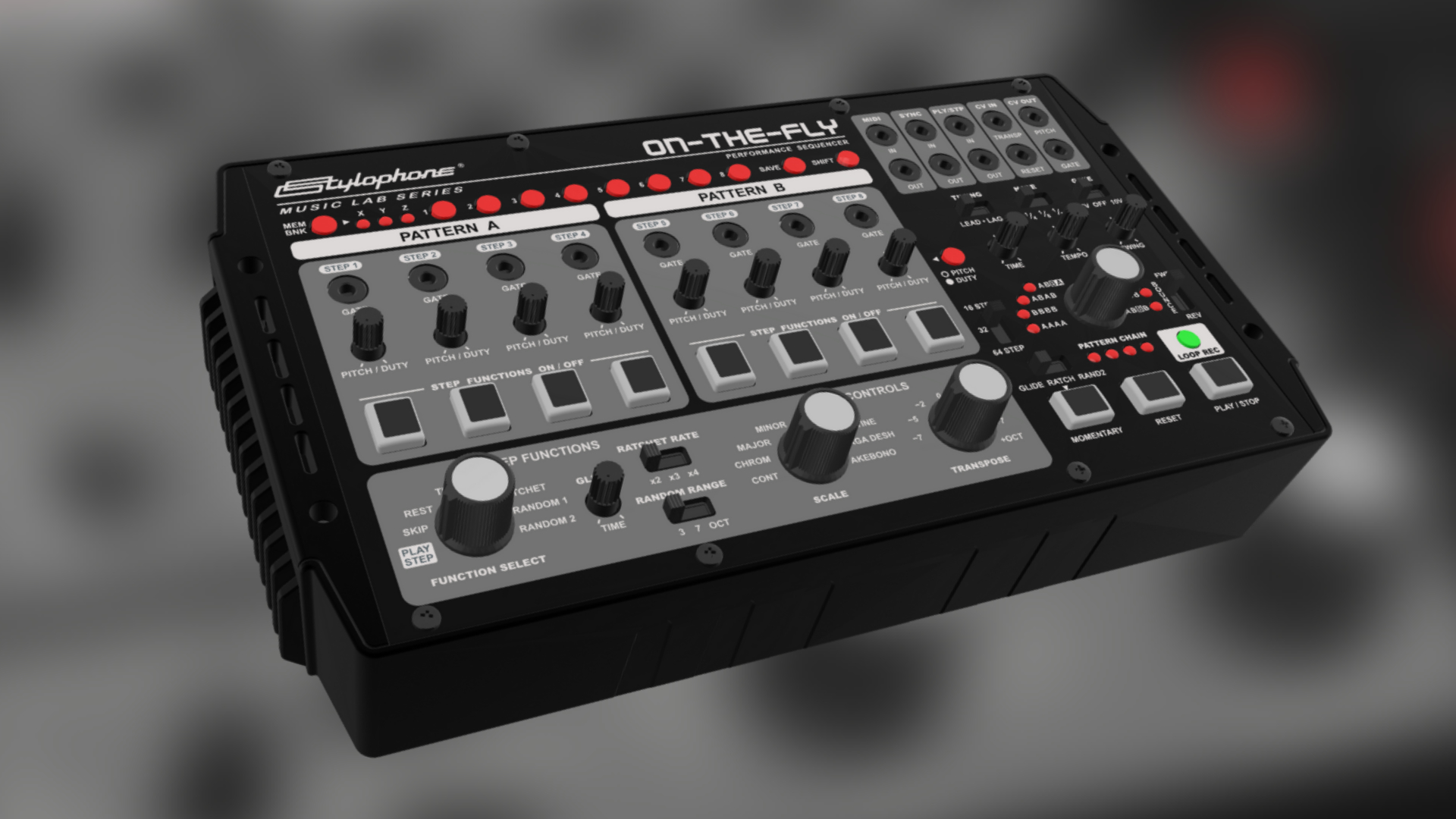
Stylophone On-The-Fly
On-The-Fly is a new hands-on performance sequencer that integrates seamlessly with the current CPM instrument/effects series or any other MIDI/CV gear.
The concept of the Stylophone On-The-Fly strongly reminds me of the almost legendary Korg SQ-1. Dubreq says it’s very accessible, with no menu diving, and it’s both programmable and playable. Exactly why the Korg SQ-1 is so loved by many.
Stylophone On-The-Fly offers two instantly accessible patterns, each with four steps, for eight steps total. Each step has its own pitch/duty control, plus a patch point.
A highlight is how uniquely it combines both patterns. It’s super intuitive: a switch knob with built-in pattern-chaining presets. Depending on the button’s position, you get multiple repetitions of pattern A or B—or a mix of both.
You can switch between these chainings instantly. The same goes for the directions: forward, backward, and backward bounce.
Four steps or eight steps might not sound like much at first glance. However, with per-step functions, you can achieve significant complexity in just eight steps.

Each step has a button for assigning a step function, from simple skip, glide, and reset options to ratcheting or controlled randomness.
This flexibility lets you create complex, highly varied sequences with as few as 4 or 8 steps. You also get a built-in quantizer with a range of scales (chromatic, major, etc.) and live transposition.
Longer Patterns, No Problem
Okay, if 8 steps aren’t enough, you can expand the sequence to 16, 32, or 64 steps- and even more. The front panel also features a built-in pattern looper that lets you capture loops of up to 1024 steps.
You’ll also find adjustable global sequencer parameters, including time, tempo, and swing, along with various note, timing, and gate settings. The gate can be switched between 5V and 10V.
You can also save patterns to three memory banks (X, Y, and Z), each holding up to eight sequences.
For connections, it offers MIDI in and out via TRS mini jacks, sync in and out, play/stop in and out, a CV input, a reset input, and classic CV/gate connectivity for analog gear such as Eurorack synths.
Dubreq says it integrates easily into modular, MIDI, and hybrid setups—and can scale up easily by adding more units to create a multi-sequencer system.
First Impression
Honestly, I’m not a fan of feature-packed, super-powerful sequencers controlled through tiny displays. But the Stylophone On-The-Fly is exactly the kind of sequencer I like: no menus, hands-on, and built for jamming.
It looks like a lot of fun at first glance, and I’m curious to see what the final price will be.
Stylophone On-The-Fly availability and price TBA.
More information here: Dubreq


It is a shame that this comes in a plastic case. Would be amazing if it were an aluminum chasis. With so much music tech being produced these days, it is really important to consider the environmental impact.
It looks to me like the same case as the other two they released.
Meaning you can take it out the plastic case and put it into Eurorack.
Or even build your own aluminium case.
Whilst aluminium is often perceived as more “premium”, modern recycled engineering plastics are extremely durable and significantly better at absorbing shock than metal, which tends to dent or permanently deform. In practical use, plastics can offer superior protection for sensitive electronics.
Environmentally, the issue is more complex than material choice alone. Recycled plastics generally require far less energy to process than aluminium, which remains highly energy-intensive even when recycled. When durability and reduced failure rates are factored in, a well-designed recycled plastic enclosure can have a lower overall lifecycle impact.
Sustainability is ultimately about longevity and lifecycle efficiency, not material symbolism.
This is absolutely false. Most enclosures for electronic devices are made from ABS. Nylon is also heavily used. This enclosure looks to be ABS.
ABS does not break down. It is recyclable but has a distinct recycling process that is not readily facilitated meaning that most ABS items end up in landfill. Any recycled ABS must be mixed with virgin material in order to become useable.
The production of ABS IS energy intensive. Recycling….if utilised is also very energy intensive.
For such an item, the choice of plastic over aluminium is purely because of cost. This is not an item built to withstand high impact or high weathering tolerance. Your argument is very uninformed.
Do not confuse feelings vs engineering verities.
• “Most enclosures are ABS” is a lazy myth.
Modern enclosures span ABS, PC-ABS, glass-filled nylon, PP, aluminium, magnesium, chosen by RF behaviour, EMI requirements, impact response, thermal isolation, tooling economics, and geometry. There is no default material.
• “ABS does not break down” is a non-argument.
Durability is a design requirement, not an environmental metric. Lifecycle energy, mass efficiency, and service life determine impact — not whether a polymer photodegrades in landfill.
• Recycling critique is selective and dishonest.
ABS loses molecular weight when recycled; aluminium loses alloy fidelity and requires re-alloying. Both rely on virgin input. Presenting this as unique to ABS is either ignorance or bad faith.
• Energy claims are backwards.
Primary aluminium: ~150–200 MJ/kg.
ABS: ~80–95 MJ/kg.
Once casting, machining, scrap, and finishing are included, aluminium is far more energy intensive per finished enclosure.
• “Plastic is chosen purely for cost” is flatly wrong.
Plastics are selected for RF transparency, electrical insulation, vibration damping, impact elasticity, weight reduction, and moulded complexity — areas where aluminium is objectively worse.
• Impact and weathering claim is uninformed.
Stabilised ABS and PC-ABS meet UL, IK, and UV ageing standards. Aluminium dents, creeps, and transmits shock; ABS absorbs and recovers.
This is not a materials argument. It is a string of misapplied facts used to justify a preconceived conclusion. The science does not support it.
thanks for that chatGPT response.
If you think that plastic was chosen for this due to anything other than cost and aesthetic, you are part of the problem.
I agree to much functionality crammed into a small screen and combination button pushes is a hassle. I share your opinion on it being a useful tool!
After not clicking with the last few manual heavy devices I’ve tried I decided that I’ve had enough of studying and will be sticking with fun, intuitive gear from now on. Life’s too short for complicated rigs that require a degree to jam with. So the recent Dubreq drops sound very appealing.
@OOO I have worked in aerospace for 27 years. I do not require LLMs to educate me, nor do I outsource my understanding of materials engineering to internet folklore. If structured bullet points are objectionable, that reflects a comprehension issue, not a technical one. This is a forum for reasoned technical argument, not the arbitration of “vibes.” Good luck to you.
20 years experienced industrial designer here.
If you think plastic is the best choice for this application in both efficiency and environmental impact….you are lazy.
Okay, enough of you two for now! You won’t find an agreement here. Everyone has their own opinion, and that should be heard, but there’s no need to escalate the conflict to an unpleasant level! Move on, have a nice day/night and make more music. Cheers.
Interesting ^^ how many TE/HP will it use when mounted in eurorack ?
probably the same as the others but not sure
Their Drone Synth is 42 HP.
I’d imagine this one uses the same enclosure, but can’t say for sure as they haven’t released the full specs yet.
I have the drone synth — love it. Actually I have two.
The plastic enclosure is a bummer, so — as someone else said — I installed them in a steel eurorack case (42 HP indeed, and I bet the sequencer is the same). Since the front panel is a metal/plastic mix, that’s an improvement.