
GForce Software Oberheim Matrix-12 emulates the 1985 flagship analog polyphonic Synthesizer that pioneered the modulation matrix.
The 1970s and 80s gave rise to many polyphonic analog synthesizers – instruments that are now legendary, rare, and expensive to get. Fortunately, many of them are available today as well-made emulations. However, one legend few have dared to tackle: the monster analog synth known as the Oberheim Matrix 12, released in 1985.
The only emulation available so far, created by Arturia, reportedly falls well short of the original, according to hardware owners. Now there’s another: GForce Software has teamed up with Oberheim again to develop a new Matrix-12 emulation.
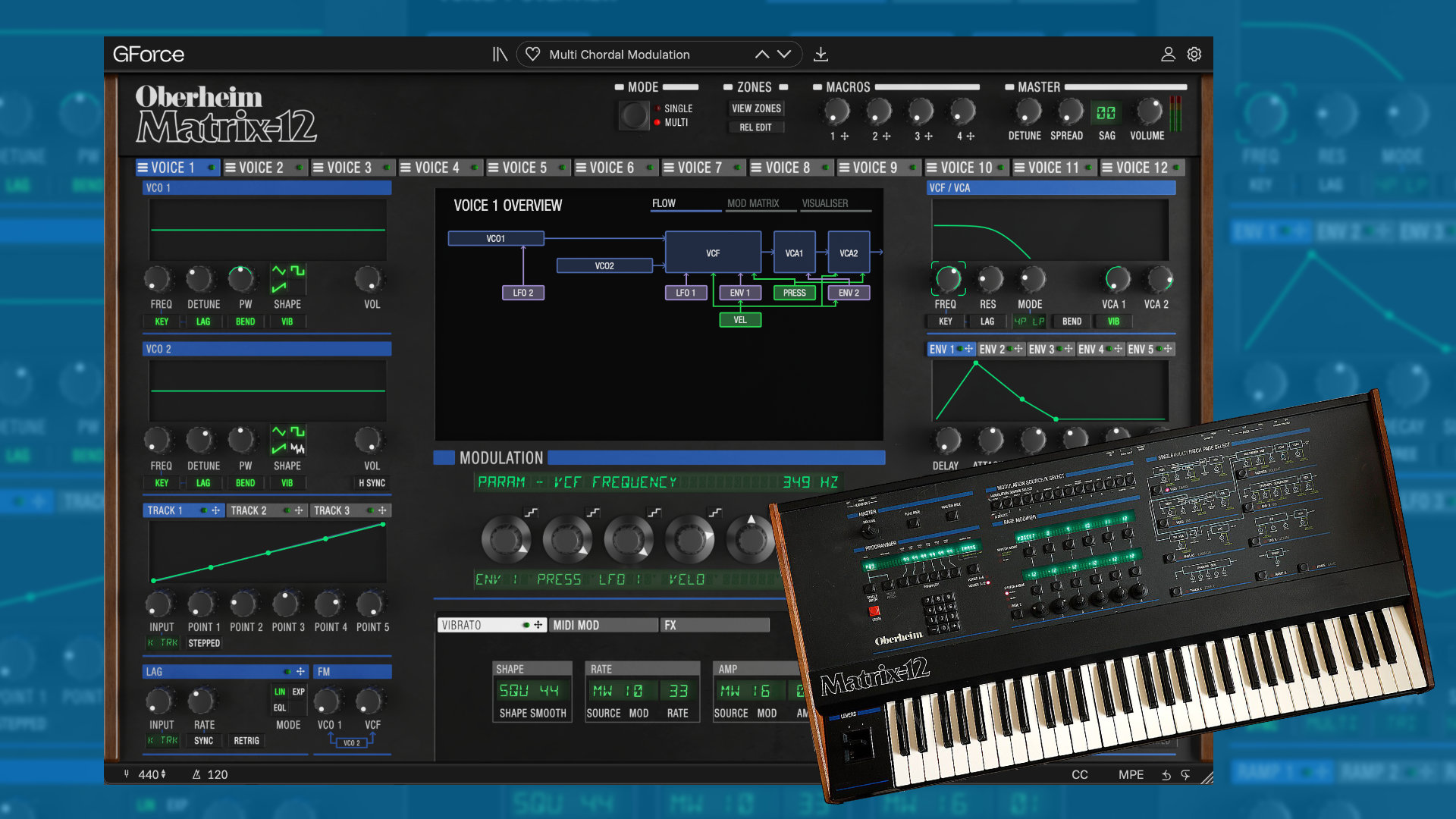
GForce Software sent me a version to test in advance. However, I won’t provide a detailed review this time—partly because things are too hectic right now, and partly because I don’t have an original Matrix-12 on hand for comparison.
Maybe an M12 will fall from the sky someday—who knows? You never know when you might get lucky.
GForce Software Oberheim Matrix-12
Oberheim Matrix-12 is a new emulation of the 1985 analog polyphonic Synthesizer of the same name. Because the Oberheim Xpander is the Matrix-12’s six-voice version, GForce Software’s emulation also recreates this iconic instrument in software.
Both are the only officially endorsed Matrix-12 and Xpander emulations on the market. They also brought on Marcus Ryle, one of the original Matrix-12 designers, to help with development. The motto was: if we’re going to recreate this vintage flagship, we’ll do it right.
The Matrix-12 is a true flagship—or better yet, a monster—of an analog synthesizer: 12 voices, 12 multitimbral parts, and an unprecedented routing and modulation engine. It was so complex that the routing diagram was printed on the hardware because no screen at the time could display it.
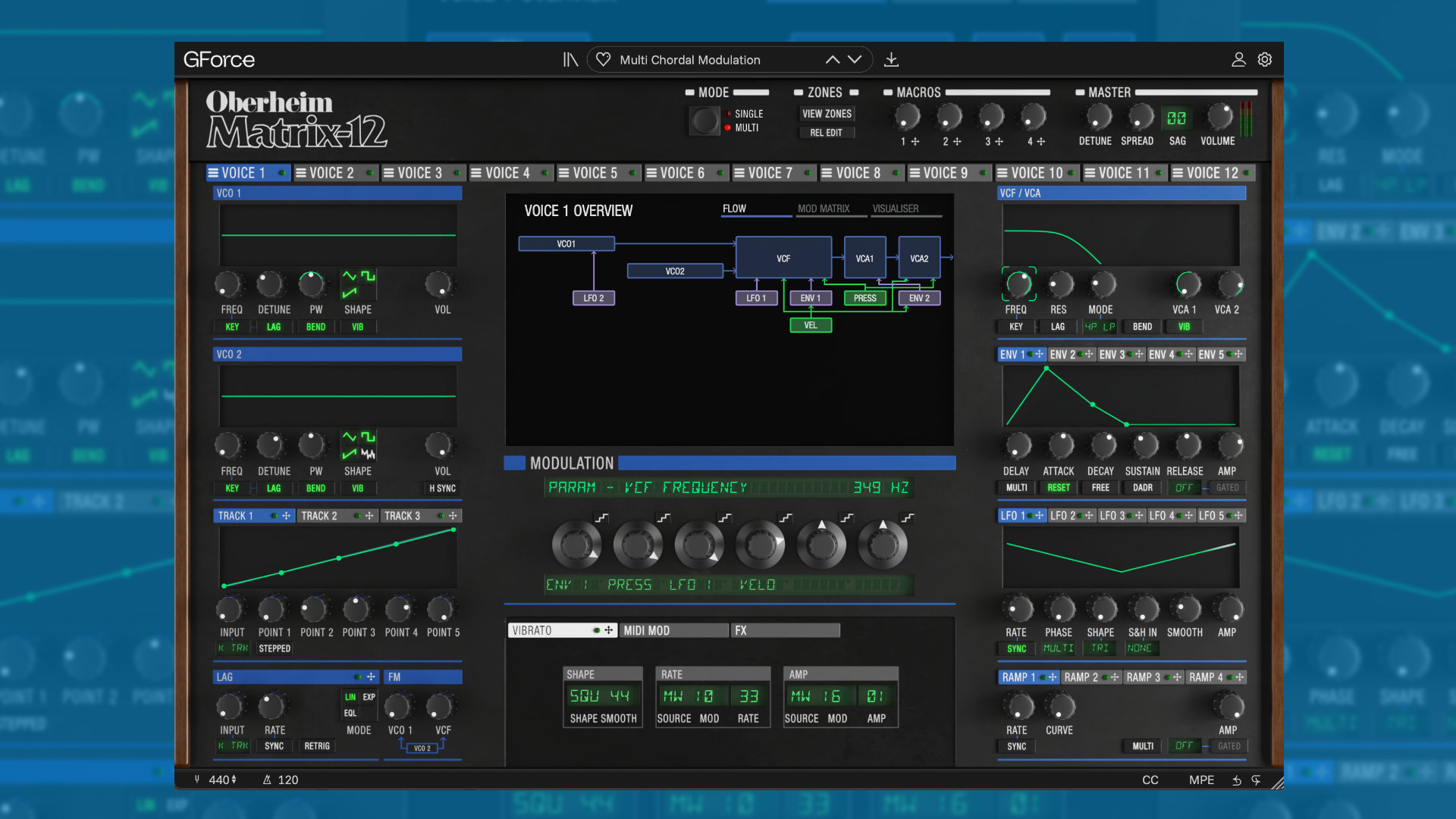
Today, this engine is best known as a modulation matrix—a concept pioneered in the Matrix-12 in 1985 and now found in almost every more sophisticated hardware and software synth.
This software version brings all the original features, including the modulation engine, plus enhancements, into your DAW. The interface, which significantly streamlines the workflow, is heavily inspired by the original—though it is not a 100% UI replica.
Recreated Signal Path
Like the original Oberheim Matrix-12, the GForce Software soft synth is a 12-part multi-timbral instrument with both single- and multi-mode. Interestingly, the voice count didn’t increase. 12 voices is the maximum you can distribute across the parts.
On a second screen, you have a voice mixer and zone control where you can set each voice’s behavior, including rotation.

Each voice/part of the Oberheim Matrix-12 plugin has two modeled VCOs with triangle, saw, and pulse waves. The second adds a noise generator and hard sync. You can also use multiple waveforms simultaneously, just like on the original. FM is also onboard.
These feed into a mighty 15-mode filter section with one- to four-pole low-pass, high-pass, band-pass, notch, phase, and the classic combinations.
A legendary filter, now also available as a Eurorack module (AJH Synth Matrix VCF) or in the Michigan Synth Works MSW-820. Unlike the original, you also have filter FM for extra character. From here, it goes into two VCAs in series.
The First Modulation Matrix
One feature no other synth has implemented to the same extent is the depth and scope of its modulation. The sheer number of modulators, combined with the flexibility in how things could be routed, remains unique to this day among analog polysynths.
A newly developed software-driven modulation matrix developed by the Oberheim team made this possible – and it remains the gold standard for modulation matrices to this day.
The Matrix-12 plug-in replicates this in software, while making it completely hands-on and intuitive to use—something that, on the hardware version, was only possible by navigating a sea of menus and buttons.
Even though this isn’t intended to be a review, I really like how they’ve brought this into the modern era. When you map a parameter with drag-and-drop, the signal path diagram for the selected voice expands accordingly.

For a full overview, it also includes a modern modulation matrix that shows all the modulators, destinations, and active mappings. Speaking of modulators.
The software Matrix-12 includes the same modulation ingredients as the hardware: five DADSR envelopes, five advanced multiwave LFOs, four mini modulators called ramps, three multi-point keytrackers, and a lag processor.
On top of that, you have dedicated vibrato, keyboard, velocity, release velocity, aftertouch, pitch bend, mod wheel, and random. Yes, it also supports full MPE – one of the new features.
New Software Features
In addition to MPE, GForce Software and Oberheim have added other new features to the Matrix-12 plugin.
This includes six micro arpeggiators in the zone control, tempo-synced ramps with linear-to-exponential curves, LFO shapes with smoothing, and a step tracker mode that turns any LFO into a four-step sequence.

Also new are four global macros and two studio-quality effects: a stereo delay and a matrix reverb with per-voice sends in Multi mode.
Matrix-12 ships with over 570 patches: more than 380 new patches and more than 190 original Matrix-12 and Xpander patches. These are available in an easy-to-use patch browser with filters and tags.
“The Matrix-12 is the deepest instrument Oberheim ever built, but on the hardware, most of that depth was hidden behind a small display.
Working with Oberheim and Marcus Ryle, one of the original designers, we set out to keep every detail of that sound and finally put the whole matrix in front of the player, where you can see it, touch it and play it. ” Dave Spiers and Chris Macleod, co-founders of GForce Software
GForce Software Oberheim Matrix-12 First Impression
I got my hands on the software version of the Matrix-12 a few days early. As mentioned, I can’t directly compare the original hardware with the software. The only comparison I could make was against the Arturia Matrix-12 V.
To be fair, the Arturia version is 12 years old (released in 2014), and its engine hasn’t been updated since then. It is clear that the GForce version performs better in this regard.
Viewed as a Synthesizer plugin, it is a fat-sounding instrument with a myriad of possibilities and a fantastic, analog-like tone. I would lean toward calling it the best Matrix-12 emulation—especially since there’s virtually no competition. And the only other soft Matrix-12 that is available is outdated.
GForce Software Oberheim Matrix-12 is available now at an introductory price of $83,99/£69/83,99€ instead of $119,99/£99/119,99€. The price includes 20% VAT. A 14-day trial is available on the website.
It runs as a VST3, AU, and AAX plugin for macOS (native Apple Silicon + Intel) and Windows. Both online and offline plugin registrations are available.
More information here: GForce Software
Available from my partner


Be the first to comment