
Arturia MiniFreak 49 delivers the full-size, polyphonic Freak Synthesizer experience in true stereo, with edges and more performance controls.
The Arturia Freak series is one of the most popular modern synthesizer lines. It began with the MicroFreak in 2019 and later expanded into the polyphonic MiniFreak. That was almost exactly four years ago, in October 2022.
In recent years, the French developers have turned the hybrid synth into a true synthesis all-rounder. The only drawback was its mini-keys—but now there’s a solution. Arturia has listened to users and just released the MiniFreak 49, a Freak with full-size keys.

Index
- Arturia MiniFreak 49 Review Summary
- Unboxing
- Connectivity
- Hybrid Engine But In Stereo
- Multifaceted, Vibrant Multi-Engine Oscillators
- Analog Filter With Edges
- Touch-Operated Modulation
- Quality Effects
- Playful Arpeggiator & Sequencer
- Play With The Touch Matrix
- MiniFreak V 49 Edition
- Sound Design
- Arturia MiniFreak 49 Review Conclusion
Arturia MiniFreak 49 Review Summary
Pro
- full-size keyboard with real pitch and mod wheels
- bigger layout – more hands-on
- built quality
- true stereo engine
- powerful yet versatile beloved synth engine
- filter FM adds edges to the filter
- playful touch matrix with neat extras
- price (300€ extra compared to the MiniFreak 37)
Neutral
- display size (could have been bigger, but it’s usable)
- mixer icons on the display could be bigger with the new hardware controls
Contra
- more polyphony would have been nice
- touch matrix: not possible to assign custom parameters and not recordable
Unboxing
The MiniFreak 49 arrives in classic 2026 Arturia packaging. Inside the box, you’ll find the synth, a USB-C to USB-C cable (finally!), a small power supply, and some documentation.
A comprehensive printed manual isn’t included, but you can download one.

MiniFreak 49 vs MiniFreak 37
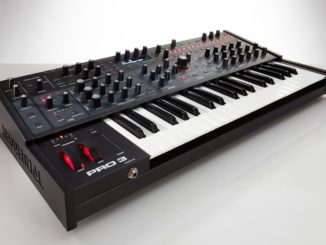
Two MiniFreaks—though the term “Mini” hardly seems appropriate for this new one. At 777 x 288 x 71 mm and 5.70 kg, it’s more of a big freak. By contrast, the MiniFreak 37 is a handy, compact synth that’s easy to take on the go, though it still weighs 2.94 kg.
The larger form factor has led to several changes. For one, the user interface has been reorganized and expanded, giving users more surface area to play with. For example, this eliminates the need to switch between oscillators, as each now has dedicated parameters.
As a bonus, it also adds engine shortcuts. The mod matrix has moved to the right and grown significantly, for good reasons we’ll explore later. Its OLED display is a bit better, but it could be even bigger, especially for a synth this size.

The larger form factor, however, fulfills a long-standing user request: out with the mini-keys, in with full-size synth-action keys. They feature velocity sensitivity and monophonic aftertouch.
There’s no polyphonic aftertouch—which would have been a great addition to this version—but perhaps that’s something for a “Super MegaFreak or Ultra SuperFreak”.
The keys play beautifully, offering a brand-new freak experience. Anyone who’s played the KeyLab 49 MK3 will recognize them: they’re smooth and feel high-quality.
Another great upgrade is the addition of hardware pitch and mod wheels. But you won’t miss the MF37’s touchy experience; the new matrix now includes those functions.

Connectivity
Larger housing, more space, but no significant differences on the back. A glance here shows a sustain pedal, clock in/out, reset out, audio input for the vocoder, stereo I/O, and a headphone socket output.
Next to this is a full-size 5-pin MIDI interface with IN/OUT/THRU, a USB-C port instead of Type-B, and a 12V DC 2A power input with a dedicated ON/OFF switch. Plus, there is a Kensington lock.
Hybrid Engine But In Stereo
If it says MiniFreak, it’s a MiniFreak. The new Arturia MiniFreak 49 features the same multifaceted, vibrant hybrid multi-engine as its smaller sibling, the 37-key version—though it includes a few welcome major changes that aren’t immediately apparent.
At its core, the MF49 features a hybrid architecture—digital oscillators paired with an analog filter. One might expect a larger design to offer more polyphony, but it doesn’t. It remains 6-voice polyphony.
However, the difference compared to the MiniFreak 37 lies in the details. While the MiniFreak 37’s engine is mono—becoming a stereo synth only at the effects stage—the MiniFreak 49 features an engine that is true stereo throughout.

On the right-hand side, a stereo knob lets you pan the 6 voices all in one knob twist. Two stereo spread algorithms (Gradual and Centered) are available. Without a voice span, the differences are not noticeable.
Once you turn it up, however, the hybrid sounds unfold more fully in space and become bigger and deeper. That’s when you can tell the difference between the two engines.
Multifaceted, Vibrant Multi-Engine Oscillators
For the oscillators, Arturia relies on the tried-and-true, beloved digital macro oscillators from the Freak series. MiniFreak 49 features the same mix of 30+ oscillator types as the Arturia MiniFreak 37. From Mutable Instruments, Noise Engineering, and originals.
These range from classic virtual analog, FM, and wavetable to sample playback, plus experimental types such as resonator, additive, granular, and more. You can load an engine into each oscillator.

However, the limitation found in its smaller sibling remains: if you use a more CPU-intensive engine for OSC1, then OSC2 can only use classic or digital shapers—such as the filter.
Four macro-style parameters per oscillator, as before. The ability to tweak both oscillators simultaneously—without switching between them—is a major upgrade that makes sound design more fluid.
The new snapshot buttons for the main engines are also useful. For oscillator 1, you have direct access to basic waves, wavetable, and the sample engine, while OSC 2 offers basic waves, FM, and a filter. It would be nice if you could assign these yourself in the future.
Mixing has also become more straightforward. The hardware now includes two extra controls for the mixer section, so you can adjust them without switching. There’s one downside, though.

You now have two nice, independent parameters, but the corresponding animation is still squeezed into the oscillator section on the right side. I almost need a pair of extra glasses here to see the exact setting.
A dedicated mixer section in the menu would be appropriate, especially since the hardware now has its own block.
This doesn’t change the fact that both macro oscillators offer a vast sound-design range. Classic analog-style sounds, digital FM/RM or additive magic, and even experimental textures—it’s all here.
You can also combine them in a hybrid setup for even more complex sounds. Very few synths offer this much, especially at this price point. And MF49 users also benefit from higher memory (256 MB) for samples and wavetables.
Analog Filter With Edges
Following the digital oscillator is an analog, Oberheim SEM-style multimode filter that adds distinct analog character. It still offers switchable—though not morphable—low-pass, band-pass, and high-pass filters.
It continues to sweep smoothly through digital soundscapes, taming digital sharpness while adding analog, wide, punchy character. At high resonance, it doesn’t enter an uncontrollable self-oscillating state but stays in place while taking on a more aggressive mood.
For those who previously found the filter too tame and controllable, the MiniFreak 49 is likely to be more satisfying, thanks to its switchable filter FM. This new ability allows you to modulate the cutoff frequency with an audio-rate signal.

On the Arturia MiniFreak 49, you can modulate it with either Oscillator 1 or Oscillator 2. Results vary depending on the algorithm and tuning. Adding Filter FM gives the Oberheim filter a much more heated, analog character.
Pull the knob left or right, and the filter will be flooded with inharmonics, grit, and dirt not available to this extent in the MiniFreak 37, especially at high resonance. It starts to sparkle—almost like a singing quality. Okay, more of a growl.
The impact is especially beautiful on sample-based content; it gives the sounds a bit of the charm of vintage samplers. Of course, you can also modulate the filter FM with the internal modulation engine. Perfect for bringing motion and dynamics into the cutoff shaping.
An additional analog drive would have been exciting, too. But the filter FM addition alone turns the Oberheim into an “Angerheim” filter.
Touch Operated Modulation
The step is the modulation engine. Nothing has changed from the MiniFreak 37, except the handling and size of the modulation matrix.
It still includes a multi-mode cycling envelope, an ADSR envelope, two multi-wave LFOs, velocity, aftertouch, and a mod wheel. You can also design custom LFO shapes. In the software, or better, right on the touch matrix.

The Mod Matrix, by contrast, has become more playful. It has moved to the right, grown larger, and is now touch-sensitive. Instead of using the small white knob, you now touch the field and set the value using a larger knob.
You no longer need to endlessly scroll to match a parameter with a modulator. For me, the touch interface makes the whole process easier and faster. Touch it, set the amount, and your modulator is ready to create animations. If you like the PolyBrute workflow, you’ll appreciate this even more.
This new touch-enabled area now also houses the two macro controls, previously embedded in the pitch and mod wheels. Despite their new location, they remain unchanged. There is more to explore here, but more on that later.
Quality Effects
The final stage of shaping—or the ultimate polish—is applied to the sounds in the 3-slot multi-FX section. In the MF37, the sound converts from mono to stereo, while in the MiniFreak 49, the signal enters the FX section already in stereo.
The same 13 effects are available as in the smaller sibling: reverb, delay, distortion, phaser, chorus, flanger, bit crusher, super unison, and more. Yes, the external vocoder option is also onboard.

Three parameters per selected effect. These are identical to those on the MF37, except the layout is now a triangle, plus each FX slot has its own button. I prefer this layout because the knobs aren’t packed as tightly together, giving you more room to adjust them.
They didn’t give the sub-type an extra knob this time either, even though there would have been room for it. The 13 effects are of the same high quality. They can enhance sounds by adding character, movement, or the final touch.
Playful Arpeggiator & Sequencer
After looking through the factory library, I found relatively few arpeggiator or sequencer sounds. With full-size keys, the focus clearly leans toward keyboard players. Did they leave out the arp/seq for the bigger keys?
Don’t worry: the powerful arpeggiator and sequencer that make the MiniFreak so special and fun are still on board. The same goes for the exploding frog’s evolution, and the full-size version also includes the other distinctive arp/seq symbols.

Explore the arpeggiator and its inspiring playback modes, in which you can work with mutation and randomization (spice & dice) or even turn single-note repetitions into chord stabs. Octave jumps, ratcheting, and repeats make it more interactive.
The freak sequencer is also fun to use. It’s a polyphonic sequencer with up to 64 steps, fully controllable via the hardware’s touch button strip. Alongside note and velocity data, you can let it evolve with four parameter automation tracks.

Spice and Dice isn’t just for the arpeggiator. Go to the new matrix, set the right mode, place your finger on it, and let your sequence evolve with the generative randomization engines. It makes your sequences more attractive and distinctive.
With macros and “dice & spice” available at the same time, you can use sequences even more performatively and for fun. All of this fun stays in sync with your other gear over MIDI or an analog clock.
The MiniFreak V version offers a more convenient way to program the sequencer if you find operating the hardware a bit too fiddly or imprecise. To be honest, I prefer doing this in software because it requires less menu diving.

Whether MiniFreak 37 or 49, the arpeggiator and sequencer are powerful yet incredibly user-friendly tools for bringing sounds to life. With the MiniFreak 49, Arturia has made both even more intuitive thanks to the new touch matrix.
Play With The Touch Matrix
Speaking of the new touch matrix: it is far more than just a touch-enabled modulation matrix, macro control, or sequencer performance tool. The developers have added more tools you shouldn’t miss when exploring the MF49.
The touch matrix’s standout feature is the ability to morph parameters. Four templates: bipolar time-stretch and filter plus vector oscillator and FX morphing.
Placing your finger on the surface lets you morph through a pre-defined selection of parameters of the corresponding function. For the oscillators, for example, you can control all the main parameters with a single finger swipe.

That’s a lot of fun—especially when you’re playing the keyboard and want to add a layer of movement to the sound that isn’t repetitive or pre-programmed.
Great: the “latch” function also lets you stay in a specific position, so you can use it as an instant sound design tool. Instead of tweaking three separate parameters individually, you can morph between them and find the sweet spot with just one finger.
Right now, you can’t record morphing gestures as modulation—neither in free play mode nor in the sequencer. It would be awesome if Arturia added that. Likewise, you can’t define custom parameters for the morph function—for instance, create a specific template that blends oscillator and FX settings.

Even wilder: I wish there was a way to morph through presets seamlessly. That’s not possible, but you can select presets from the matrix using touch. In my opinion, it’s cool, but this feels more like a gimmick than a must-have; I prefer the old-school knob.
Also worth mentioning is the matrix’s built-in patch visualizer. You can choose from various patterns that then react to your playing. It’s a lovely addition but not more.
The new Touch Matrix has given the MiniFreak 49 another dimension of creative expression. At first, I thought it was more of a gimmick, but I’ve used it a lot ever since, especially the morphers, which still have a lot of potential.
MiniFreak V 49 Edition
The MiniFreak always has two parts: hardware and software. Arturia includes the “MiniFreak V” software in the new MiniFreak 49 version that comes exclusively with the hardware. It includes the new hardware features, including filter FM and voice span.
As of now, this is only available to MF49 hardware users. Who knows what things will look like in a year—perhaps it will then be released to everyone else, as it was with the M37 software.

Sound Design
The MiniFreak synthesizers (37/49) are true paradise for sound design. It’s not your go-to synth for creating a particular legendary sound; instead, you dive into a vibrant garden of synthesis options and possibilities. You experiment, combine things, and see what happens.
The factory sounds are like a map or guidebook. They show one possible path, but you can also head in other directions. The MF is perfect for that. Use VA (virtual analog) or FM synthesis, combine them with samples, create lush pads using granular synthesis, and so on—there are many possibilities.
The MiniFreak 49 offers all this while adding grit, edge, and width with the new filter FM and stereo spread options.
Arturia MiniFreak 49 Review Conclusion
Is the MiniFreak 49 just a larger 49 full-size version of the MiniFreak 37? No! Is it an entirely new synth? No!
With the MiniFreak 49, Arturia lets users experience the polyphonic “Freak” experience with full-size keys for the first time. Those who opt for this larger version also benefit from an enhanced engine with full stereo sound, a faster workflow, and more performance-oriented features.
The MiniFreak has gone through another evolutionary stage, and I really like it. Playing the engine with proper keys makes this entire synth even more pleasant and inspiring.
Not everything about the MF 49 is perfect, but Arturia should leave room for a potential “SuperFreak” or “UltraFreak”—likely the next step in the instrument’s evolution.
Arturia MiniFreak 49 is available now for $799/789€.
More information here: Arturia
Available from my partners


“but perhaps that’s something for a ‘Super MegaFreak or Ultra SuperFreak’ ”
I imagine they’d opt to call it a poly-freak or a matrix-freak 😂😂
I’m surprised that this one wasn’t the poly-freak with more voices and after-touch.
Maybe that’s the sign of more freaks to come, as well as the often dreamed-of drum-freak.
Heck, the company should change its name to Freak-turia and just get it over with.
Freak-step and Freak-step Pro incoming!!
Joking aside, I really enjoy when a company has clear functionality tier-levels, series, and naming conventions.
Korg was almost there with the -logue series, but half of them died off.
Kudos to Arturia for keeping the price at a reasonable $800 compared to $600 for the original. Both represent a tremendous value considering how much synth you’re getting.
Couldn’t agree more. I’ve sung the praises of the MF37 and recommended it as one of the best deals in synths since I got one…well done Arturia for adding so much more AND keeping the price reasonable. No double the prices for used MF37s will dive now too. Tempting indeed!
They couldn’t add TWO more voices and make it 8-voice? Boo!!!
I do wish for a few more voices and at least two timbres, but I know that would add to the price. Still, with a 49-key setup, it’s worth it.
It’s a good price/feature compromise.
At that price point, it’s ideal otherwise adding a polyAT keybed or more voices would have not only made it too expensive for many + canibalized what’s to come in the 1500-2000e range, ie MPE compatible Polyfreak/Superfreak.
I do like the idea of 2 rows of oscillators on this 49 key model + the full size keybed from the Keylab Mk3, the modwheels as well as the very nifty touch matrix which sounds great for performance.
I’ll probably keep my OG Minifreak37 though as the compact form factor is equally interesting and it pairs great with the Polybrute 12 keybed and Osmose.
I agree. There always has to be that price-to-feature balance.
I have the Arturia Keylab 49 MK3, and this keybed is identical to that. It is a VERY good keybed.
I’ll probably keep my 37, as well, because of the form factor. It’s much more convenient for live playing. If I didn’t already have the 37, though, I would definitely get the 49.
They solved my biggest grievance which was that touch strip mod wheel and pitch bend. I hate the trend towards that in MIDI controllers, as well.
Anyway, it looks much easier to program. This thing will be a studio workhorse, looking forward to buying one. 😊
OOg. The big thing for me is oscillator panning, I’d need to hear more with the filter to know how envious I should be. Still like the original.
Nice. May have to sell my 37 now, as the smaller keyboard was my biggest complaint, and the price on this is pretty reasonable. That being said, I’d happily pay a couple hundred more for 8 voices over 6.
Wait another 6 months or so, I wouldn’t be suprised if they had a superfreak in the works which is bound to turn hears.
At the moment, Thomann have the MiniFreak37 white edition with Vocoder Microphone for 467 euros, which is nearly half the price of the 49 key version (the 49 is also bound to come down in time)
I guess I’m the only person who hopes that they wouldn’t call it super-freak 😭😭
Please arturia, stick to poly-freak or something 🙏🙏 lol
Super-freak is funny, but it’s leaning into pop-culture and memes, rather than arturia’s own spirit.
(I don’t actually care what they call it 😇😇)
Its very nice. I had the Minifreak but sold it to fund other purchases. I would really liked to have seen a second filter as I always felt one was limiting. A second filter would allow each synth engine to be filtered separately or balanced between each one – similar to Pigments.