
The Usual Suspects Goldfinger is a new Waldorf Q Synthesizer emulator plugin for macOS, Linux, and Windows
One of the first synth emulators based on the Motorola DSP 56300, developed by “The Usual Suspects,” was the Waldorf microQ, released in 2023. Since then, the developers have released numerous other emulators
After Novation Supernova and Roland SoundCanvas, the next one is ready for private beta testing—and it has a connection to the microQ.

The Usual Suspects Goldfinger
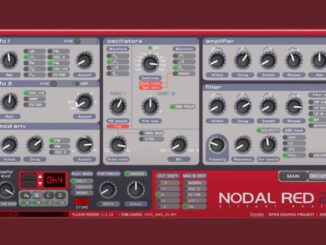
Goldfinger is a new ROM emulator plugin for macOS, Linux, and Windows for the Waldorf Q Synthesizer (2000).
Correction: I will use the term emulation again. Emulation tries to emulate the process, while simulation tries to simulate the end result with little regard for the process. The first one fits better with the TUS releases. Sorry for the confusion.
As with the Vavra (MicroQ), the original ROM is required here; I do not share or link to it. Goldfinger plugin offers all the original features of the Waldorf Q synthesizer.
The original Waldorf Q from 2000 was a 16-timbral virtual analog Synthesizer with PPG wavetables as an option. Both the Q and MicroQ are closely related; they share the same engine but have slight differences.
The Q had 16 notes of fixed polyphony (expandable to 32), while the MicroQ’s maximum number of dynamic voices can be tripled to 75. The oscillator section is the same, with five sound generators, including three oscillators, noise, and ring mod.

Filtering was also powerful on the Q, but with differences. For example, the Q had a PPG filter emulation while the microQ didn’t.
You also had the same two multitype filters with FM and distortion, but you can blend the two filters between parallel and serial. So interpolation was only possible in the Q, not the microQ. Same for the filter self-oscillation, only available in the Q.
Also onboard were four multimode, extensive ALDSDDR envelopes and three multi-wave audio rate LFOs with fade and delay functions.
The Q also featured a unique Xmorph parameter morphing function that lets you morph from one sound to another.
Effects & Seqencer
Another difference on the Q was the better multi-FX section. It offered eight effects processors, two per sound: chorus, flanger, phaser, overdrive, AM, delay, reverb, and more.
When it came to melodies, the microQ also lacked something important: it had a programmable arpeggiator but no sequencer. It was only available in the Q.
In the The Usual Suspects Goldfinger plugin, the sequencer isn’t divided into four banks of eight steps but into two with each 16, making it more easier to program
Each step will hold a single note or a chord of up to 10 notes, plus values for velocity and filter cutoff frequency, up to a maximum number of 256 notes per sequence. The software also has two controller lanes.

First Impression
Even though the two are very similar, it’s great to be able to use both now. The Q sounds different due to these little function swaps and benefits from the built-in sequencer for more extensive evolving sounds.
The Usual Suspects Goldfinger is now available as a private beta to supporters (£20 minimum) on their Discord channel. It runs as a VST2, VST3, AU, LV2 and CLAP on macOS (native Apple Silicon + Intel), Linux and Windows
More information here: The Usual Suspects


Why is it in “Hardware” category?
corrected, sorry 😉
I have tried one of their simulators and it was hammering the cpu so hard that it was unusable.
so, you Need a New Computer which is more expensive then those old 90s machines?
🙂
You are incorrect on “simulator” vs “emulator”. It is exactly the opposite.
Yeah, my fault. I did some research and got it that emulator is the right term
Sorry all for the confusion
You are incorrect in the following: “but you can’t blend the two filters between parallel and serial. That only works on the microQ”
It’s just the opposite. Possible on the Q, not on the mQ. 😉
damn that correct yeah 😅
but you have to buy only one computer … 🙂
not all of their emulators are resource-heavy, by the way
OK😄